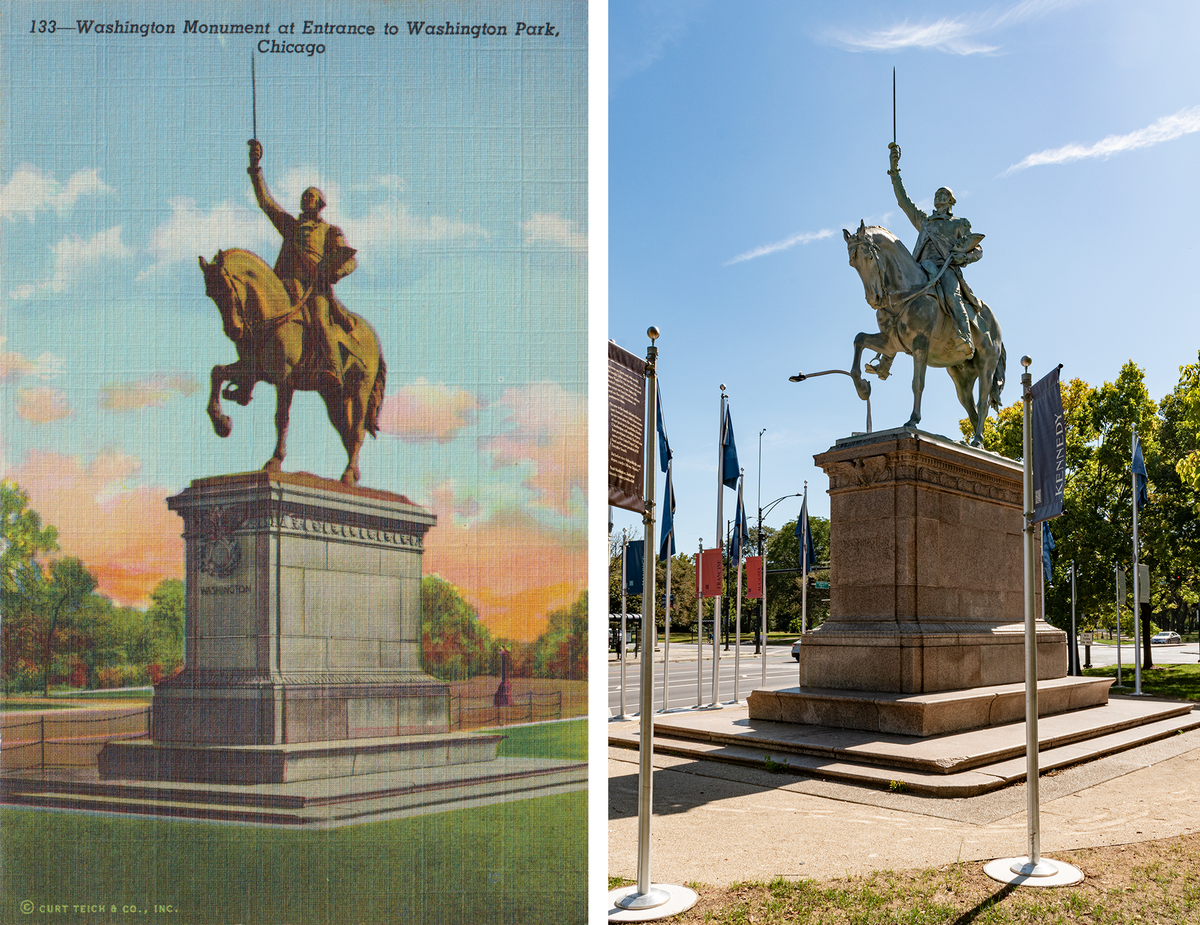
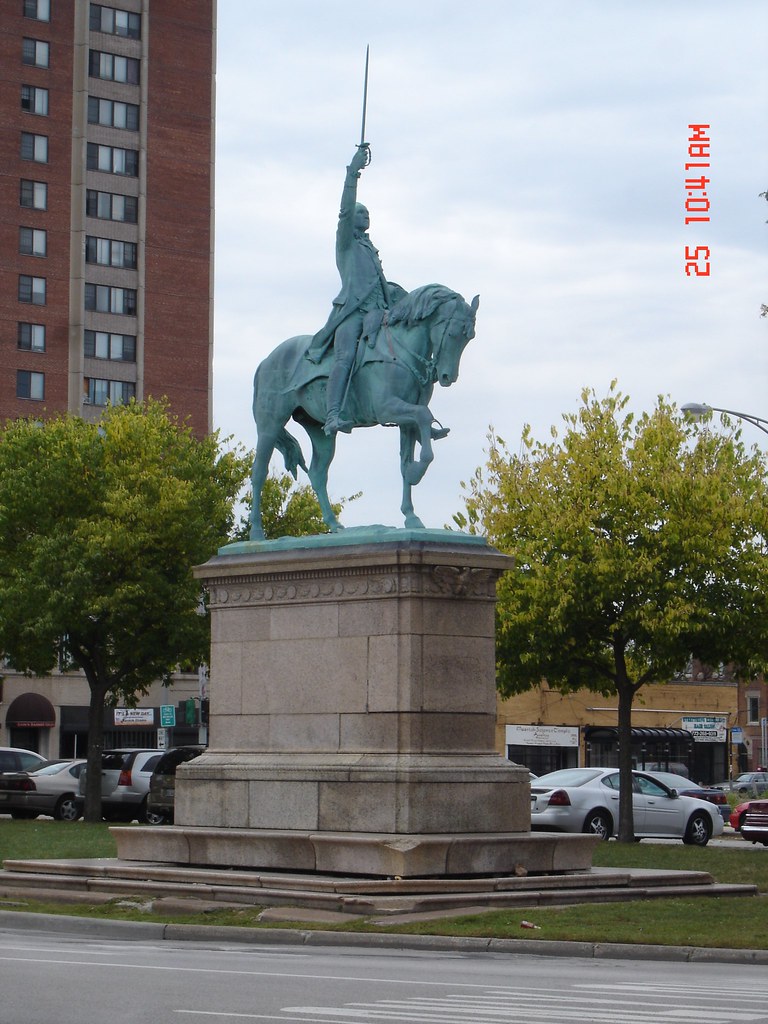
With “Other Washingtons”, artist Amanda Williams brilliantly recontextualized and reinvigorated this otherwise inert George Washington equestrian statue—marooned on a verge between six lanes of car traffic at the edge of Chicago’s Washington Park—by surrounding it with flags honoring other people named Washington. 90% of Washingtons in the US are Black—some whose ancestors received that name from slaveholders like the first president, but also many descended from those who took the name when emancipated African Americans, finally free to choose their own surnames, selected ones that expressed a belief in the professed ideals of the American project, despite the country (like Washington the man) regularly failing to live up to those ideals.
Created in 2026, Williams’ intervention took the original Washington monument—installed in 1904, with Washington the man by David Chester French, the horse by Edward C. Potter, and the plinth by Charles F. McKim—and turned something fixed, sepulchral, and a little overlooked into a living monument in dialogue with its neighborhood, an exercise in archive-making.
It’s great.
“Other Washingtons” is one of the best things to come out of the Chicago Monuments Project, the initiative organized in 2020 to interrogate the monuments in Chicago’s public space and—with support from the Mellon Foundation and the Chicago Department of Cultural Affairs and Special Events—commission new work or events that tell a more inclusive, accurate version of history. As Williams put it when describing “Other Washingtons”, “traditional monuments serve an outdated purpose. They leave communities fixed in their understanding of history and repeating narratives that are not reflective of who we are as a country and who we can be,”.
Flags of other Washingtons include Chicago Mayor Harold Washington and educator Booker T. Washington, of course, but also—visible here—regular Chicagoans like Kennedy Washington, a local high schooler. Williams described the intervention as “an opportunity for audiences to reclaim a name that carries immense historical weight, turning a singular symbol of the past into an expansive, crowdsourced future.” The installation will hopefully serve as a living archive, with new Washingtons mixed in as old flags degrade. Social, cultural, and historical meanings of color are central to Amanda Williams’ practice, and here they allude to yet another Washington—the specific shade of blue used for the flags was patented by George Washington Carver.


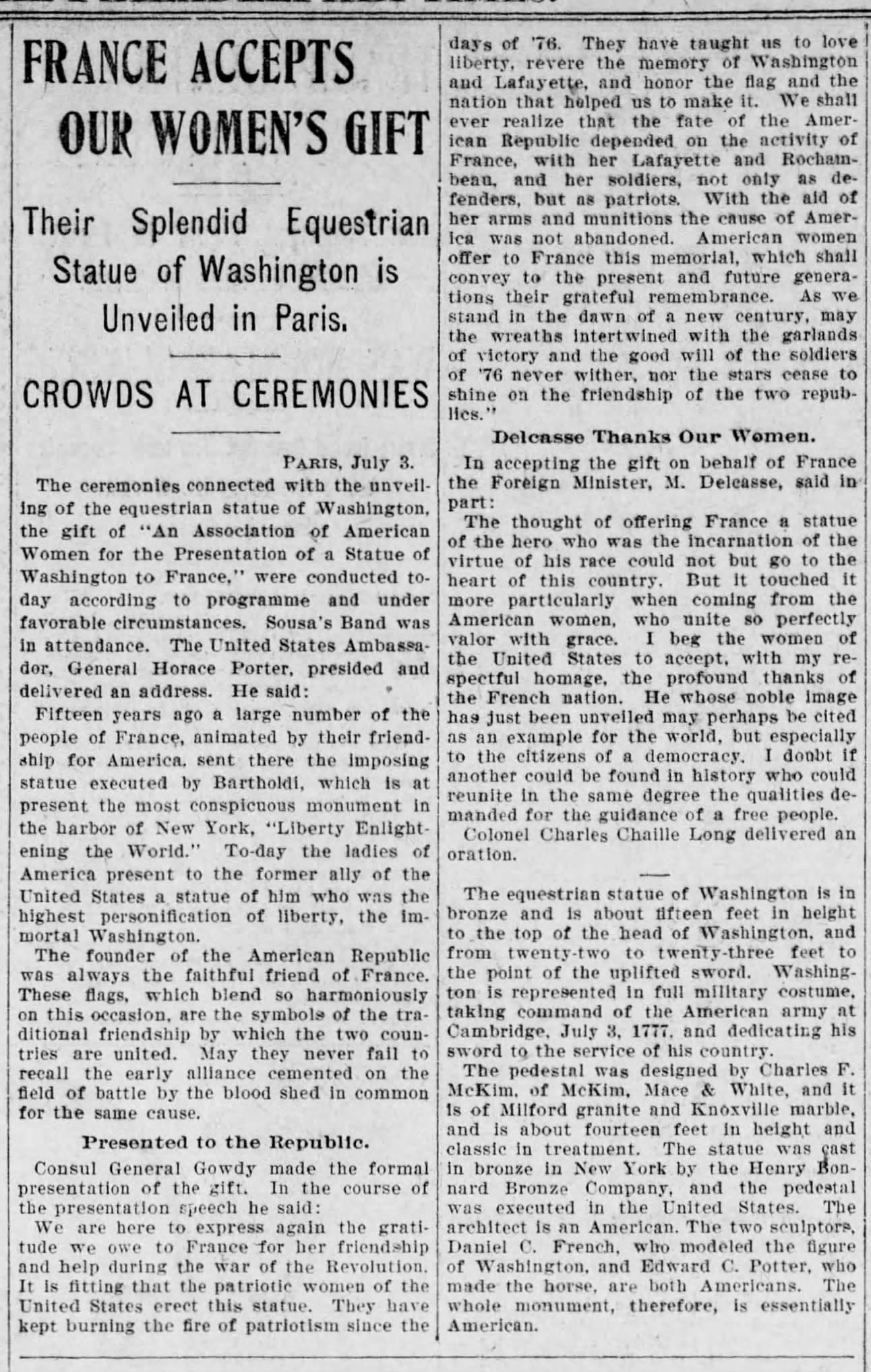
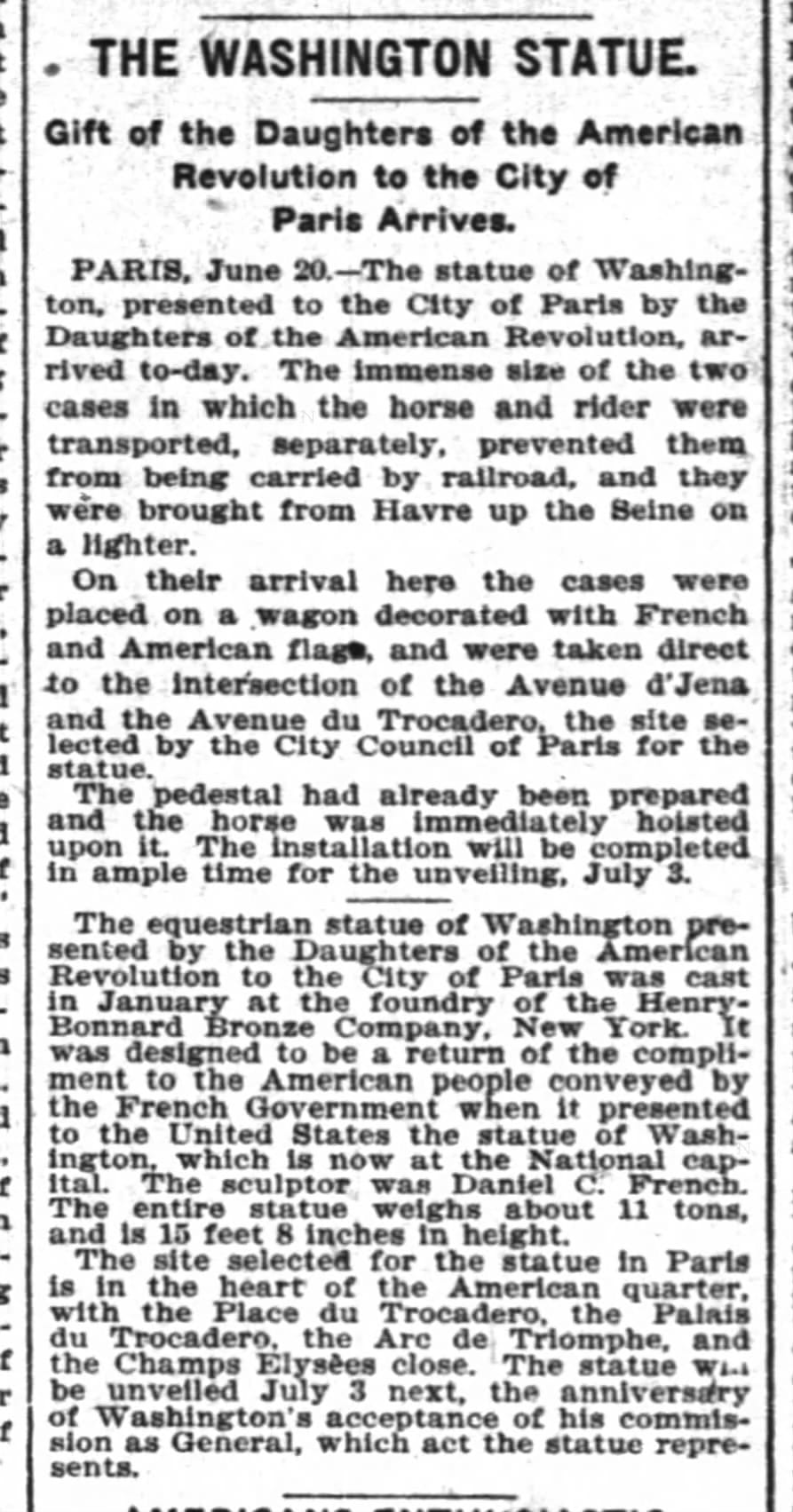
The equestrian statue itself is a replica of a monument commissioned as a gift to the city of Paris from the women of the United States, installed during the 1900 Paris Exposition. Credit for the original is generally attributed to the Daughters of the American Revolution, but I think that’s stolen valor—it looks to me like money for the George Washington monument in Paris was raised by the Washington Statue Association, a group formed by Washington, D.C. women specifically to commission and donate this monument. The D.A.R. donated a different equestrian statue, one depicting the Marquis de Lafayette, to the city of Paris and thus attended the unveiling of this one, which might explain the mixup. Even at the time there was confusion over who actually deserved credit (the New York Times, for example, attributed it to the D.A.R.), but it's pretty clear that the actual donating party was the Washington Statue Association (aka the Washington Memorial Association).
To create their gift, the Washington Statue Association commissioned sculptor Daniel Chester French, who depicted Washington in the 1770s when he was leading the Continental Army. French, who’d later become most famous for his work on Abraham Lincoln inside the Lincoln Memorial, partnered with animalier Edward C. Potter to make the horse Washington sat upon. The combined bronze was cast by the Henry-Bonnard Bronze Company in New York, then installed upon a plinth designed by Charles F. McKim of renowned New York architecture firm McKim, Mead & White.
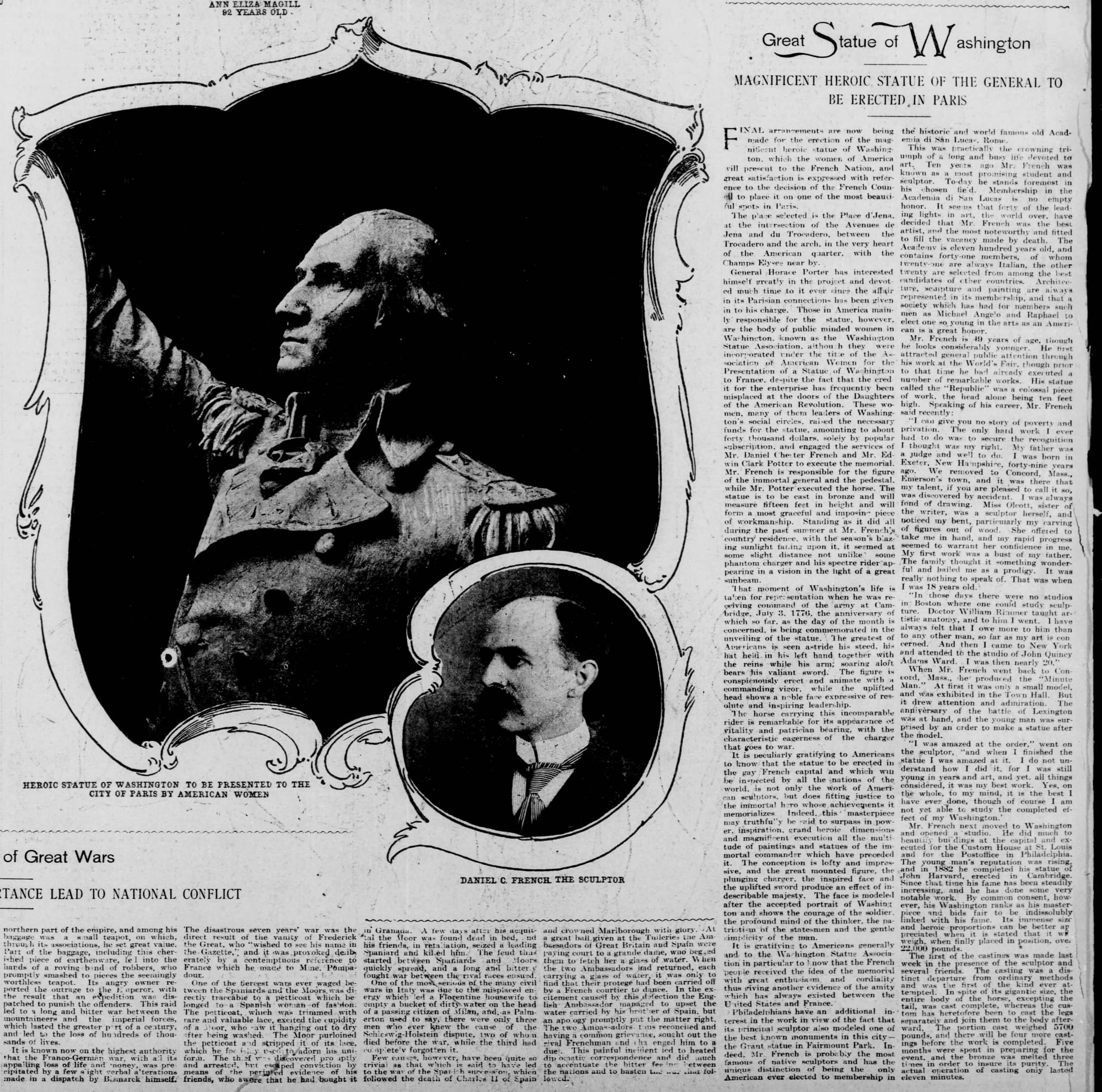
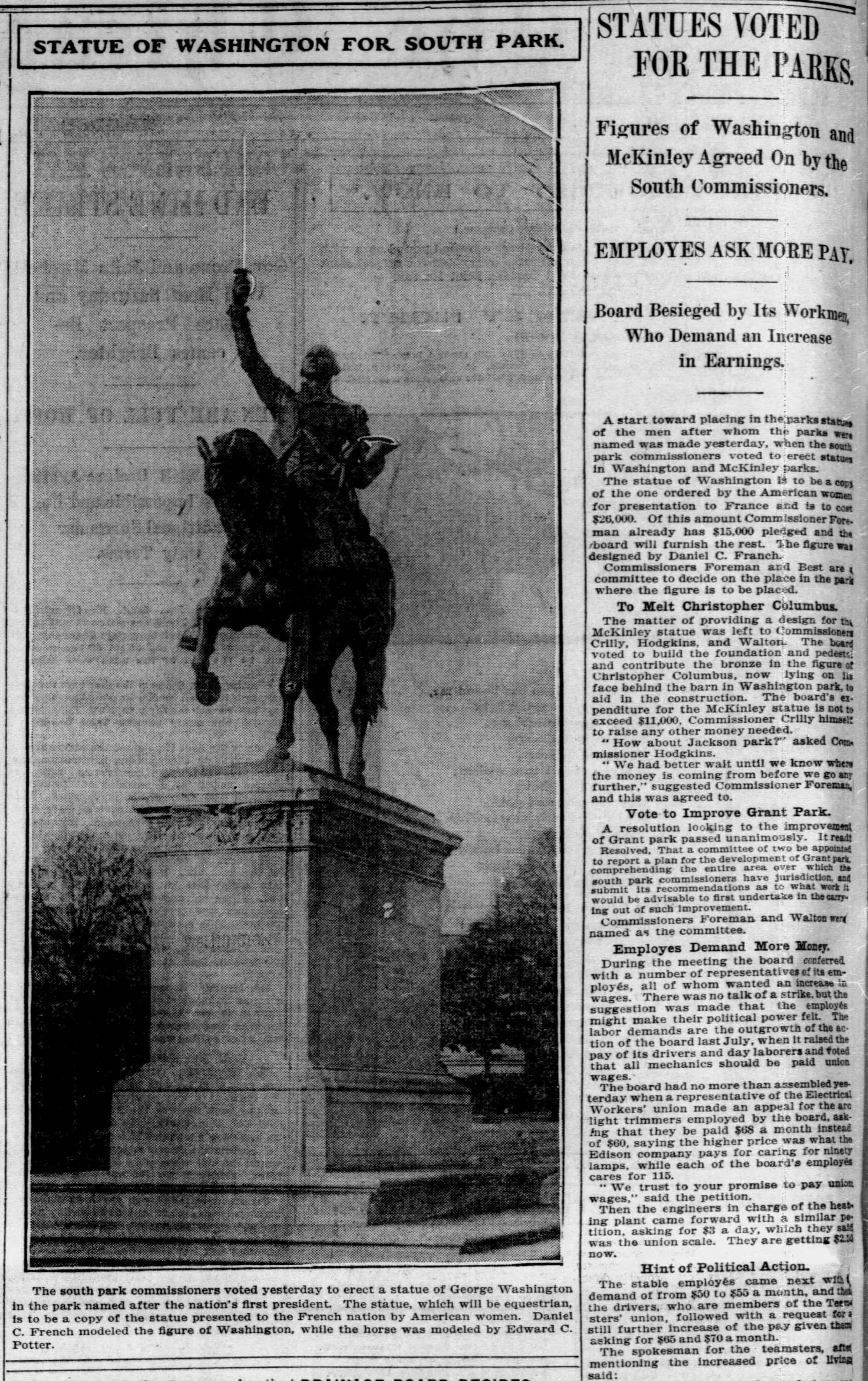
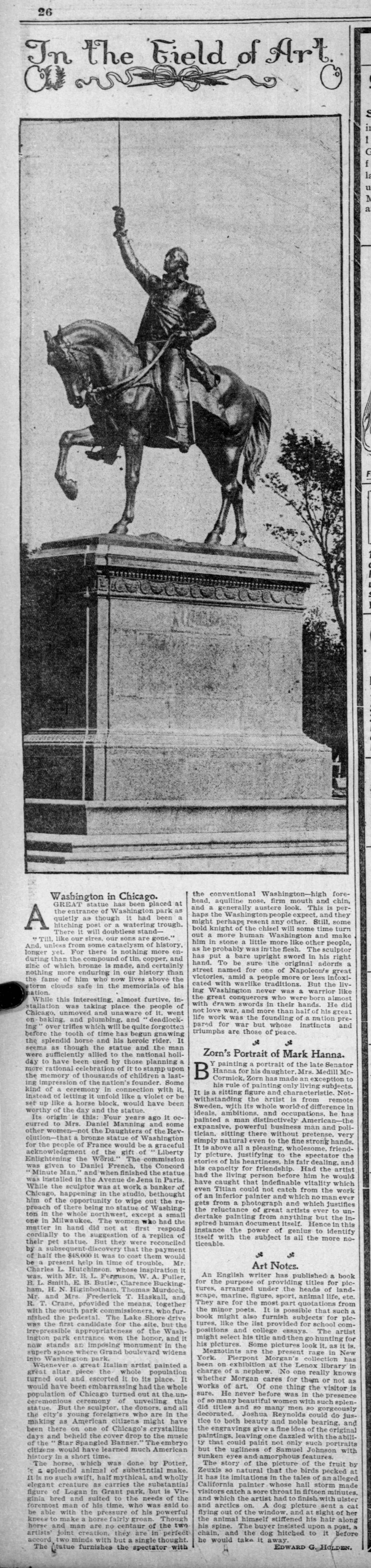
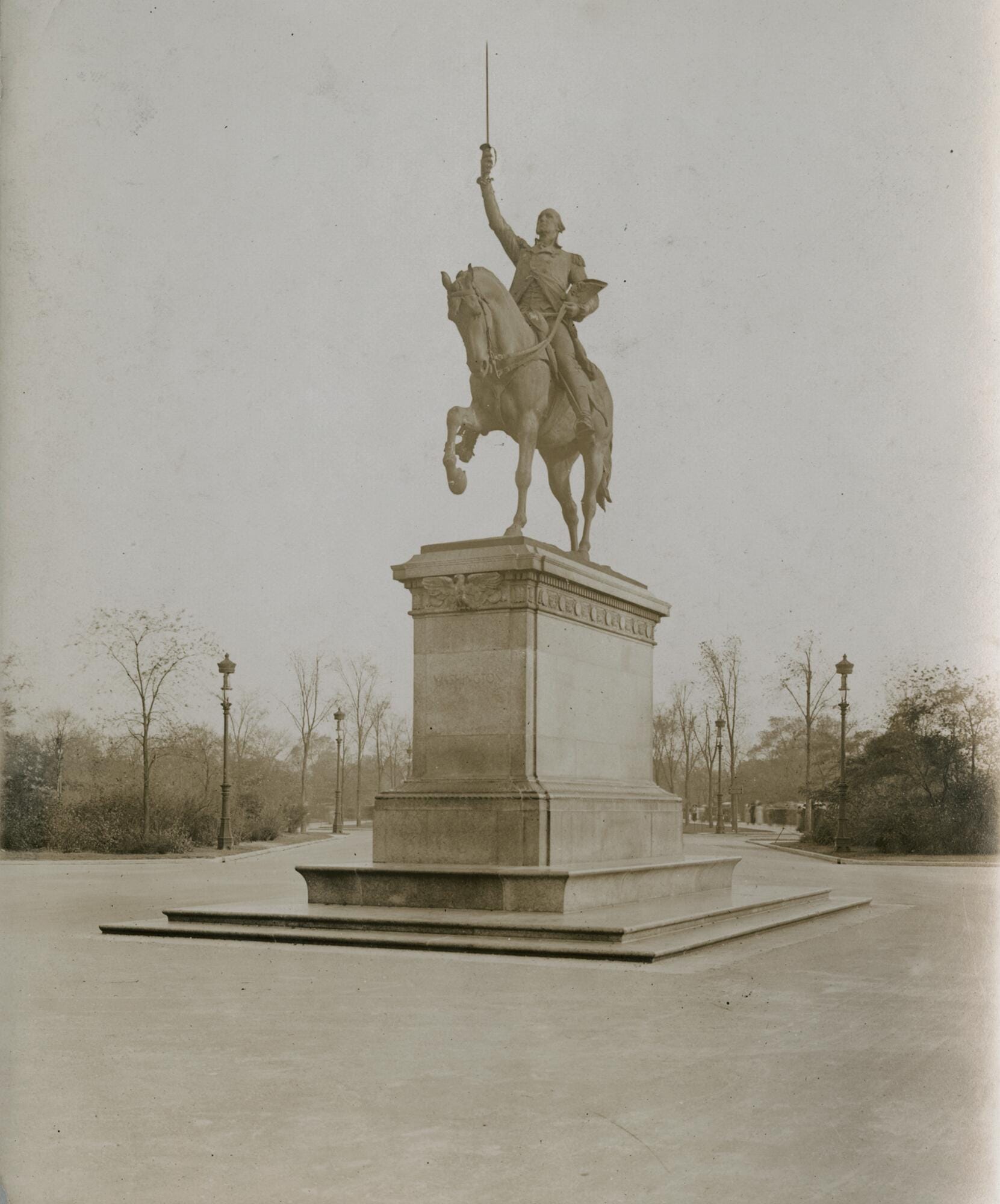
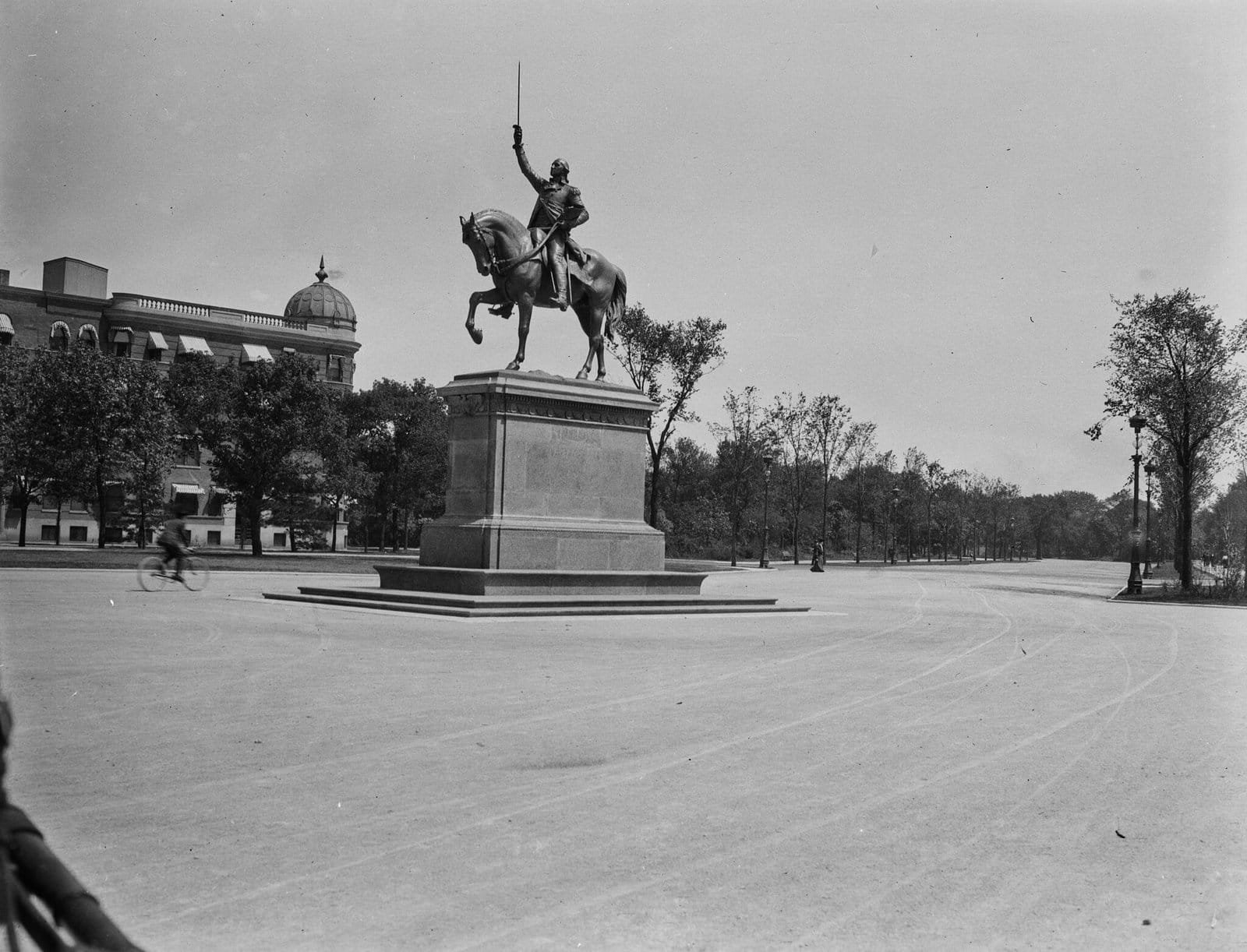
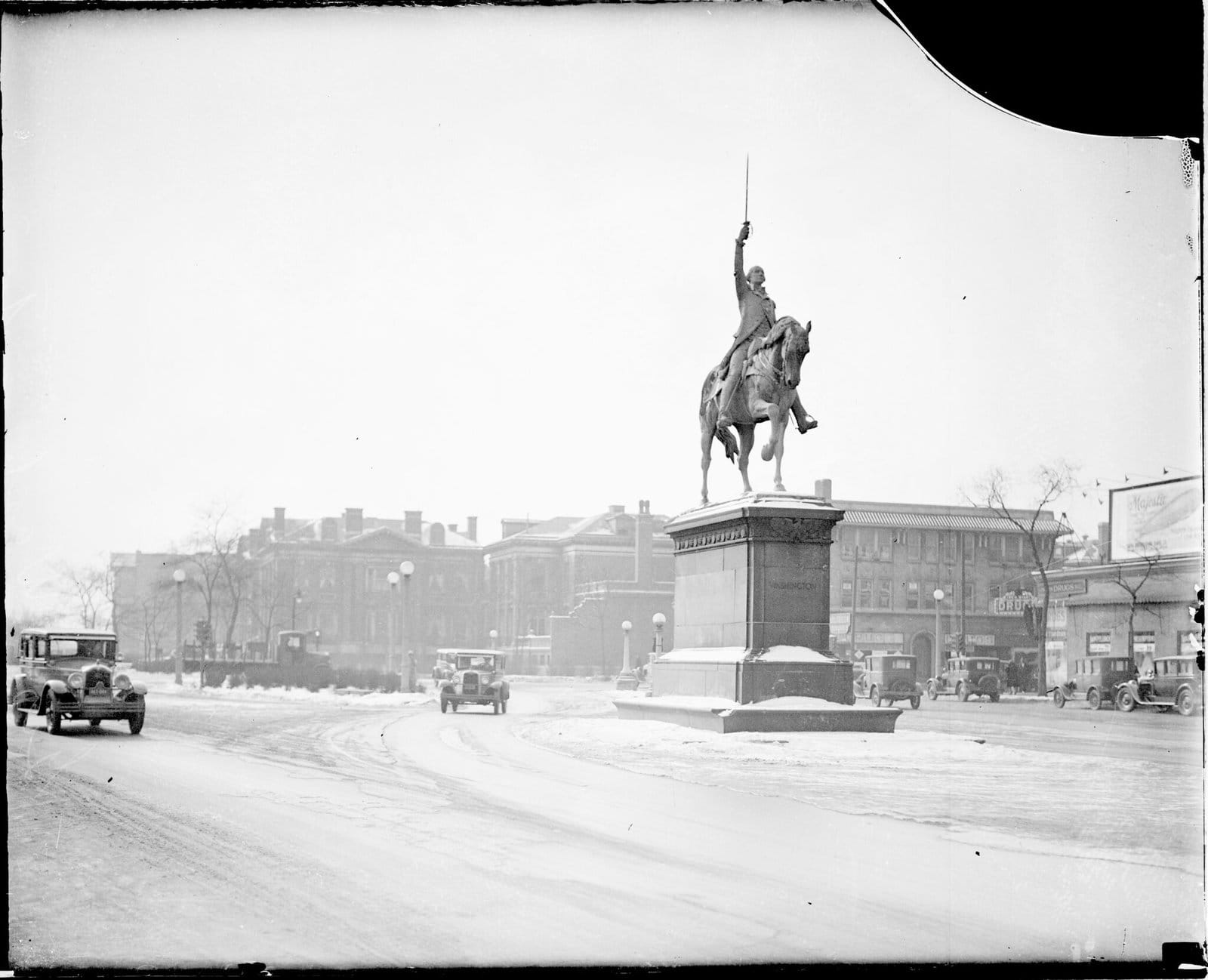
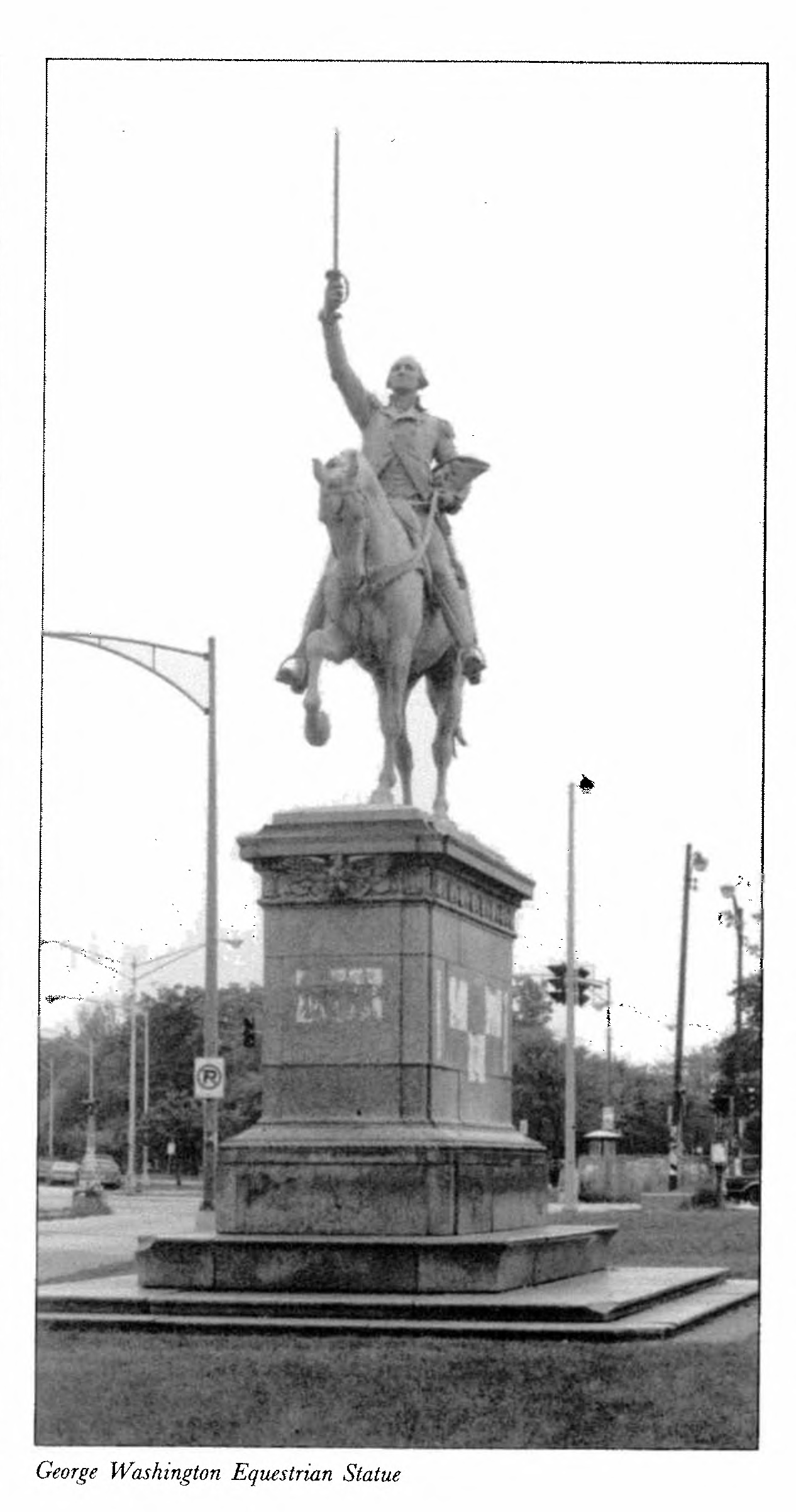
1900, Washington Monument in Paris | 1902, statue of Washington for Chicago | 1904, statue installed in Washington Park | Undated, Percy H. Sloan, Newberry Library | Undated, Chicago History Museum, ICHi-071534; Charles R. Clark, photographer | 1929, DN-0087724, Chicago Sun-Times/Chicago Daily News collection, Chicago History Museum | 1936, Art Institute of Chicago Archives | 1960, Chicago History Museum, ICHi-112362; Raeburn Flerlage, photographer | 1989, "Life Along the Boulevards", the Internet Archive
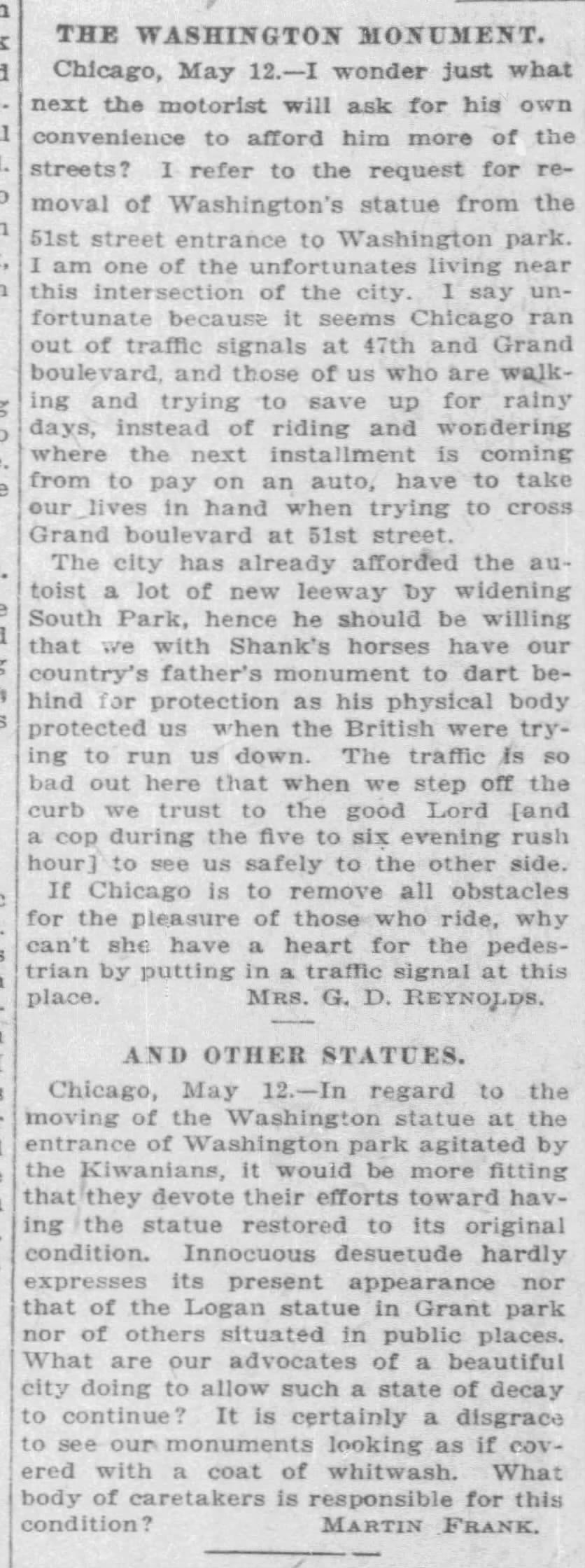
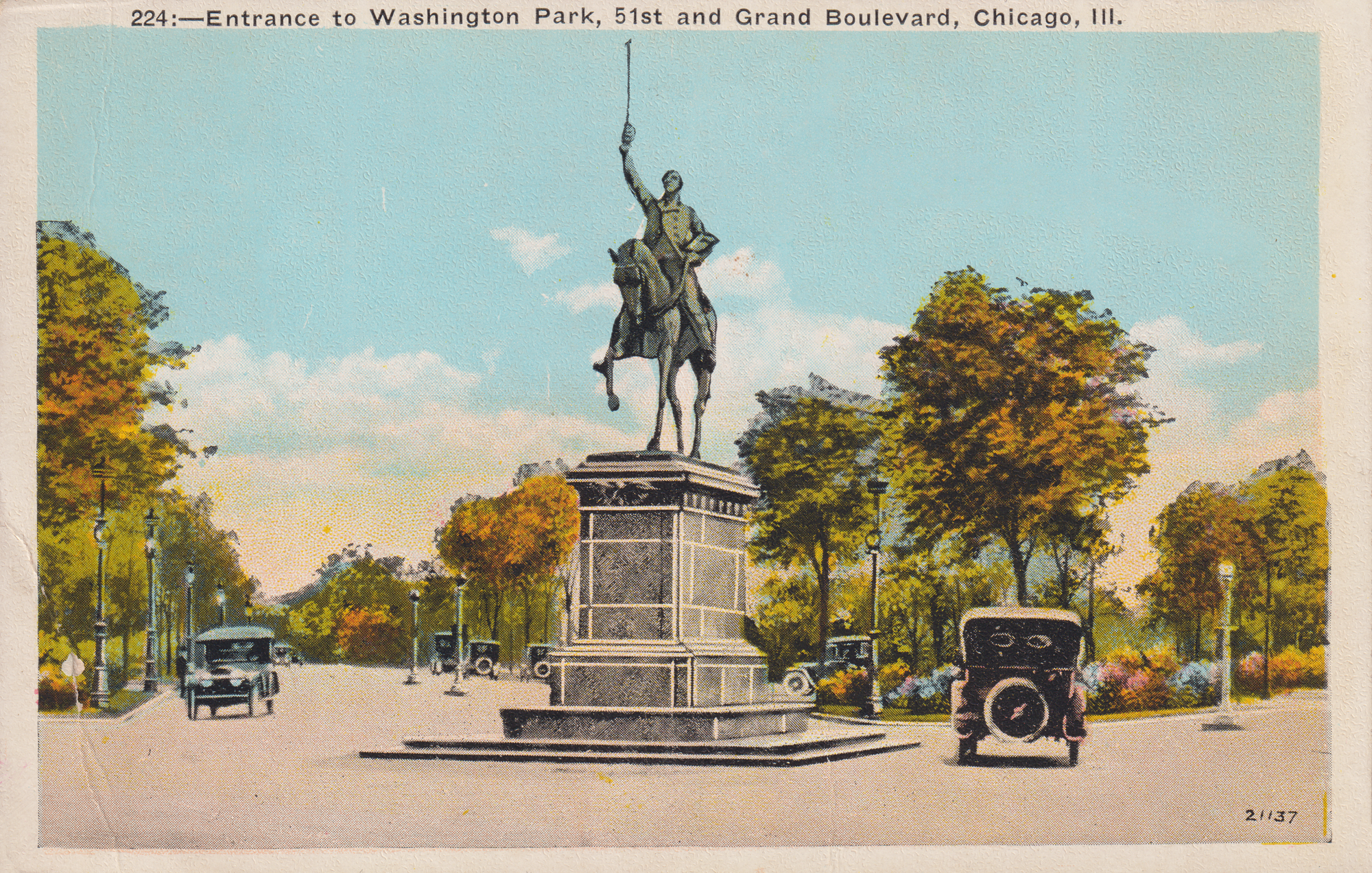
French had also sculpted “Republic”, the gilded symbol of the 1893 World's Columbian Exposition—he was well known in Chicago. Chicago philanthropist and Art Institute of Chicago president Charles L. Hutchinson saw a model of the Washington monument for Paris in French’s studio and wanted a version for his city. Chicago’s replica of the Washington monument was installed at the northwestern corner of Washington Park in 1904. It was moved a few hundred feet for the convenience of drivers in the 1920s.
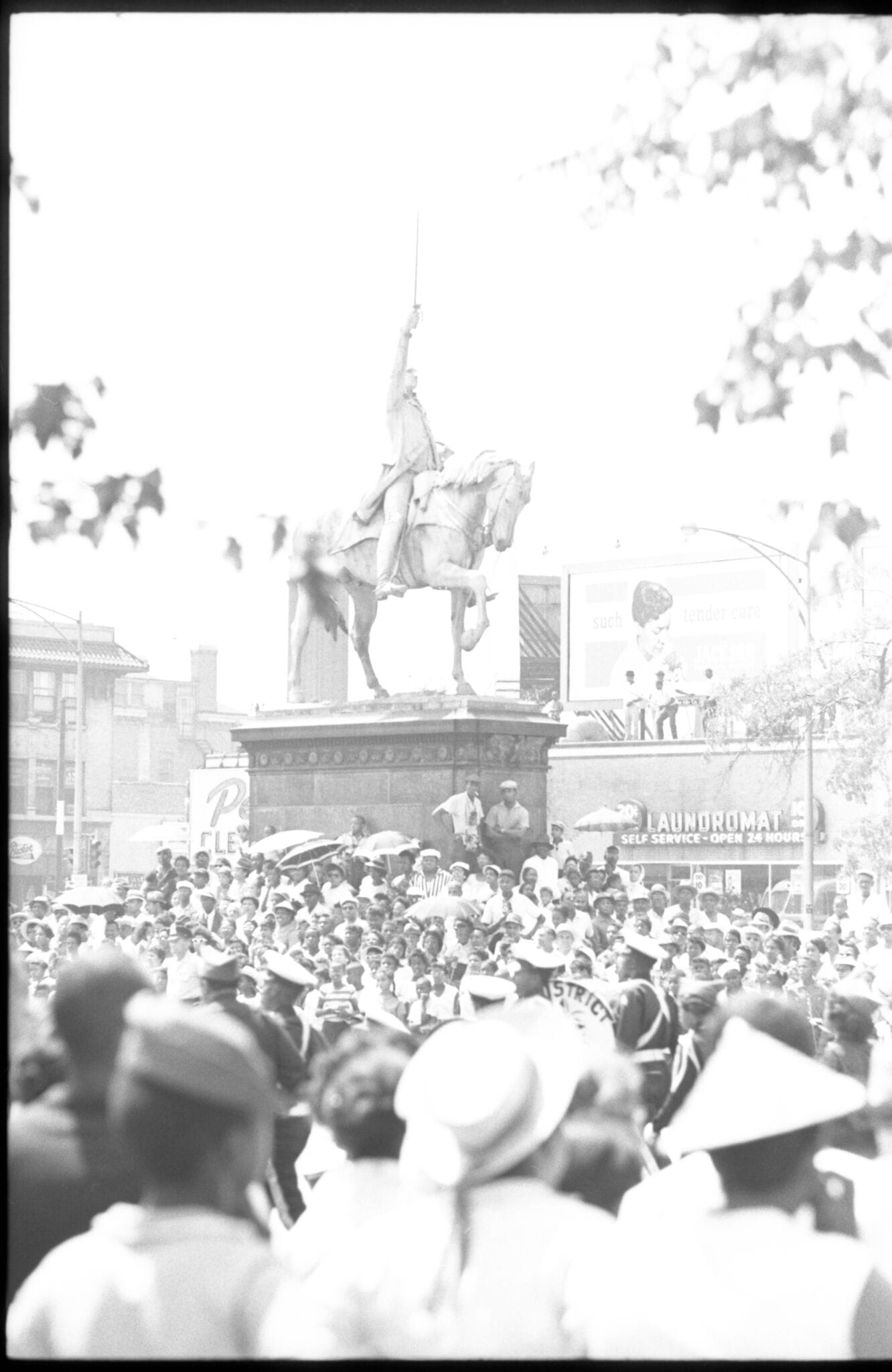
Highly visible during the Bud Billiken Day Parade, Washington Park’s Washington Monument was otherwise relatively overlooked. As the city grappled with its collection of public monuments in 2020, it became hard to ignore the incongruity of having a monument to an unrepentant slaver (and yeah, also the first president, sure), as the gateway to one of the South Side’s flagship parks. The Chicago Monuments Project and the city commissioned Amanda Williams for an intervention that told a more complete, more relevant, and more contemporary story than French’s monument alone. As she told WBEZ, “You get to first encounter these other Washingtons, and oh yeah, by the way, George…So he doesn’t go away, but he’s not central anymore. I think that’s a beautiful kind of response to the challenge of how do you complicate a story? How do you expand a story?”
1983, Chicago Film Archives
Production Files
Further reading:

 Courtney Kueppers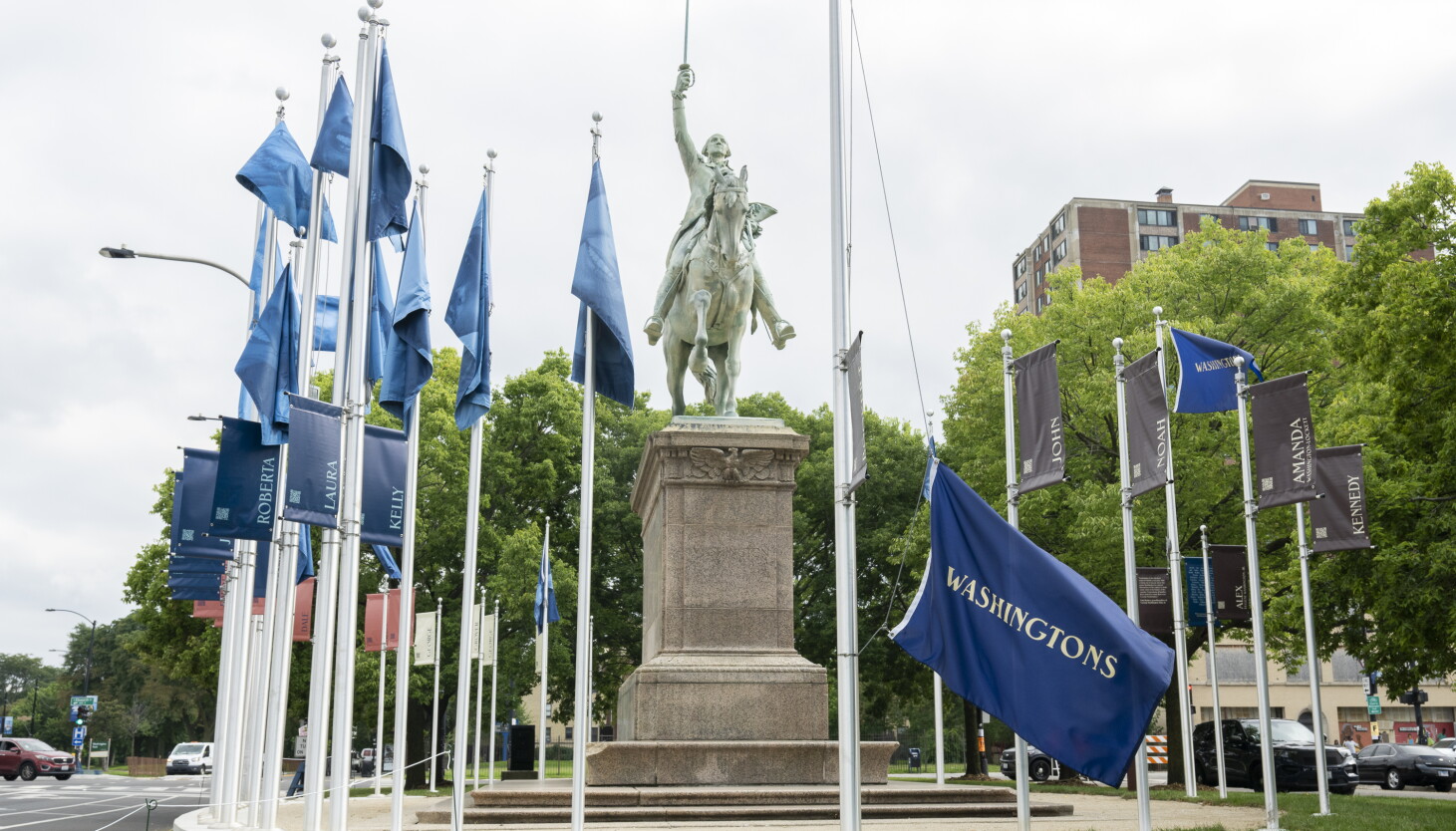
 Marc C. Monaghan, Hyde Park Herald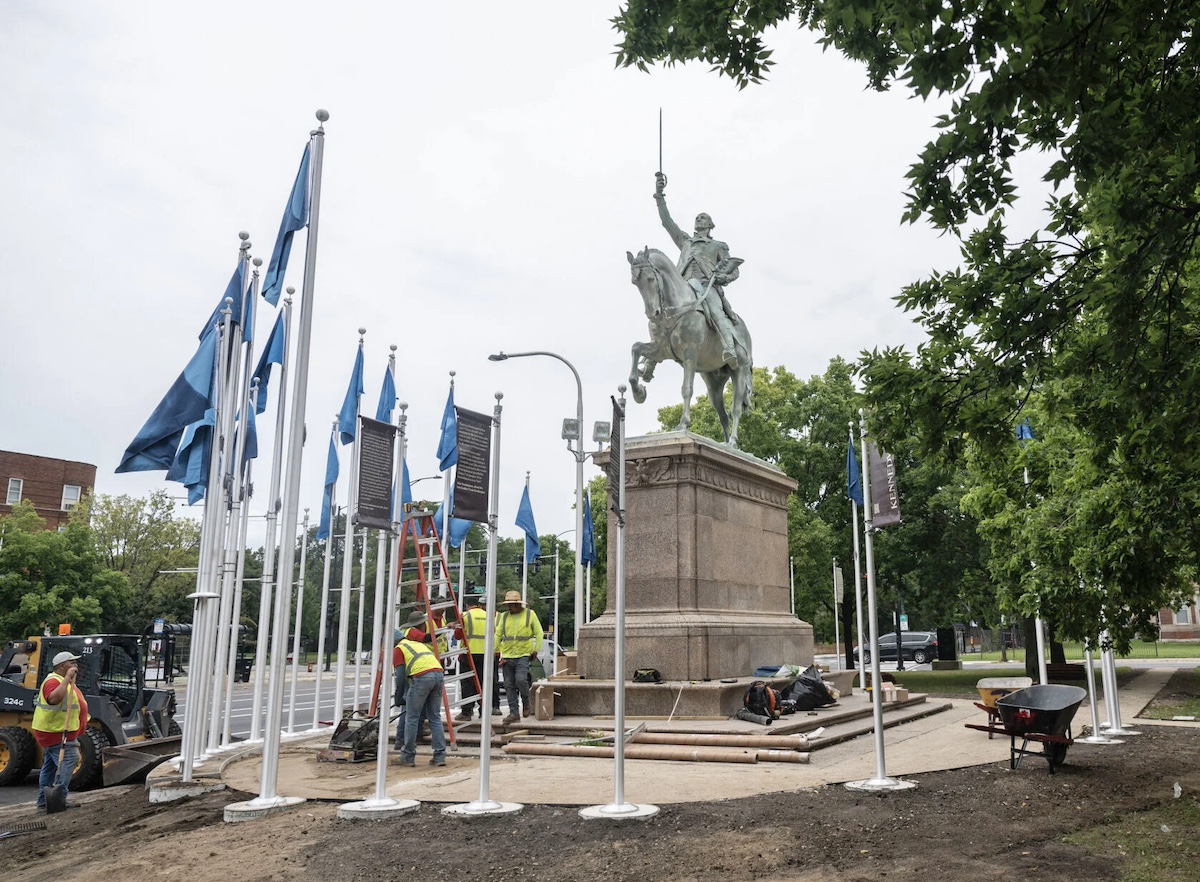
 Jessica Watts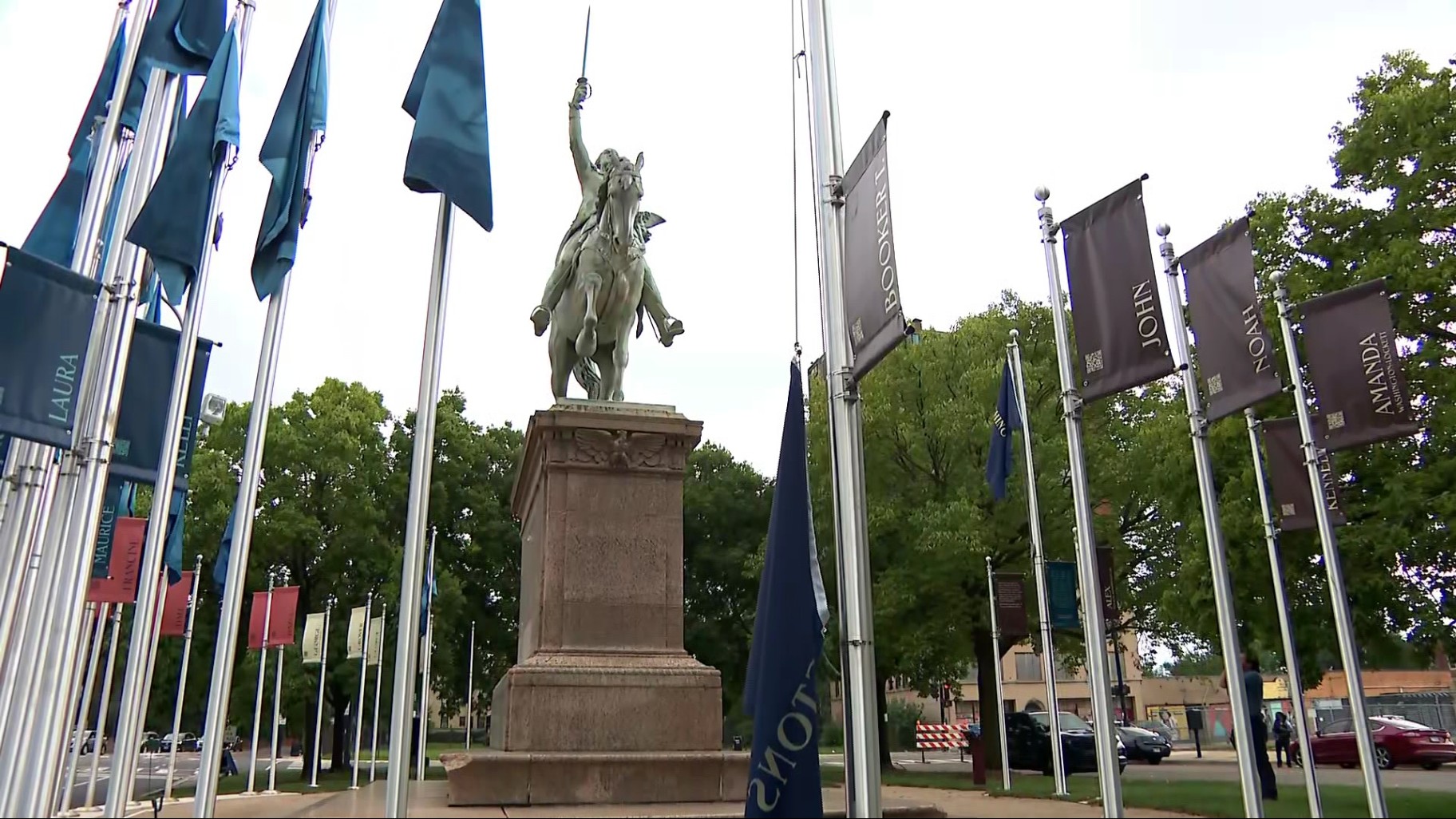
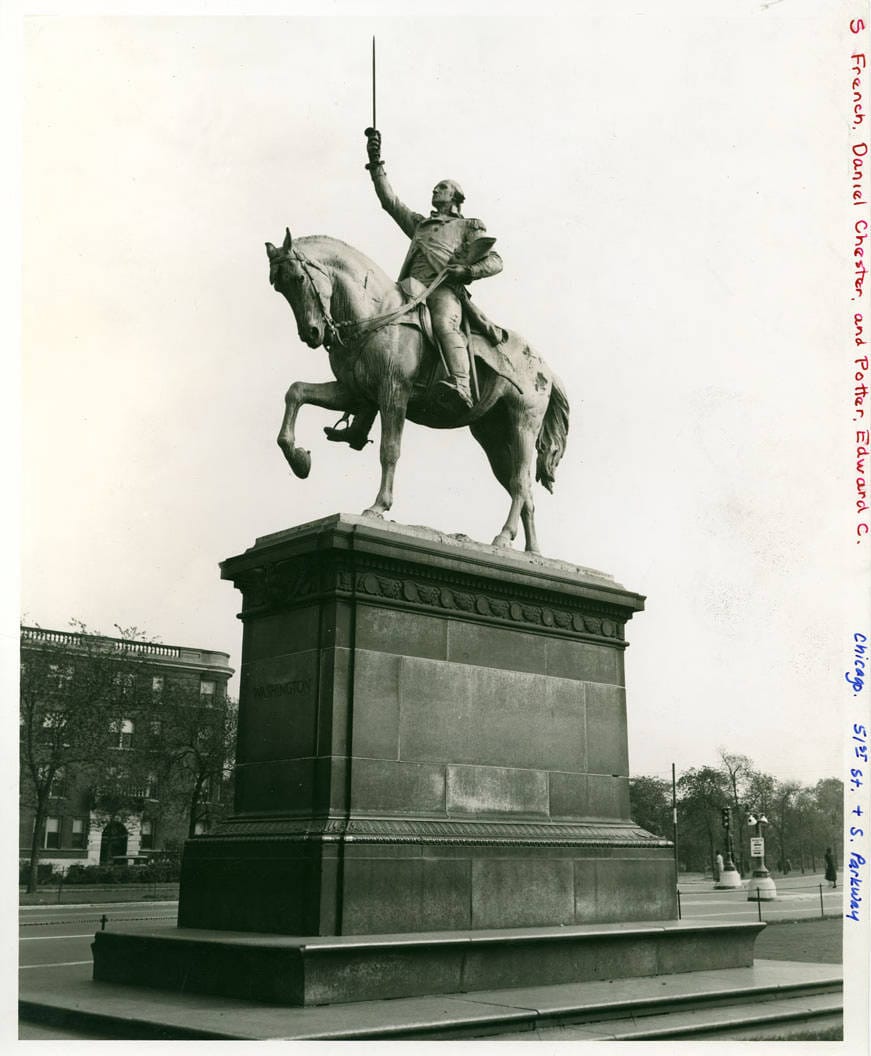
Mildly interesting production file at the Newberry Library for this one—we have a photo ticket ("take out people and cars" of course), the retouched image, and a black proofs.
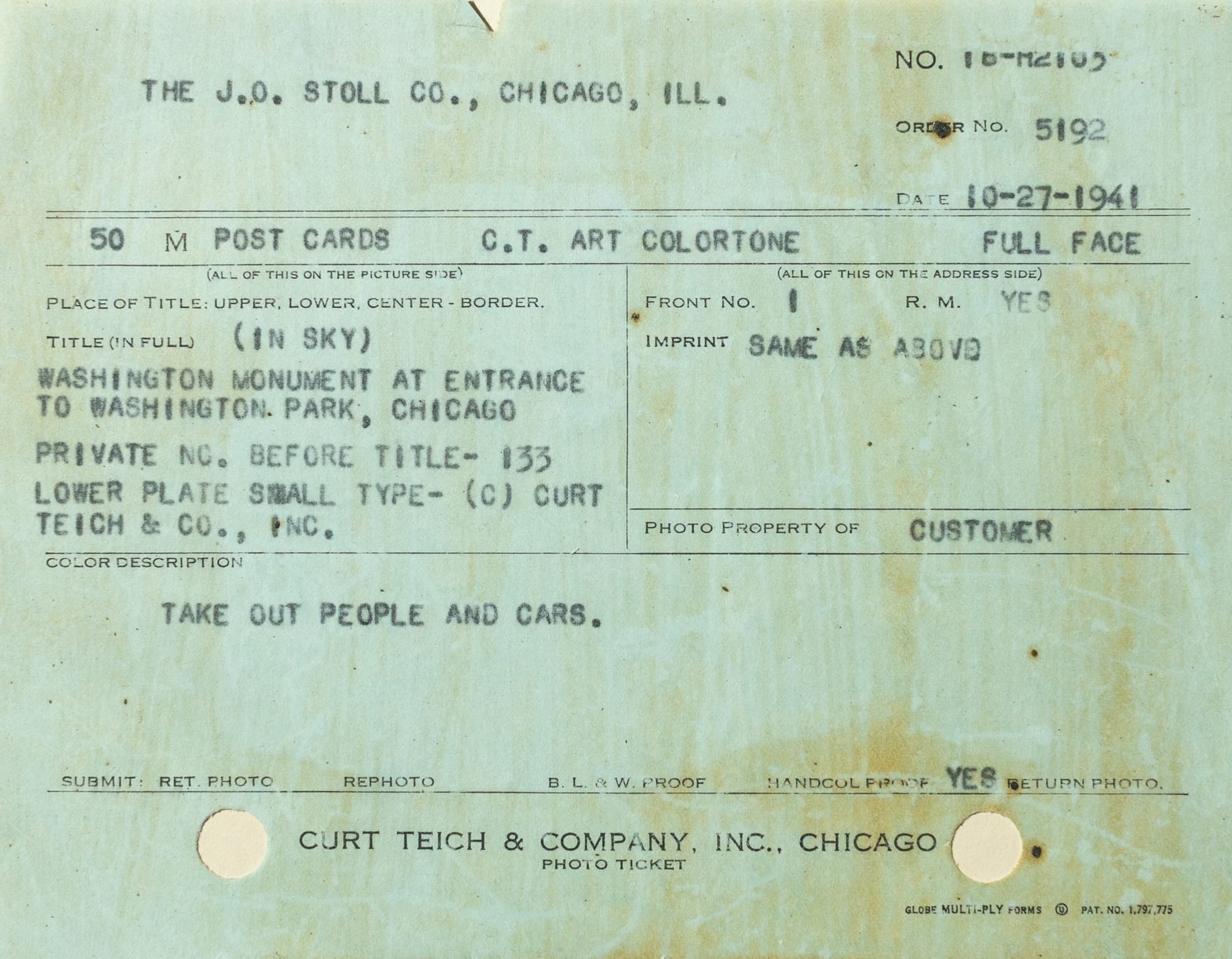
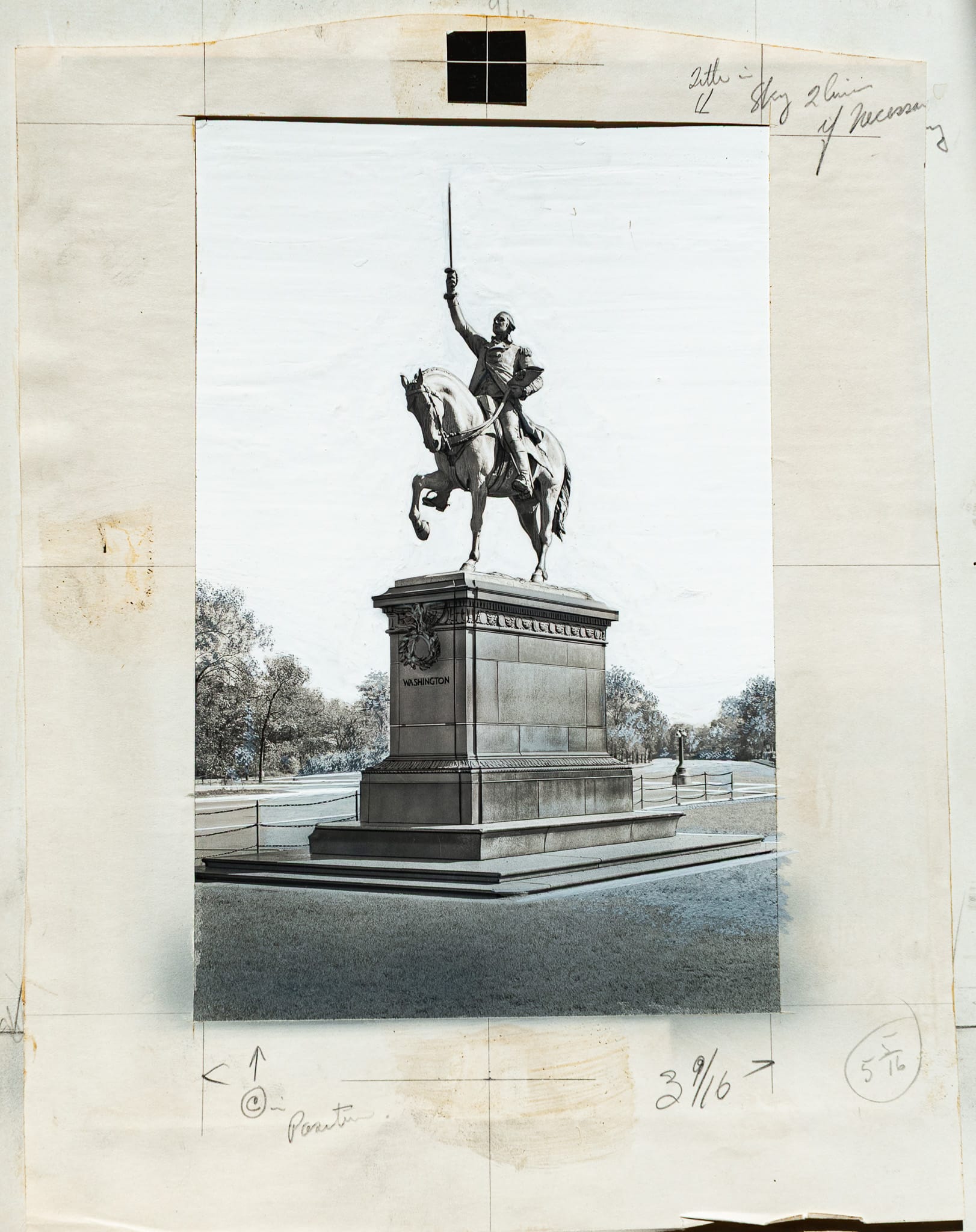
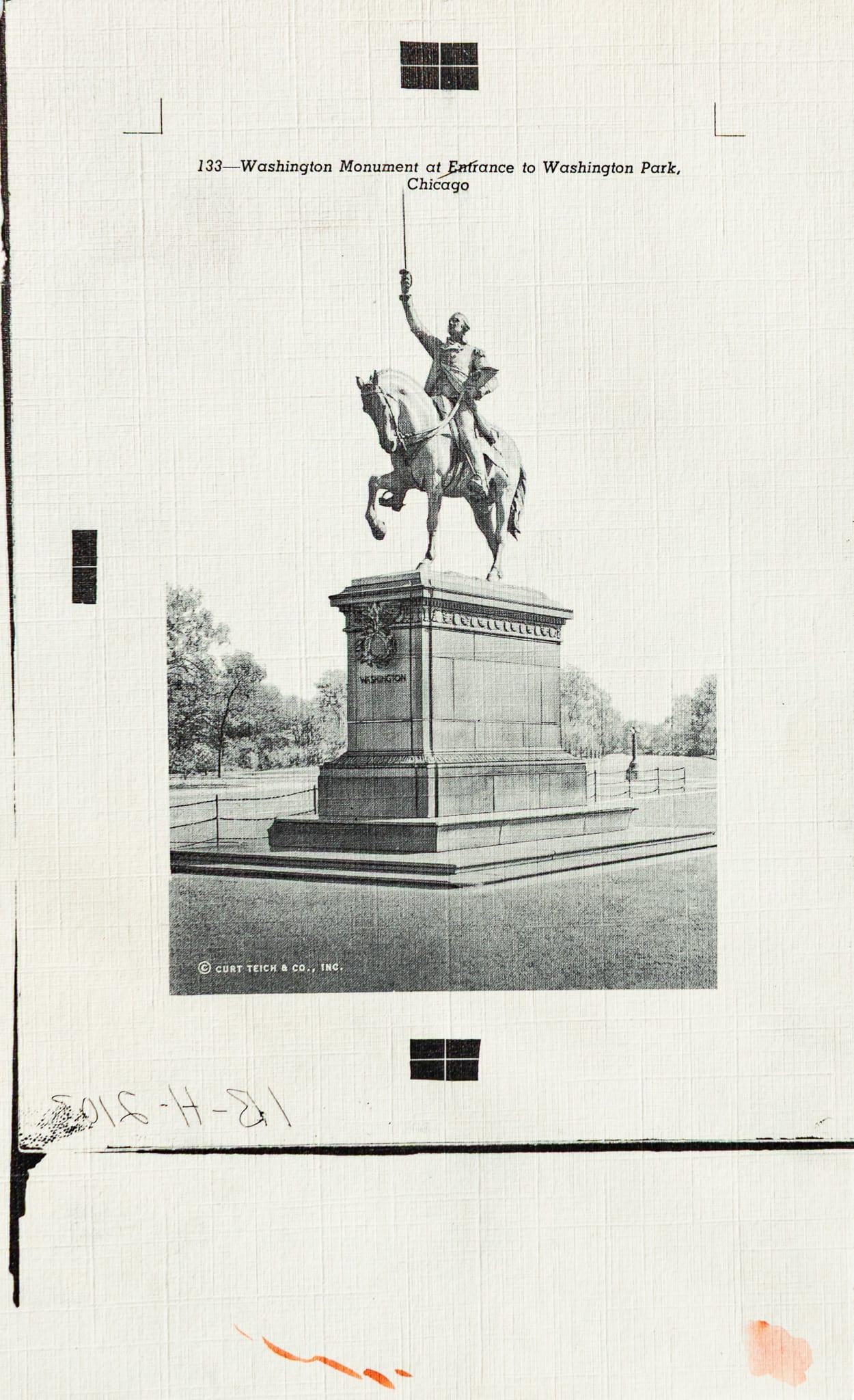
Curt Teich Postcard Archives Collection, Newberry Library
Plus the approved back of the postcard and a reference postcard that was used to make it.
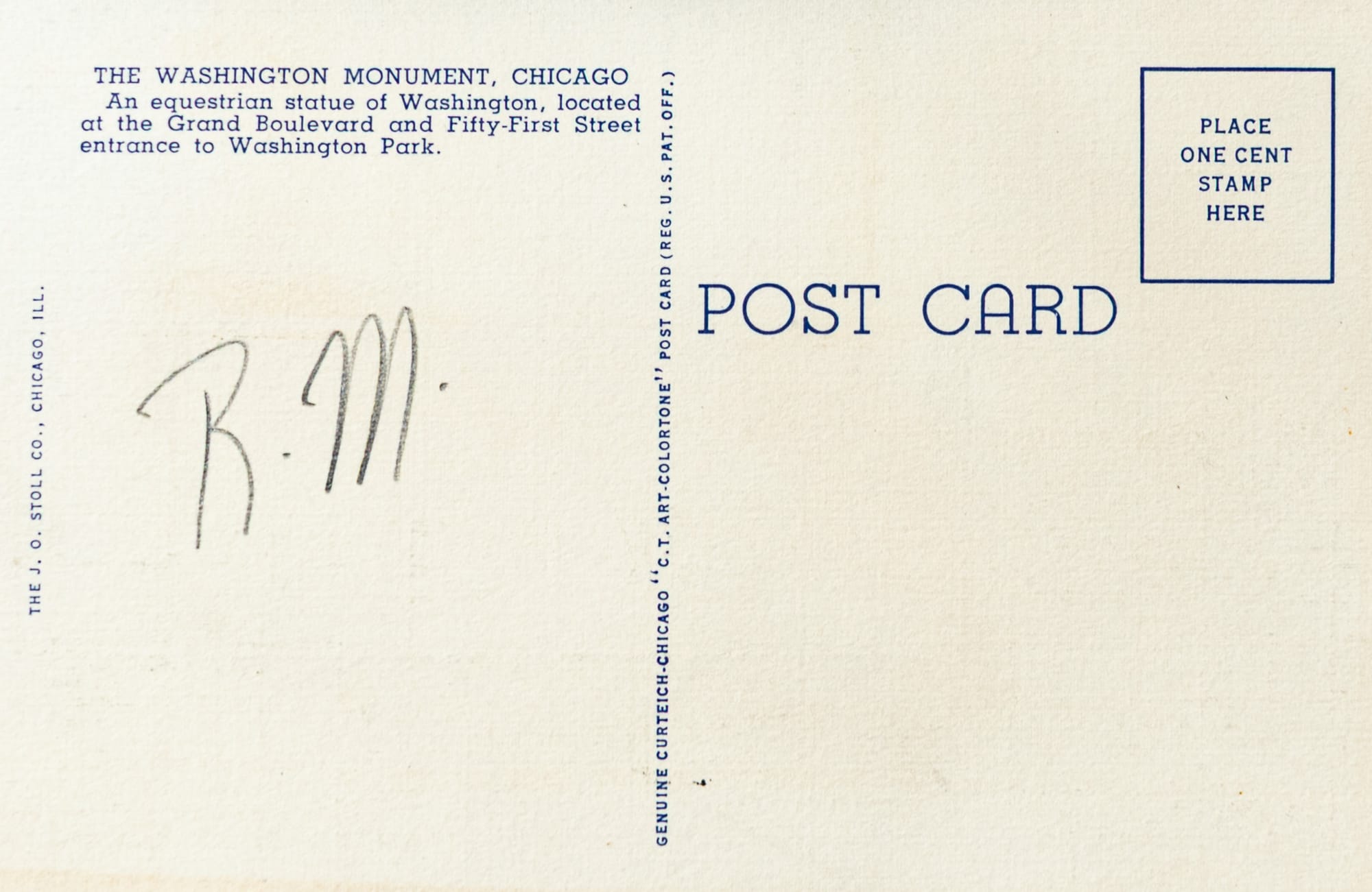
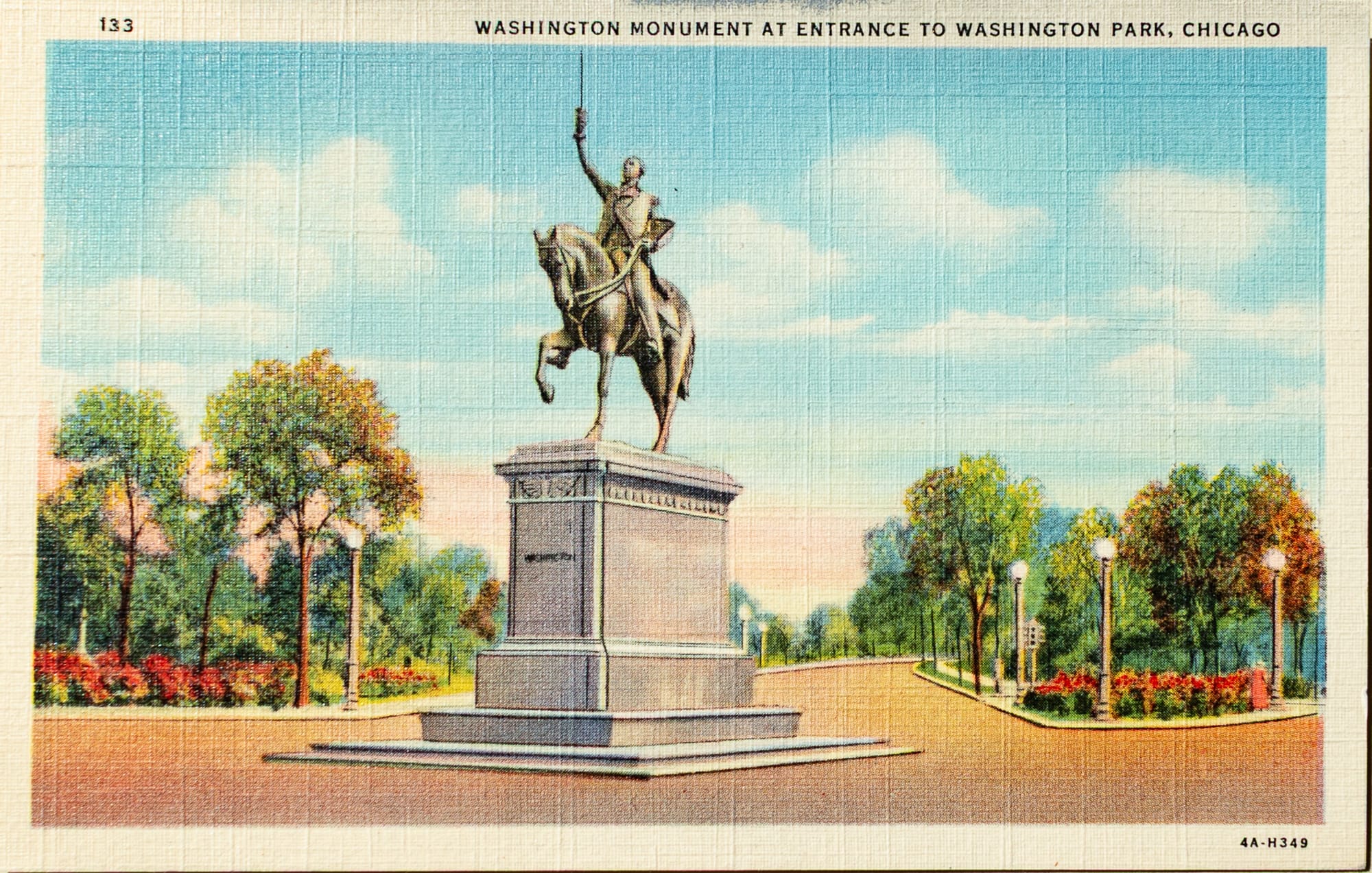
Curt Teich Postcard Archives Collection, Newberry Library
But the most interesting thing here is undoubtedly the production file envelope, which contains a timeline of production (this 50,000 postcard order for a magazine distributor took two months start to finish in 1941), but also a stamp reminding the various departments that the J.O. Stoll Co. had orders for 28 different postcards ongoing at once, and that they needed to create a harmonious, coherent set.
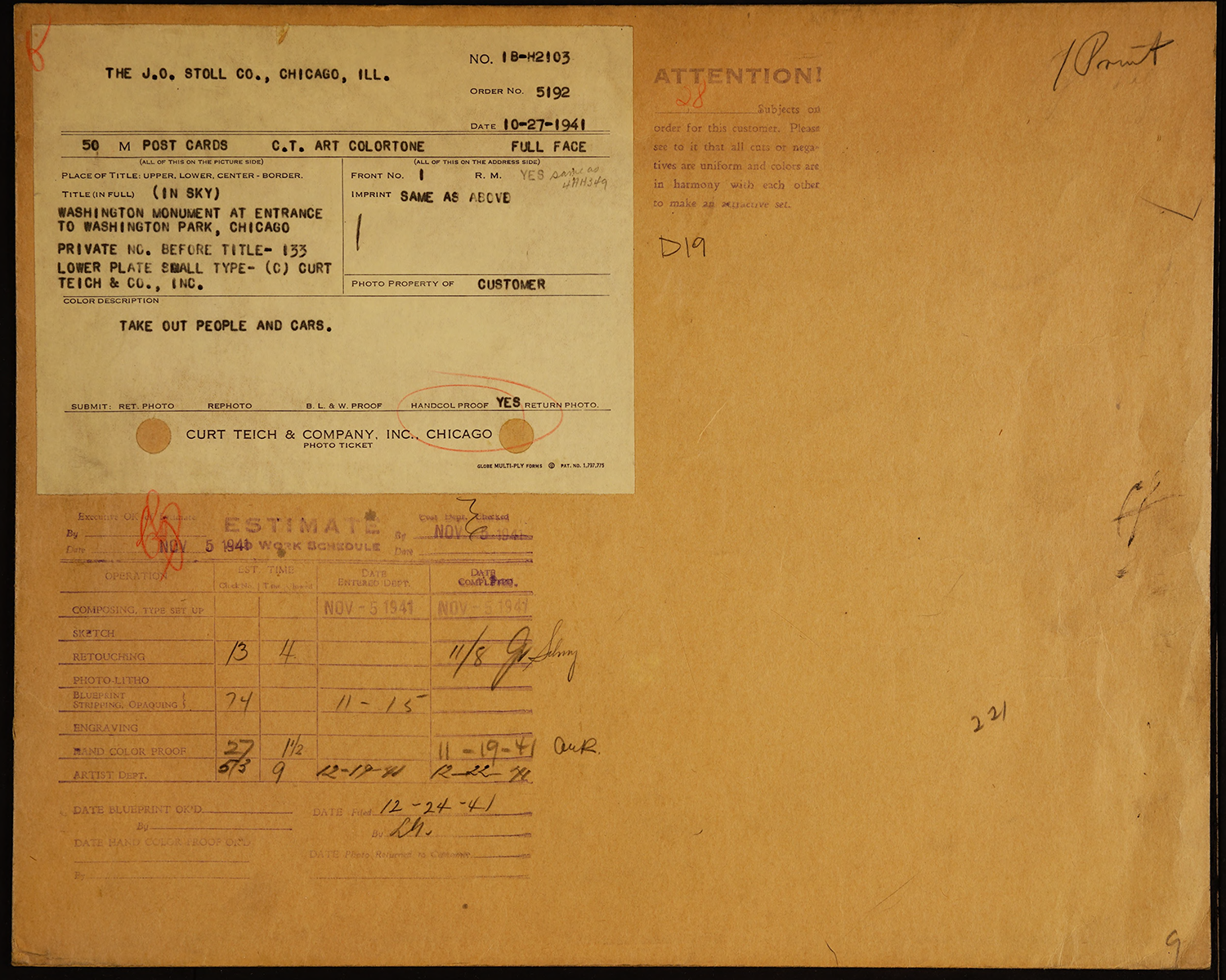
The vast majority of current writing about the statue gives the Daughters of the American Revolution credit for commissioning the equestrian statue, but reading contemporaneous articles, that just doesn't seem right (plus the fact that all these guys in 1900 were like, "everyone keeps saying this is the D.A.R. but it's not"). In the 1890s it was all the Washington Memorial Association.
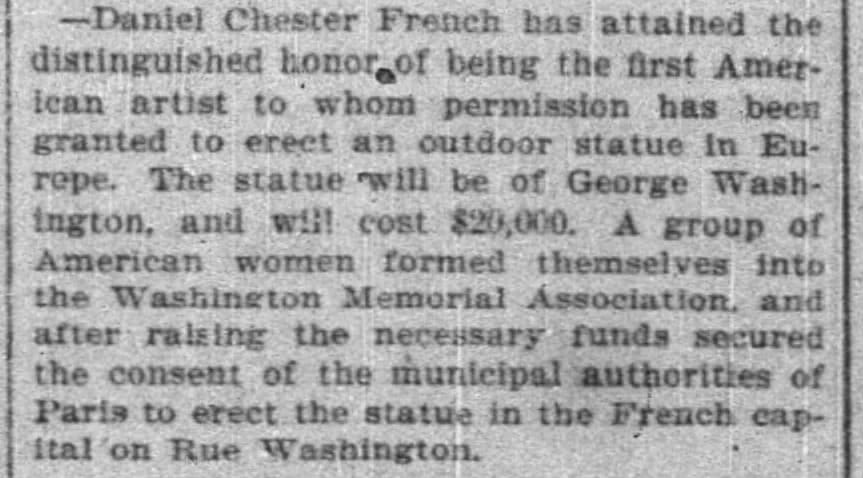
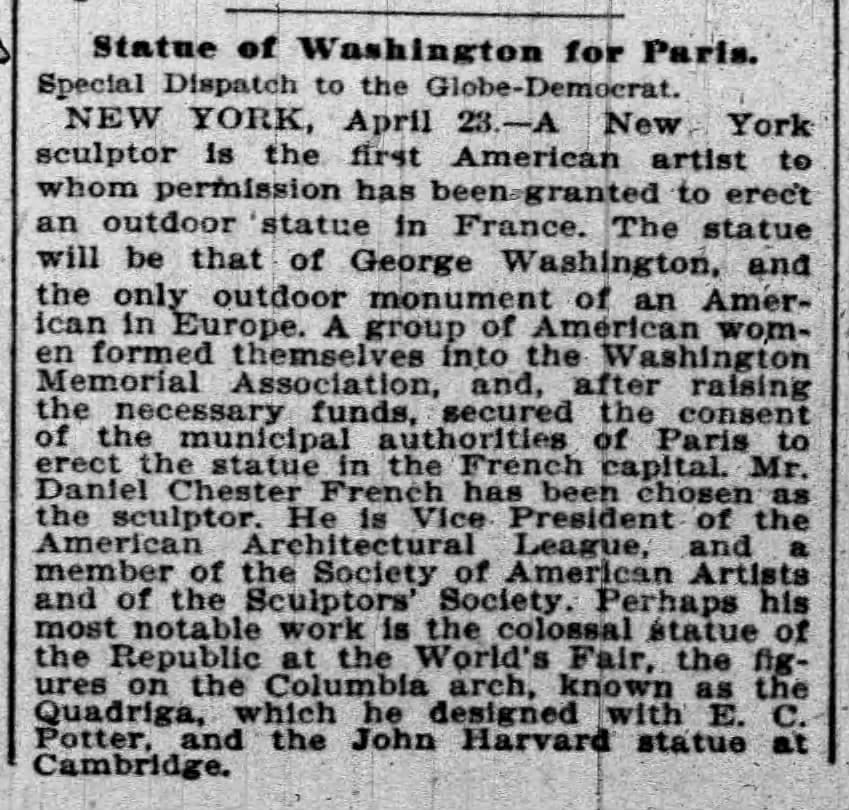
1896, New York Times | 1896, St. Louis Globe-Democrat
Then in 1900 it was mostly a generic "gift from American women", plus a few specific Washington Statue Association attributions, then the New York Times busting in like Kool-Aid Man saying "D.A.R! D.A.R.!"
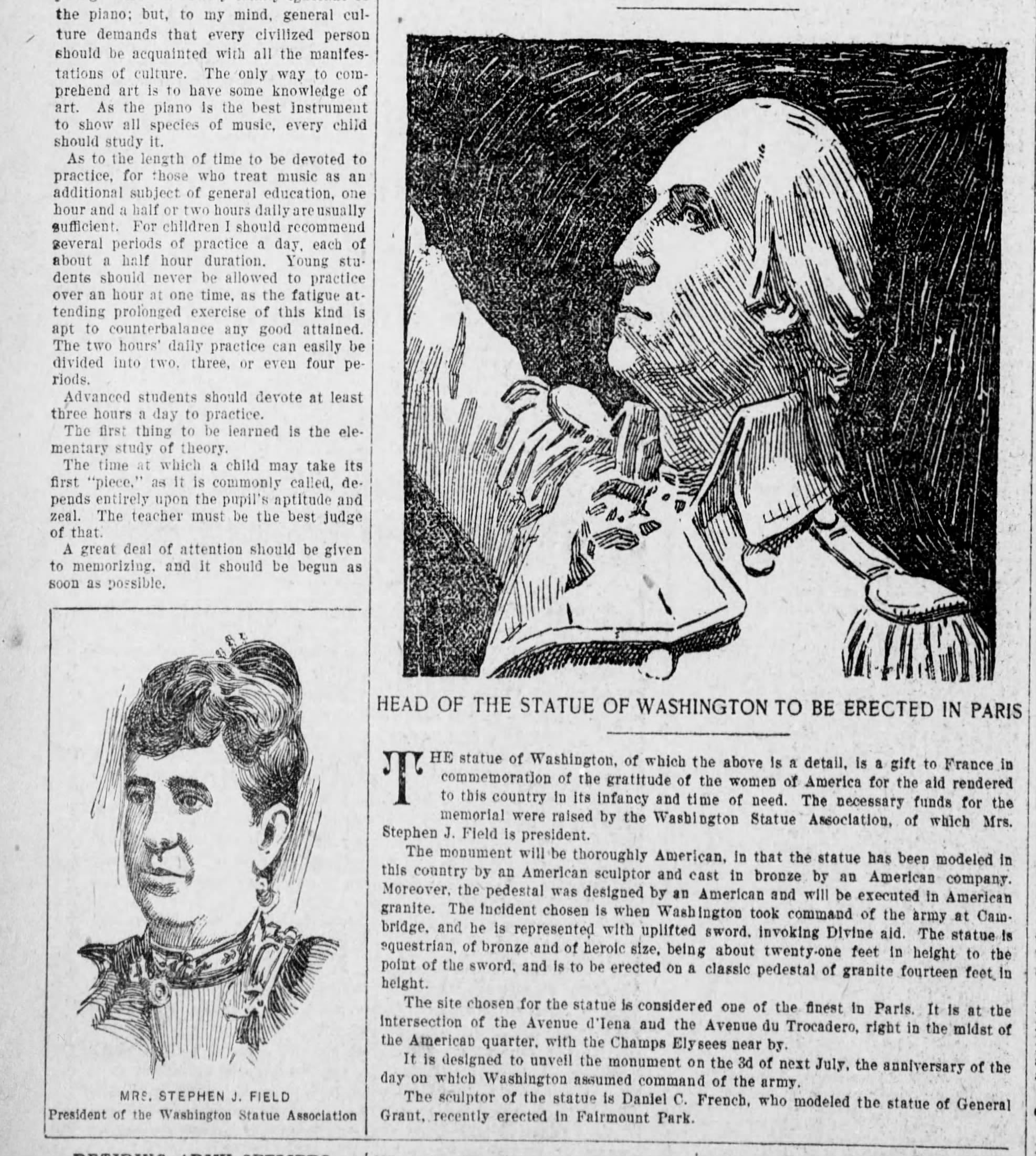

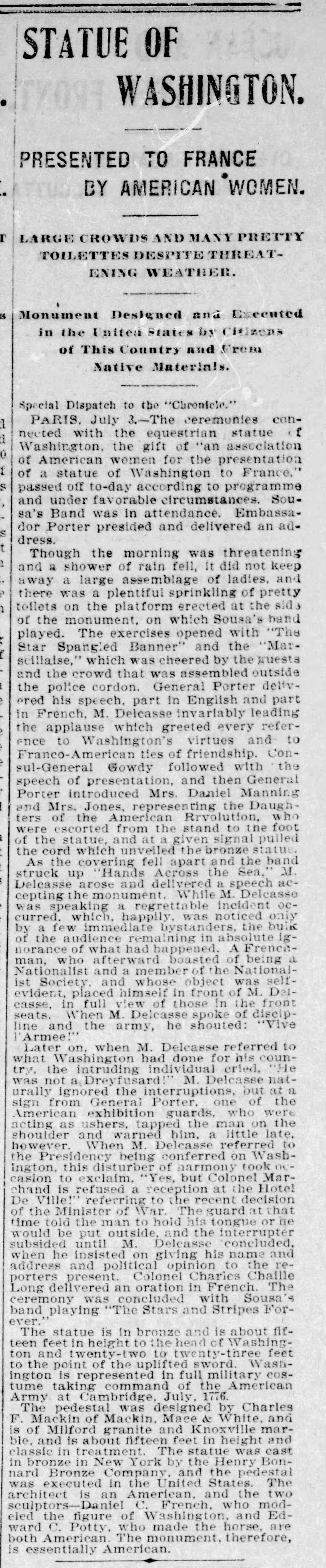
1900, Philadelphia Times | 1900, the Washington Post | 1900, San Francisco Chronicle | 1900, the Philadelphia Times | 1900, the New York Times
It was moved a few hundred feet in the 1920s because drivers didn't like that it was in the middle of the street.
1926 letter to the editor decrying the moving of the statue | 1920s postcard, Wikimedia Commons



Here is where I took the photo from.
Member discussion: