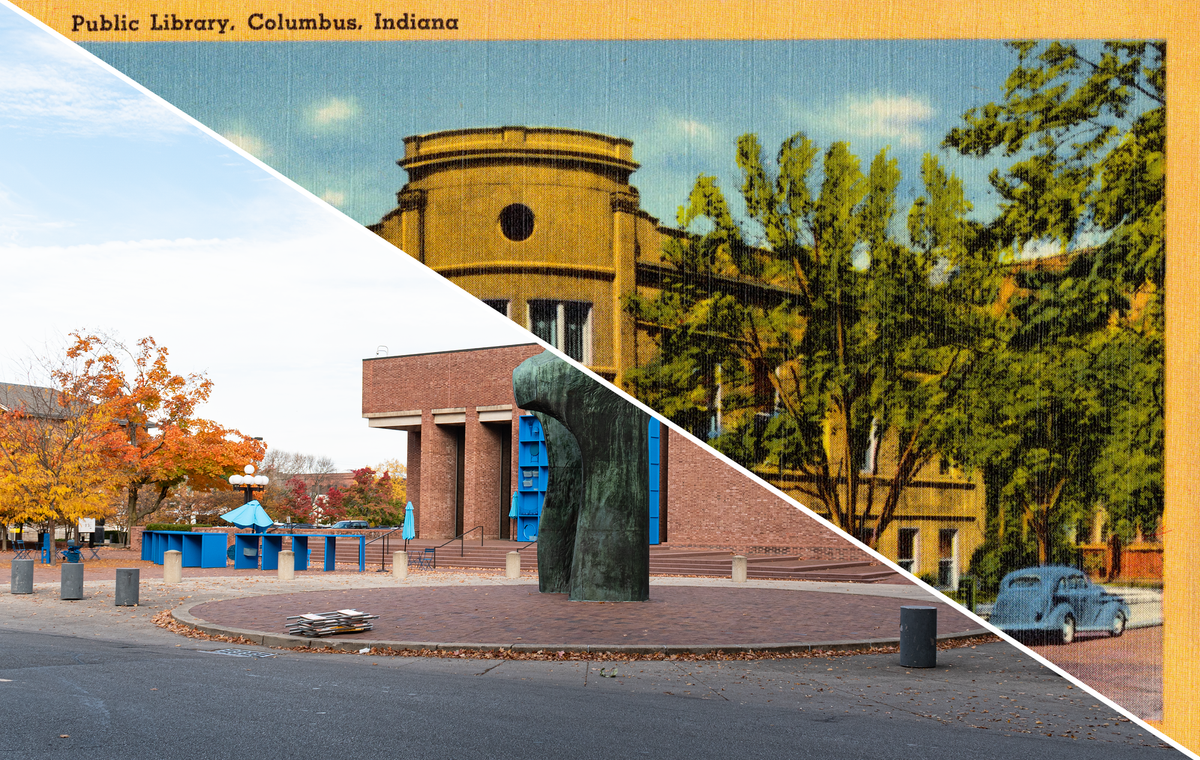
Columbus outgrew its cramped, dark, and functional Carnegie Library so—inspired by the wave of modernism transforming the Indiana town into one of the architectural capitals of America—the Bartholomew County Library Board went out and hired a rising young architect to design them a big new home. Completed right as I.M. Pei’s career really started to blow up, Pei envisioned the Cleo Rogers Memorial Library as the final “wall” that would create a central civic room for the city of Columbus, one defined by monumental modernism.
They succeeded…but more importantly, it’s also a wonderful library, warm, inviting, and serene behind an austere facade.
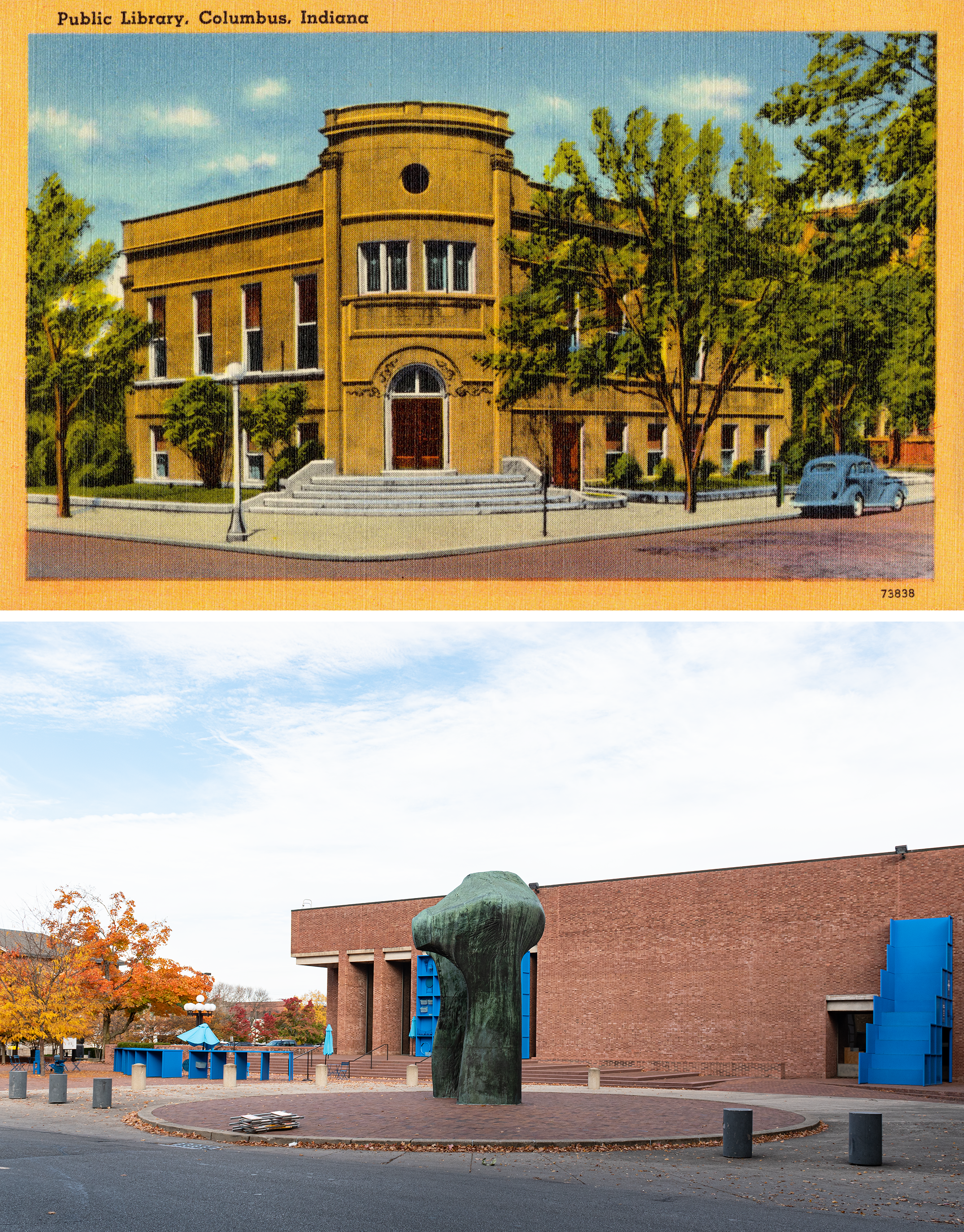
So, what’s changed? Well, yeah, literally everything—the city planning commission even vacated and erased Lafayette Avenue to create the space Pei’s library project needed.
A partnership between local and national philanthropic muscle, Columbus’ Carnegie Library opened in 1903. On the national side, Andrew Carnegie contributed $15k of the library’s $20k construction cost. On the local side, nothing happened in Columbus without some kind of involvement from the local Irwin-Miller-Sweeney clan—here, Joseph Irwin donated the site where the library was built. Architect John W. Gaddis designed the library, a fine little Beaux Arts building with a nicely curving entrance. If you’re bummed that his building was razed, don’t fret—a contemporaneous (and very similar looking) Carnegie Library designed by Gaddis still stands in Olney, Illinois.
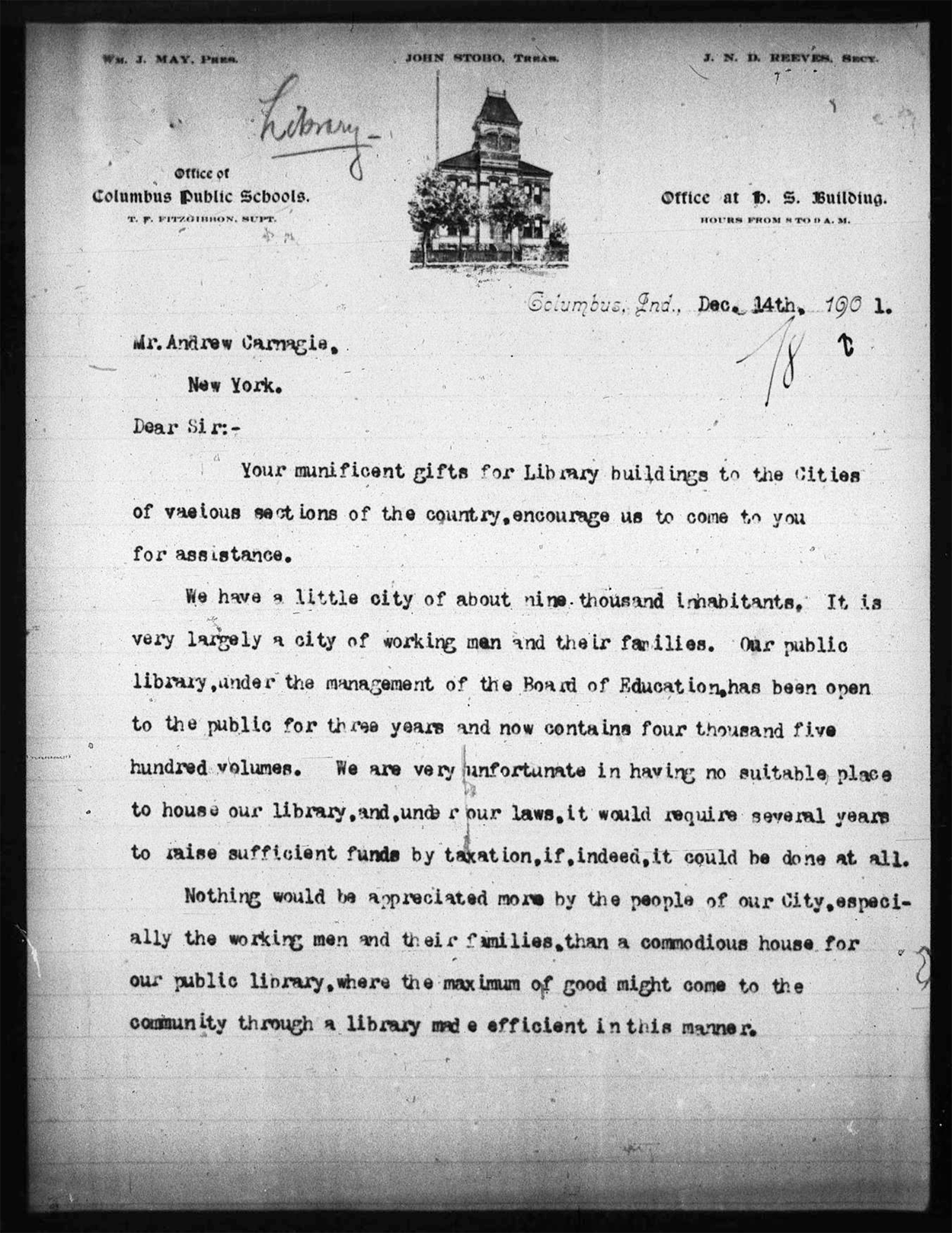
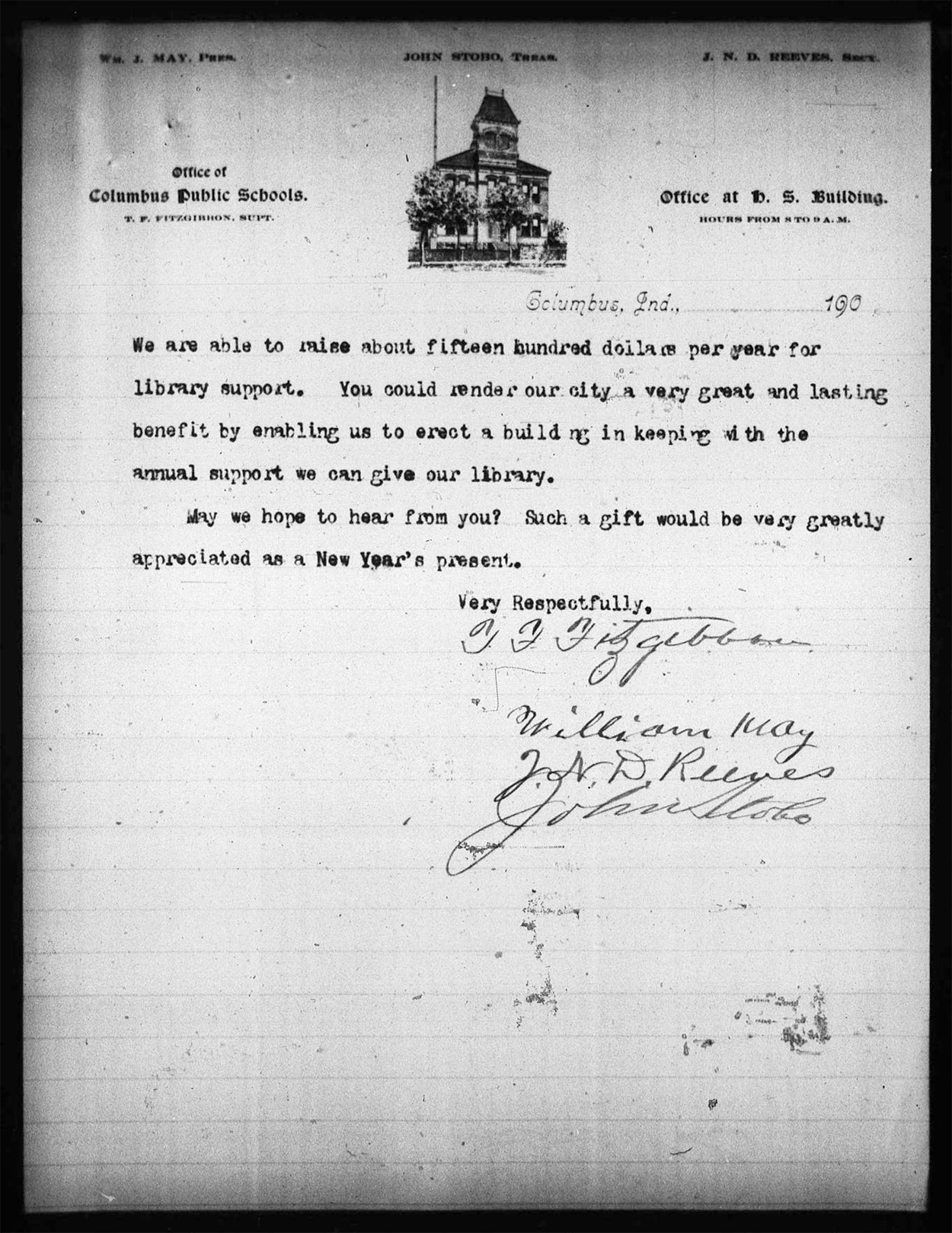
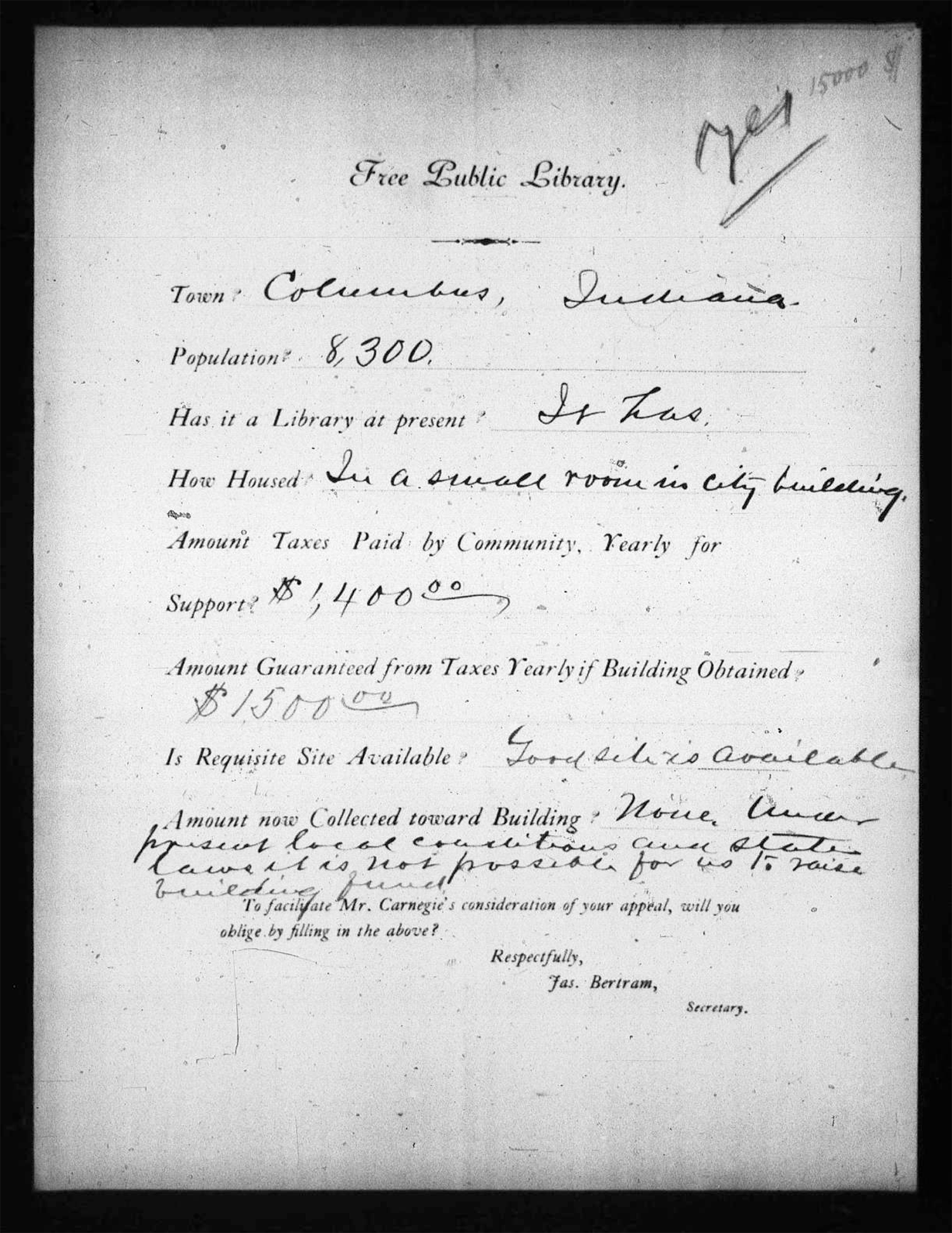
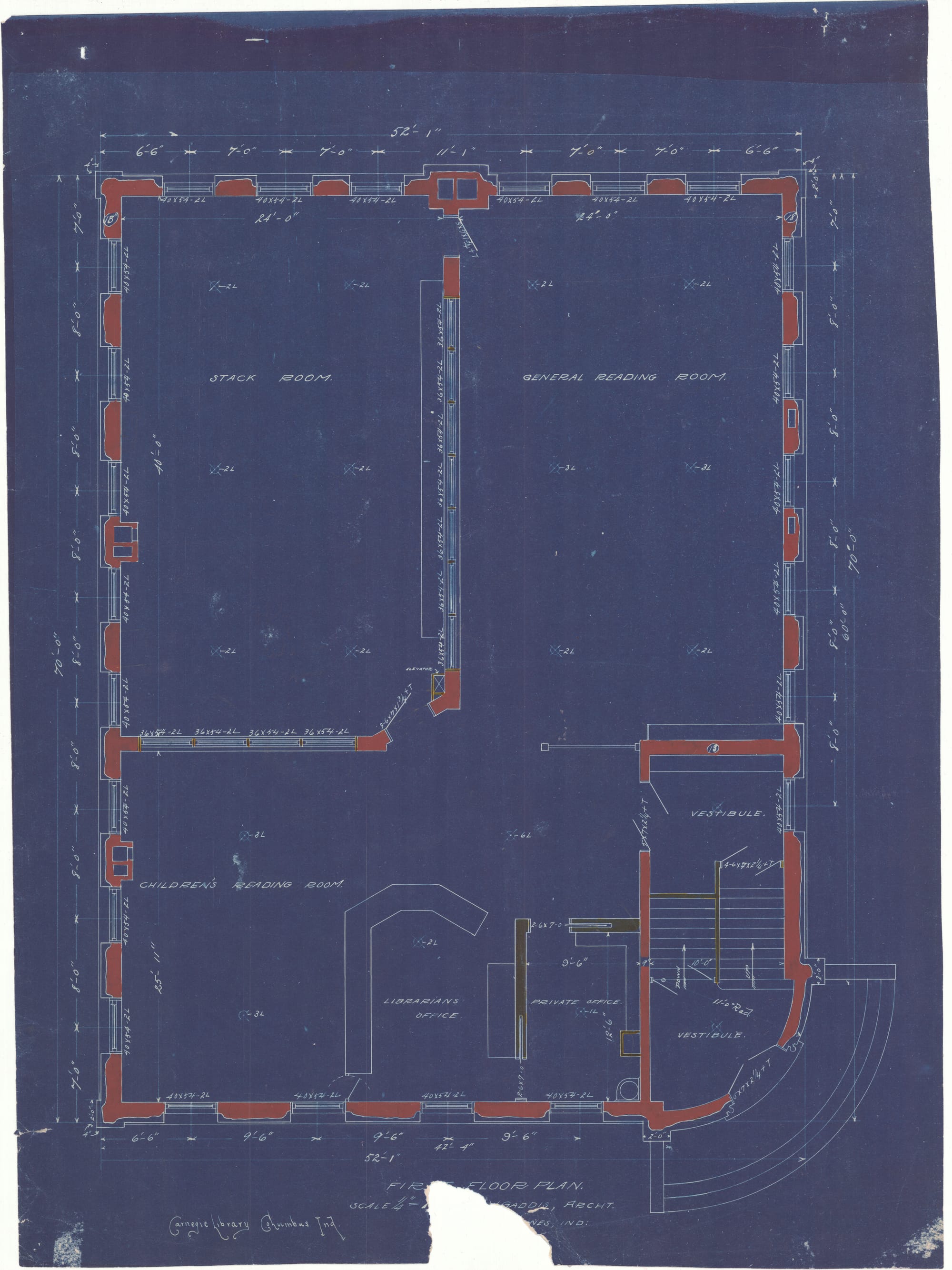
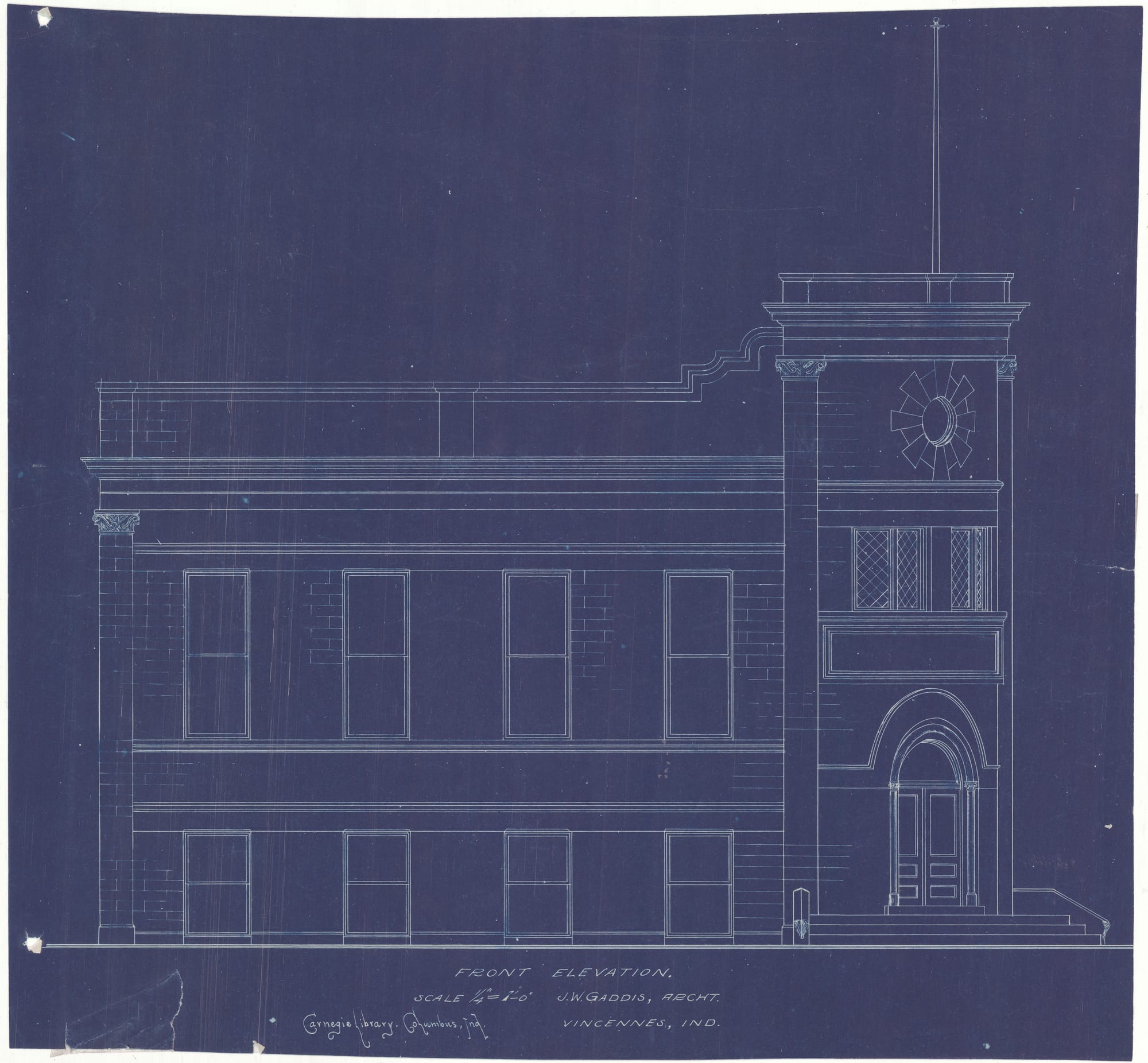
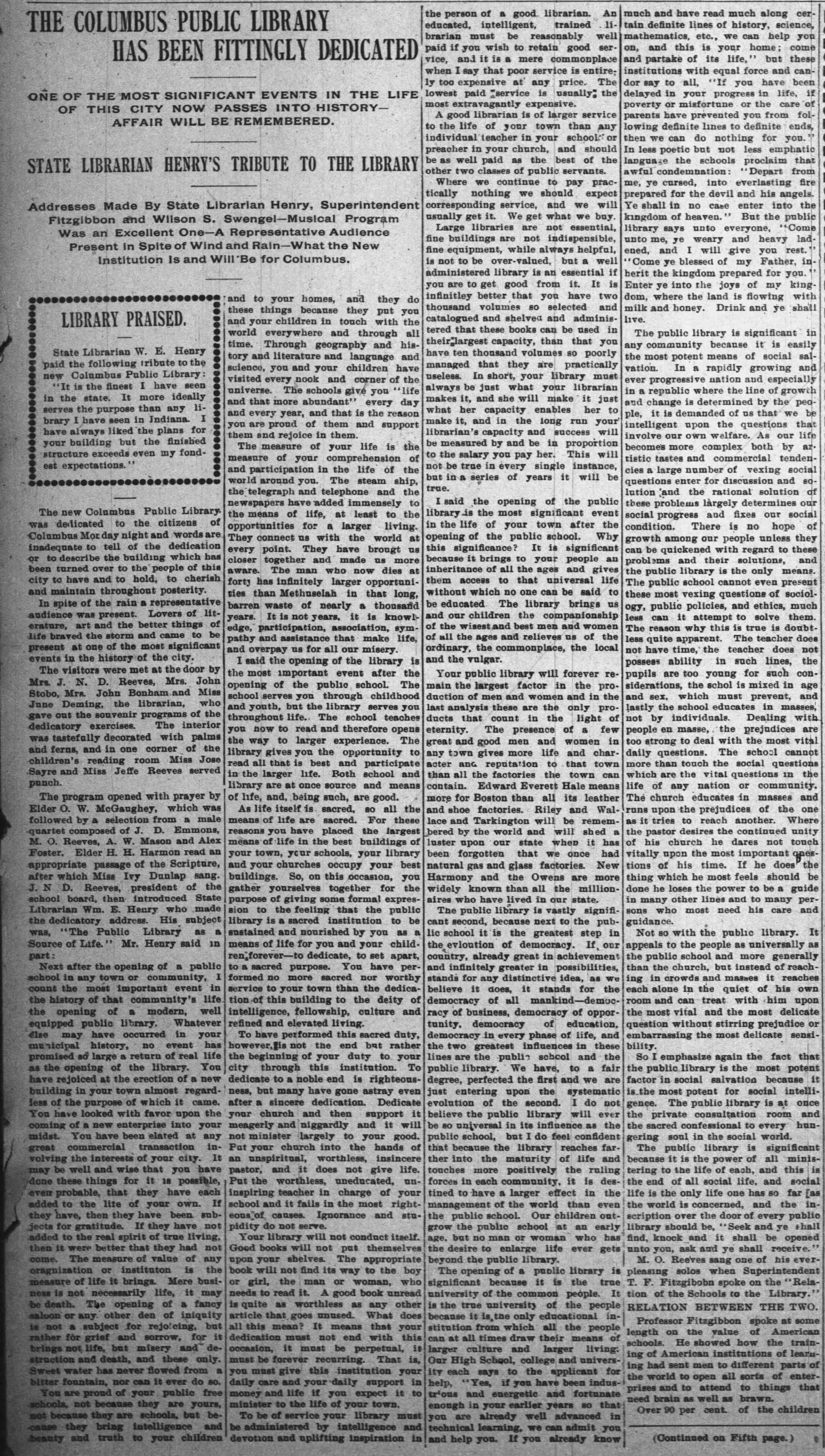
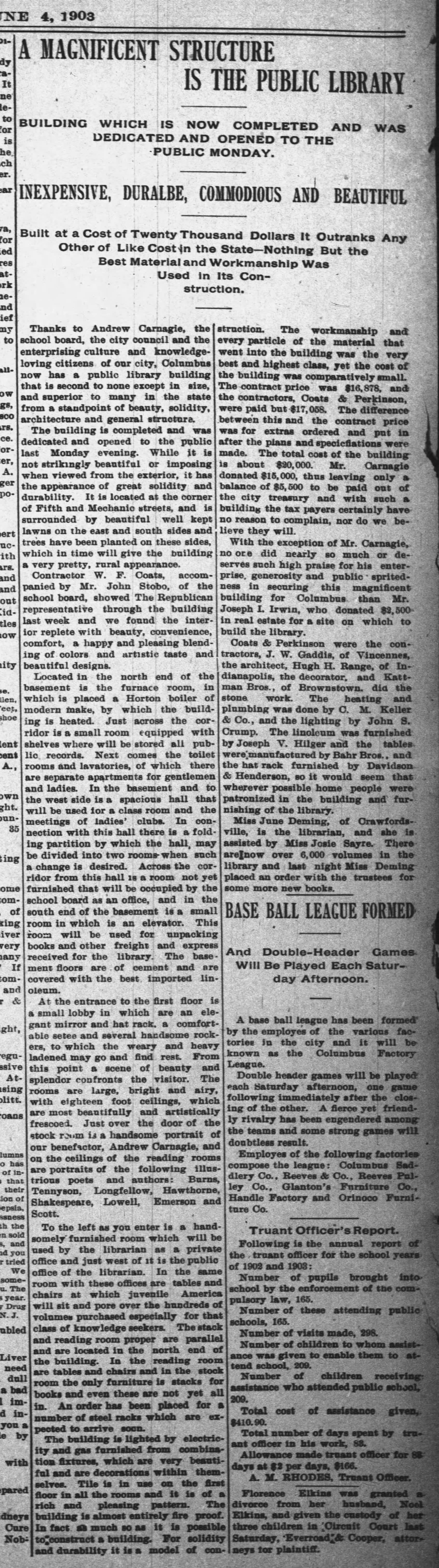
Letter from Columbus to Andrew Carnegie requesting a donation and the filled-out application form, Carnegie Corporation of New York Records, Columbia University | Gaddis' Carnegie Library blueprints, Columbus, Indiana Architectural Archives, BCPL Archives, Bartholomew County Public Library | 1903 articles on the opening and dedication of the new Carnegie Library
In 1959, the newly-formed Bartholomew County Library Board took control of the library system from the Board of Education. In the half century since the Carnegie was built, Columbus’ population had doubled. In one of their first acts, the new library board commissioned a study on the future of the system, which unsurprisingly found that a main library built for a town of 10,000 was insufficient for a town of 20,000, and they quickly began organizing to build a larger modern library.
Architecturally, it was an interesting time in Columbus—after the success of the Saarinens’ First Christian Church across the street, J. Irwin Miller created the Cummins Foundation Architecture Program, which paid architect fees for modernist public buildings in Columbus.
…but this was not funded by that program, a testament to the town's broader embrace of its growing identity as a hub for cutting-edge architecture (the Irwin-Miller family did end up donating some land for the library’s expansion and the Cummins Foundation did chip in to support construction, even if the building wasn’t part of the formal program).
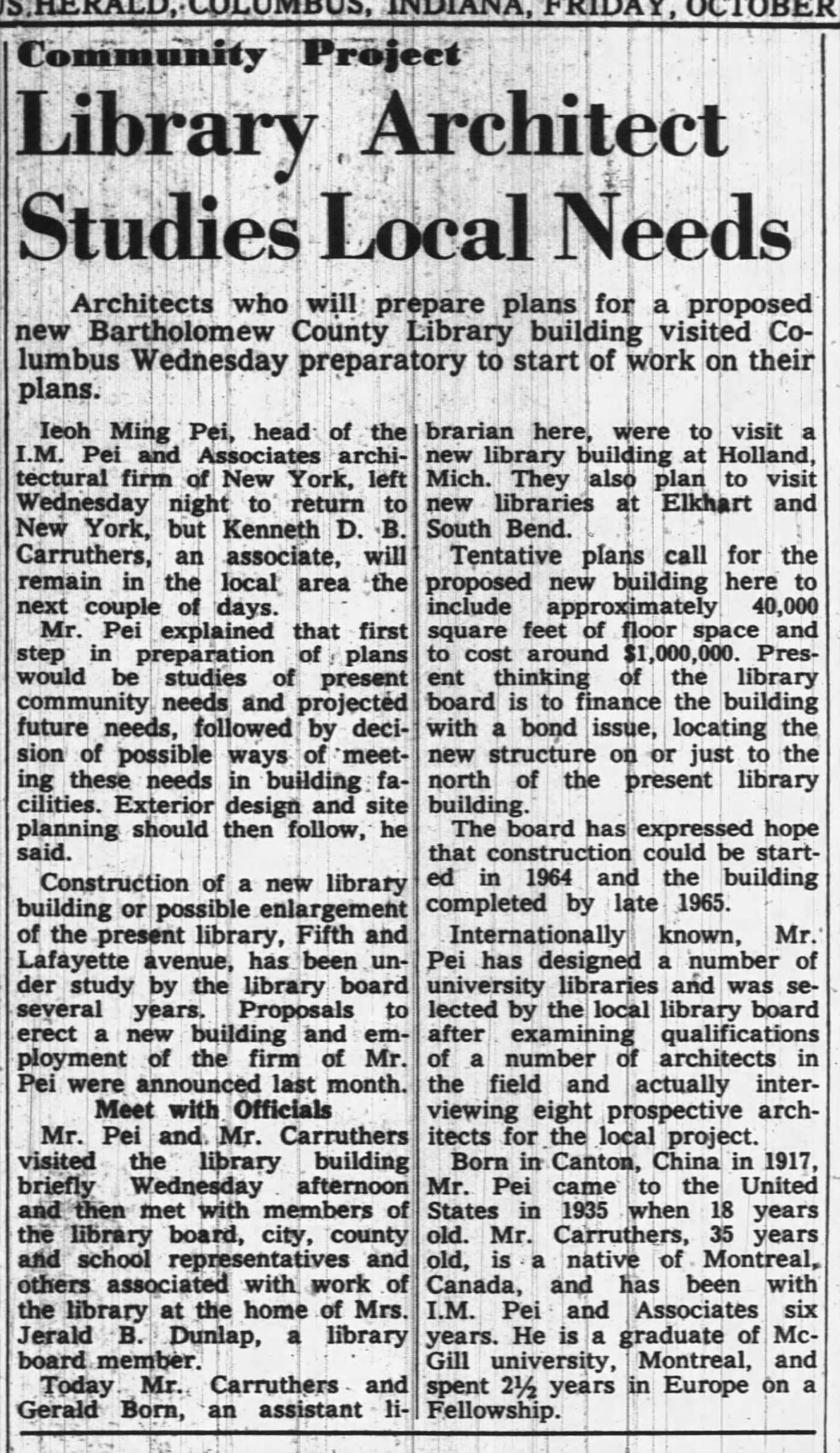
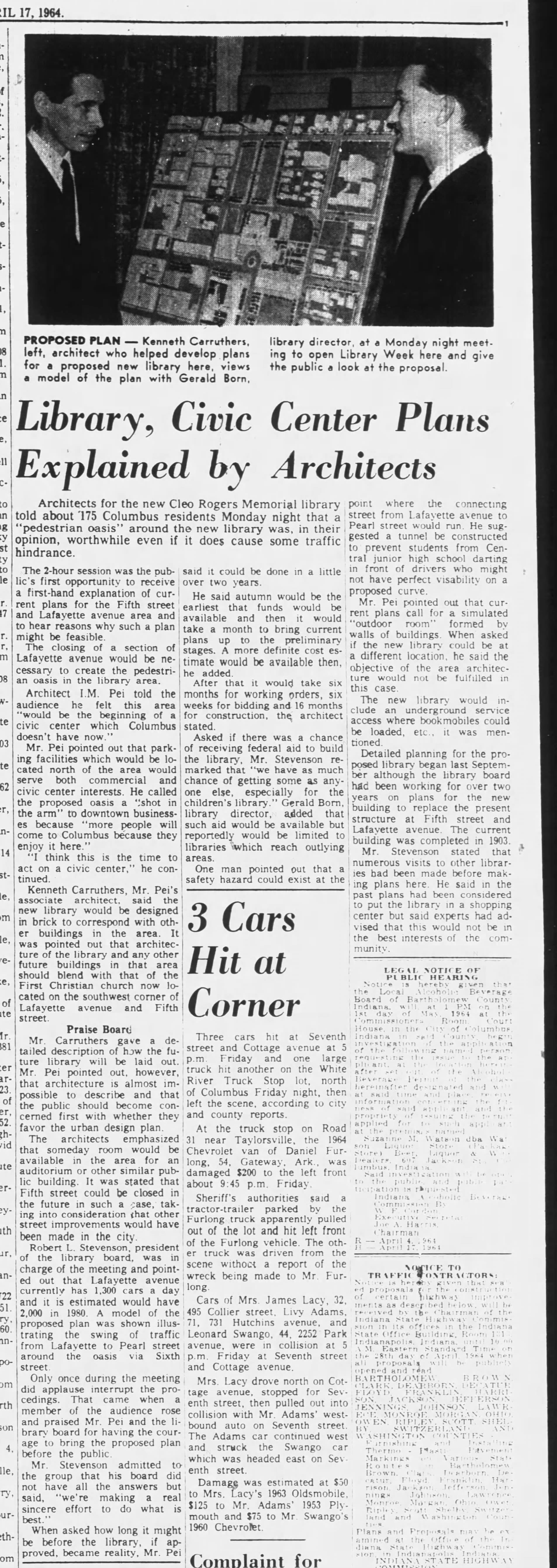
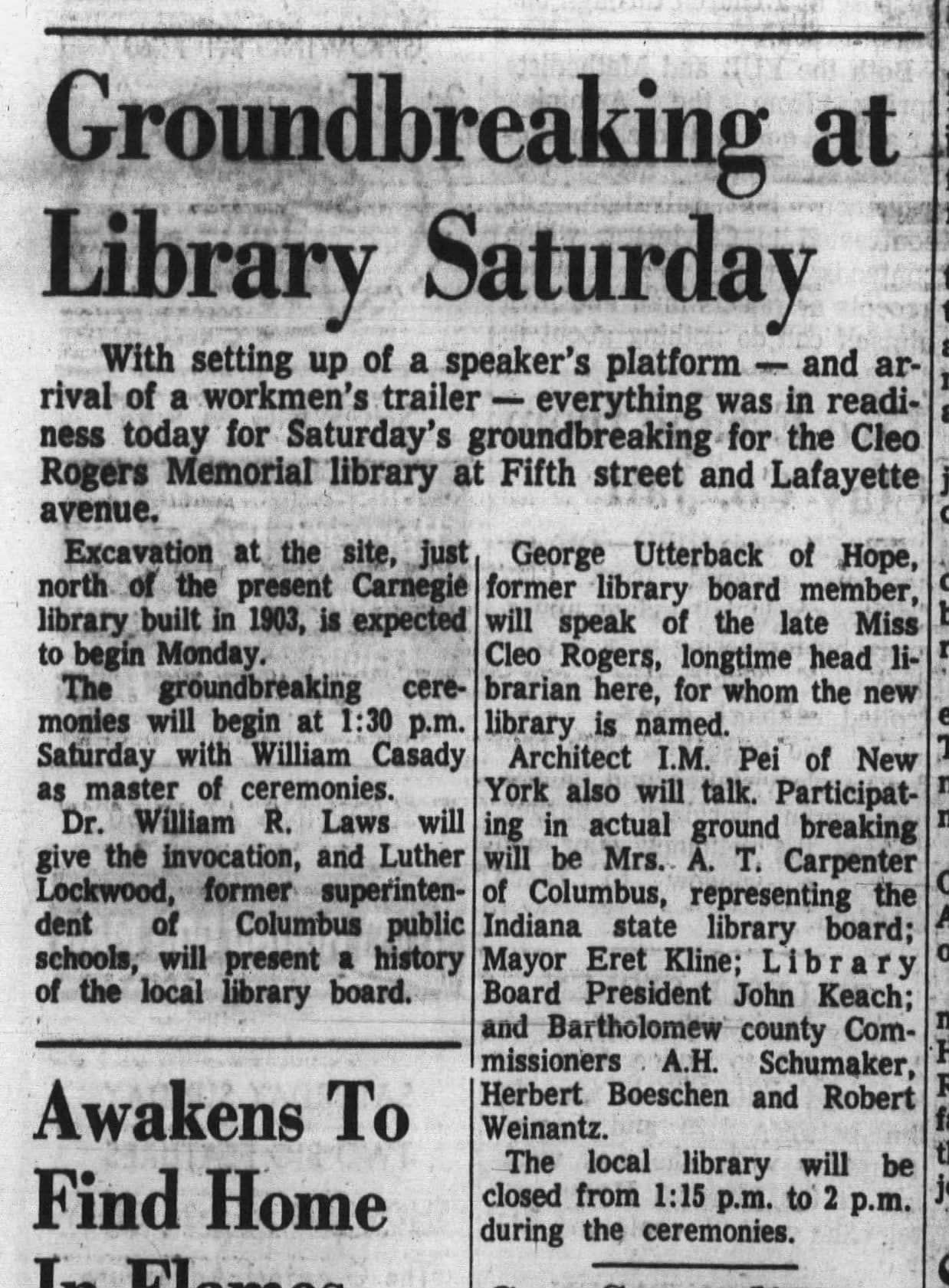
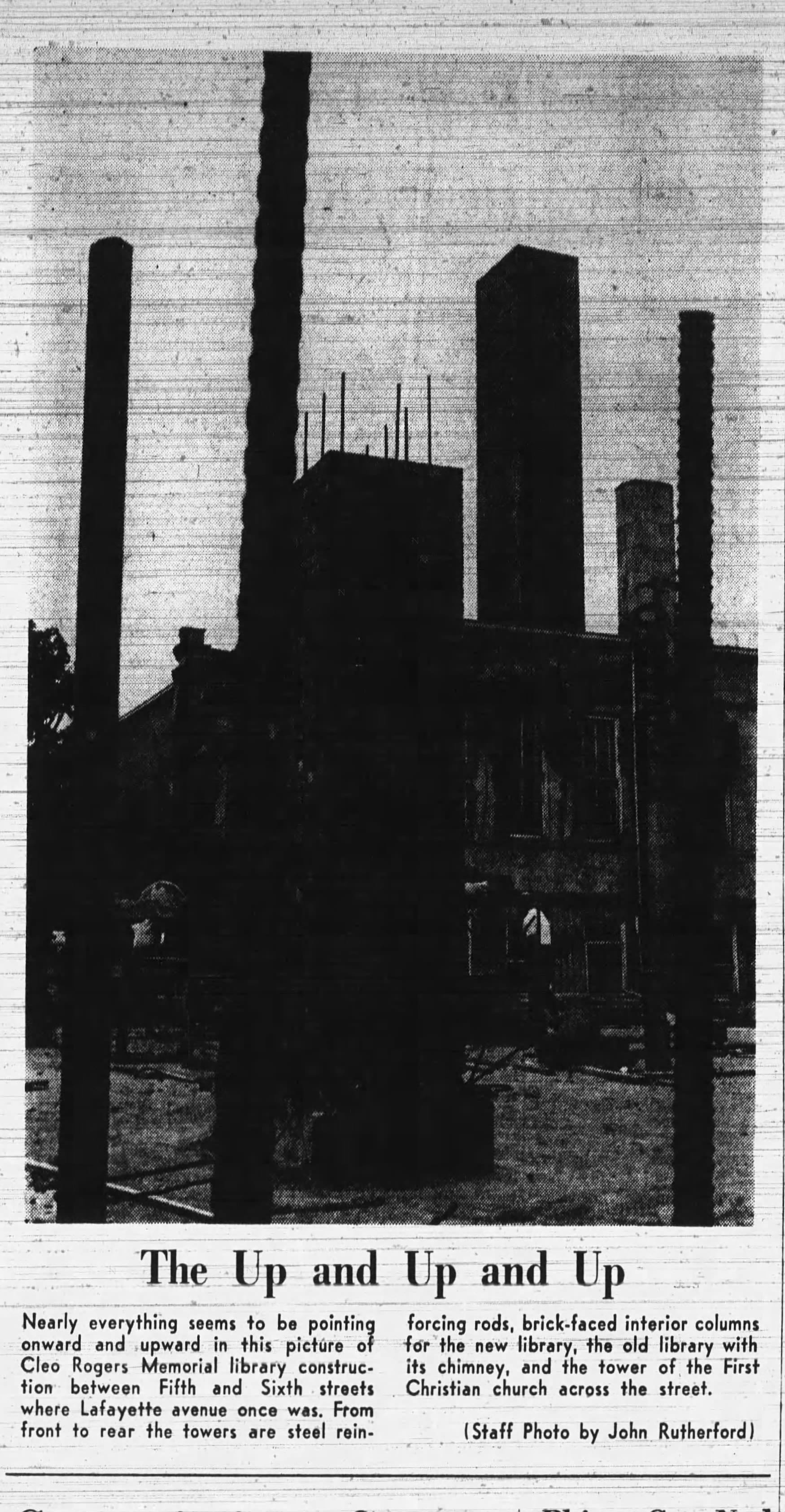
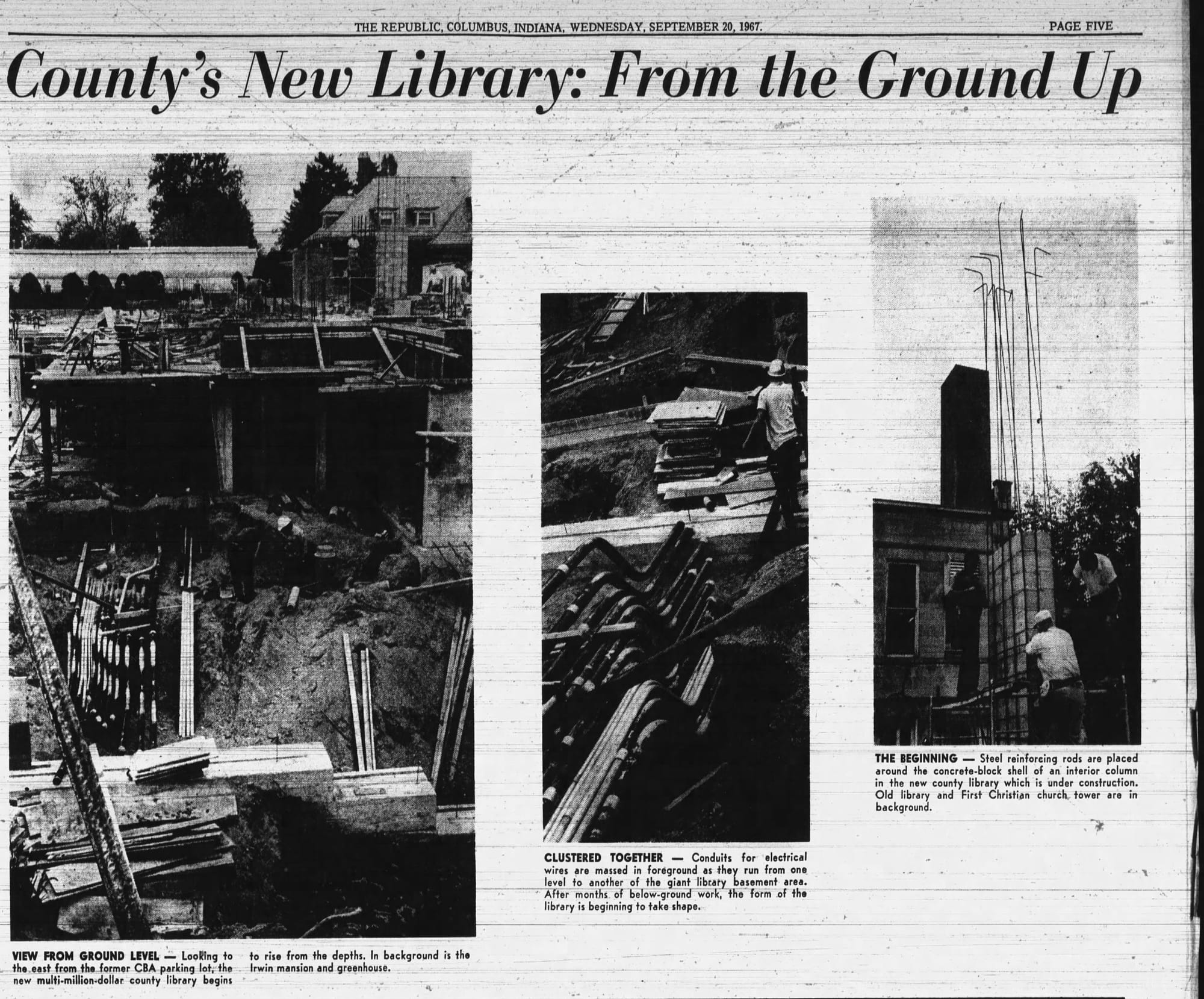
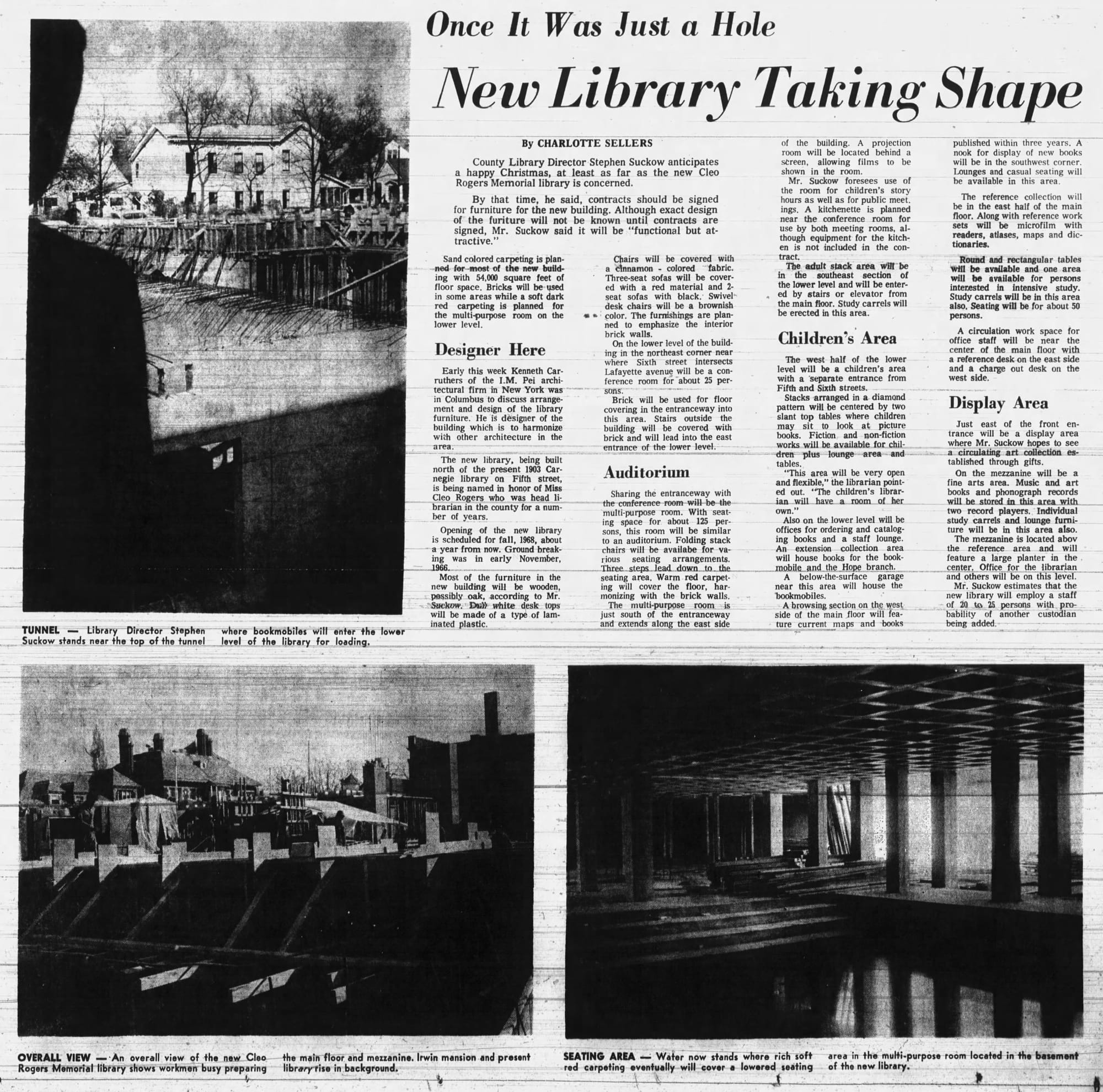
1963, "Library, Architect Studies Local Needs" | 1964, Pei explains plans | 1966, groundbreaking | 1967 articles on the construction of the new library
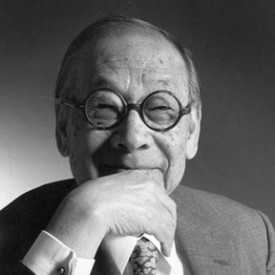
To design their flagship new library, one that would create a new civic heart for Columbus, the library board hired I.M. Pei & Associates in 1963. Relatively early in the firm’s existence (they only began operating fully independently in 1960), the library commission came as I.M Pei & Associates began to blossom from a nationally-productive firm into one of the most illustrious architecture firms in the world—part of a series of 1960s civic hits for the firm, including the Mesa Laboratory of the National Center for Atmospheric Research in Colorado and the JFK Presidential Library, along with similar projects like the Everson Museum of Art in Syracuse, and the Sculpture Wing of the Des Moines Art Center.
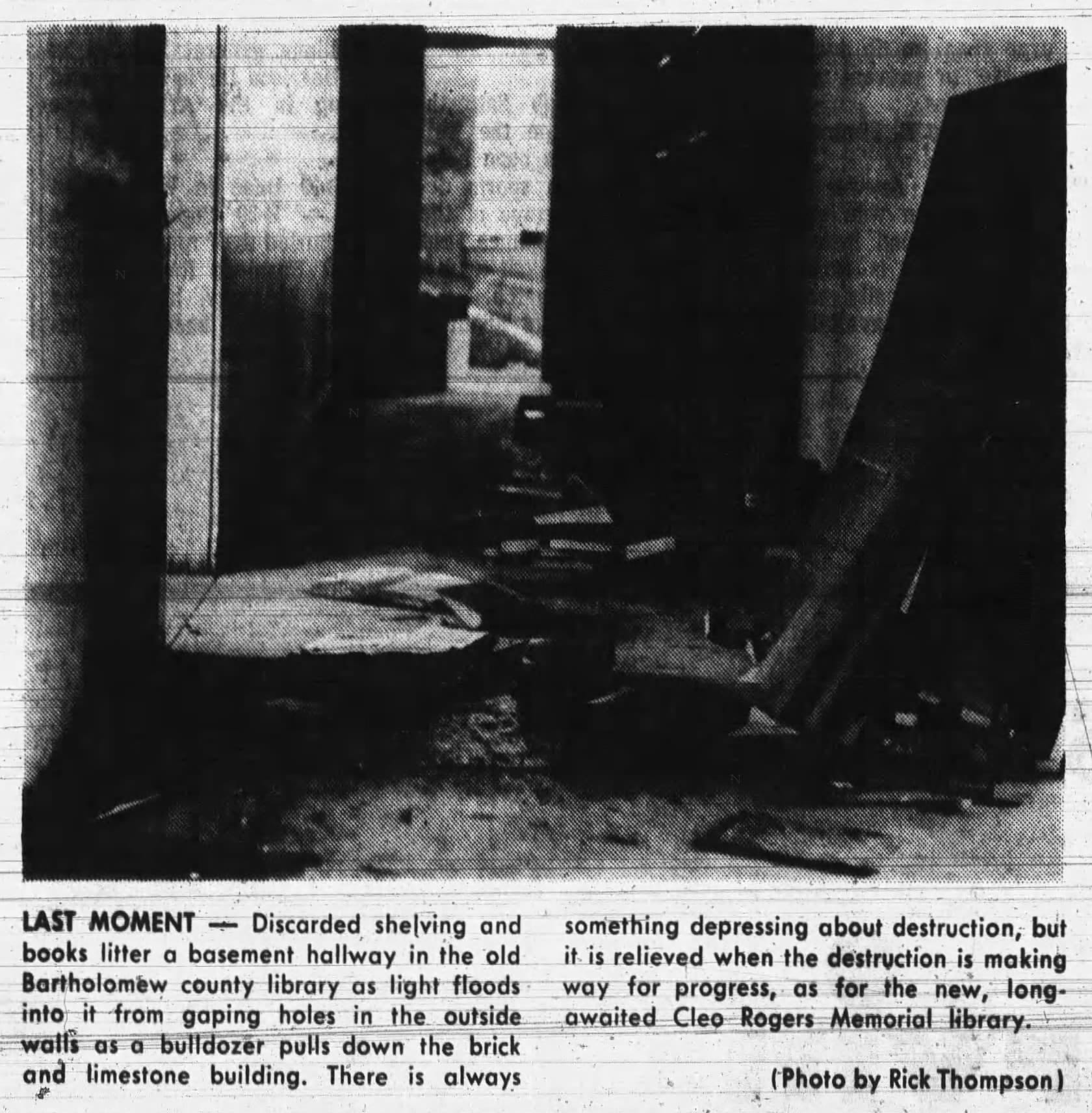
With architect Kenneth Carruthers I.M. Pei’s man on site, construction on the new library began in 1966. The little old Carnegie stayed open as its successor went up next door over the next three years—when it was ready, they installed a conveyor belt between the two libraries to move books from the old to the new. Emptied of books and with the new library ready to go, they demolished the Carnegie Library soon after and started to work on the square. Named for Cleo Rogers in recognition of 37 years of service to the Bartholomew County library, including 28 years as the head librarian, the new Columbus library opened in 1969.
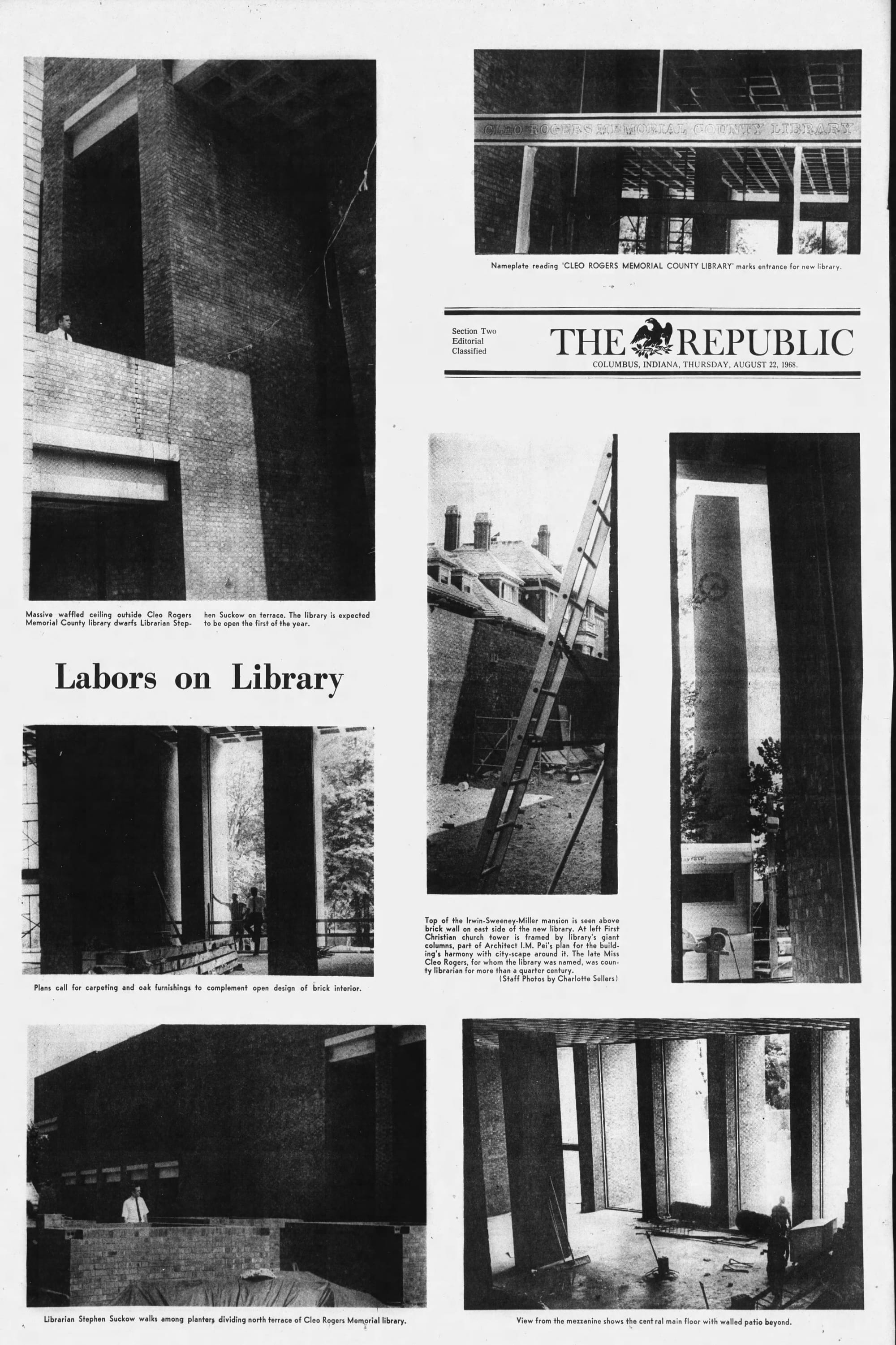
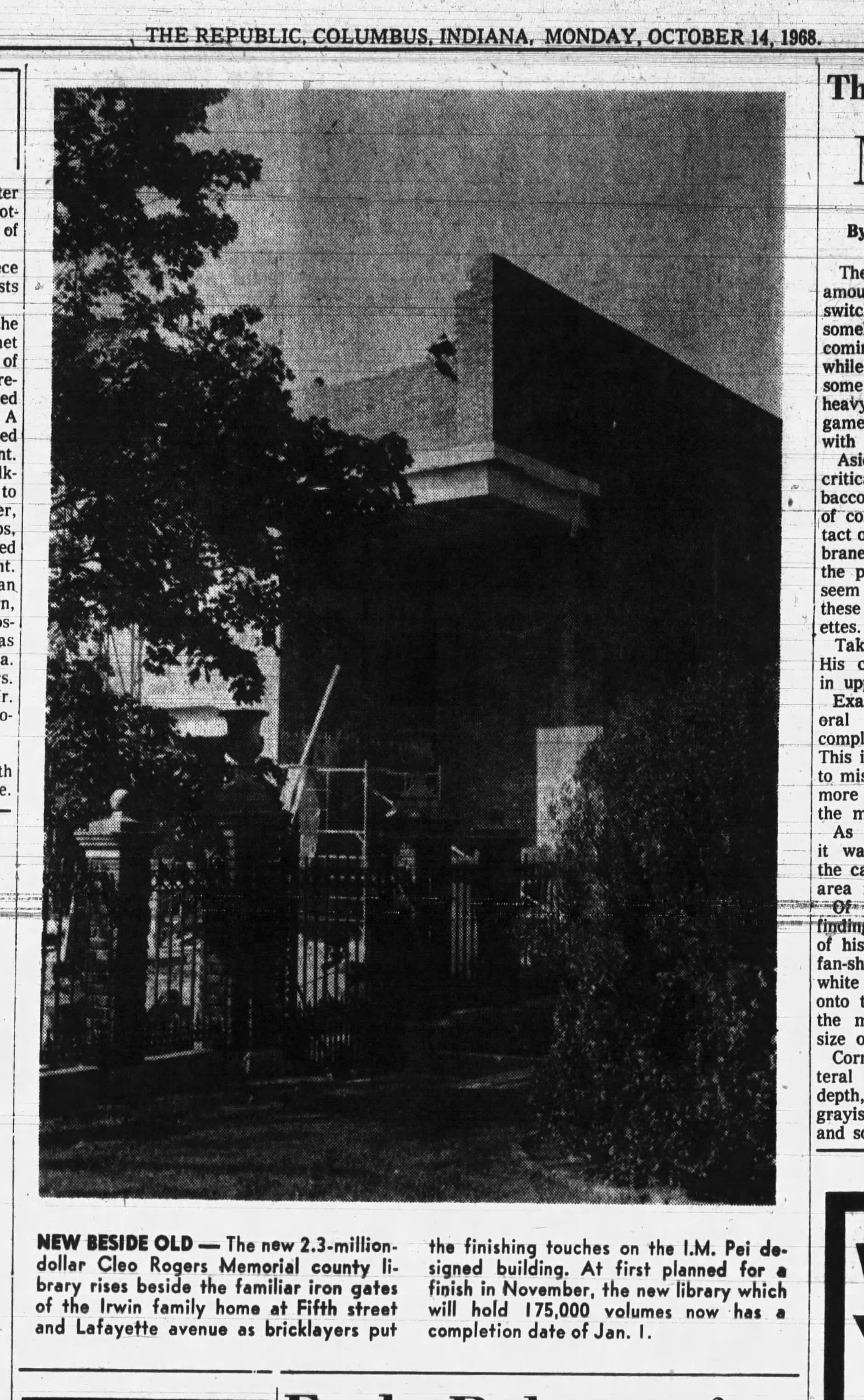
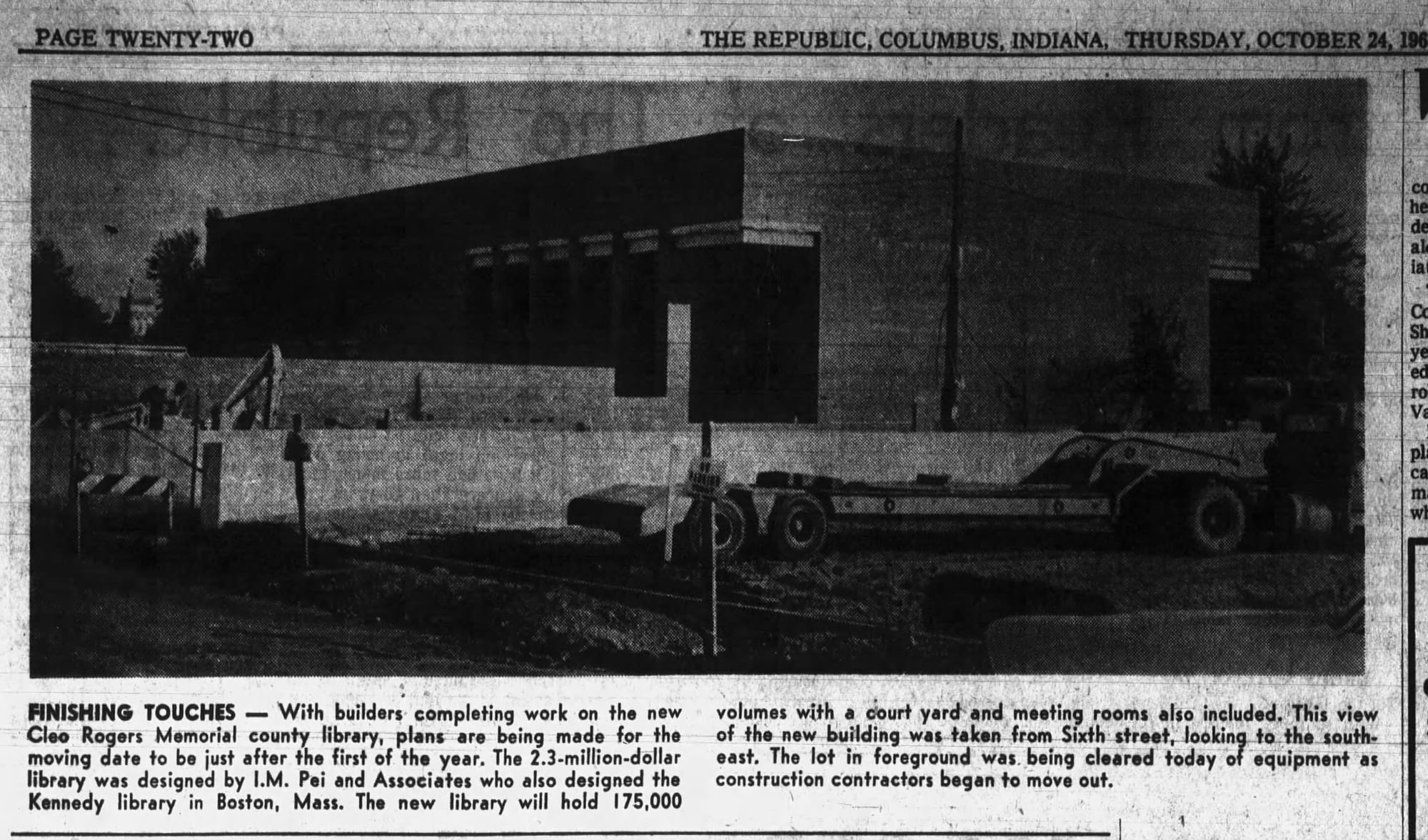
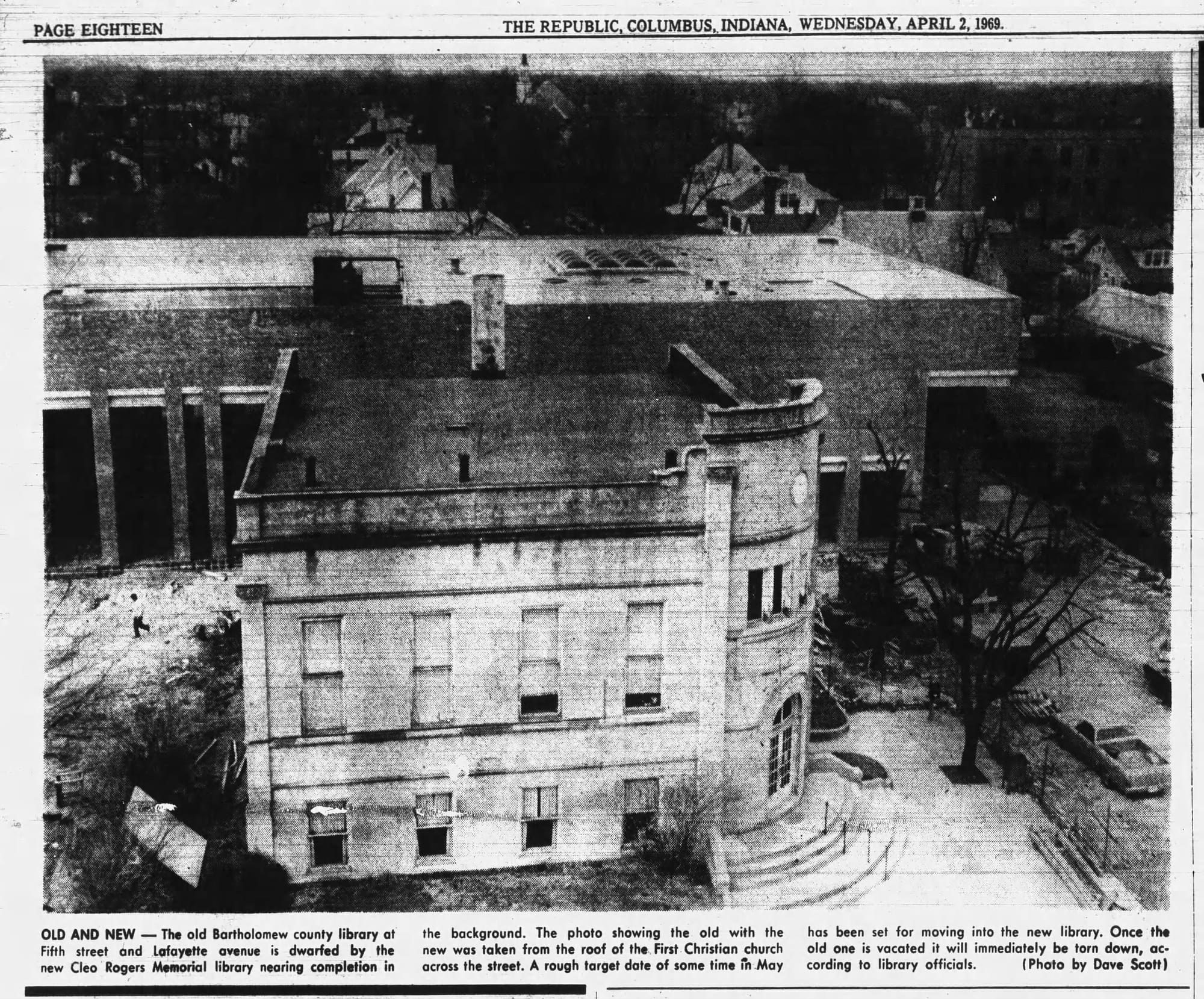
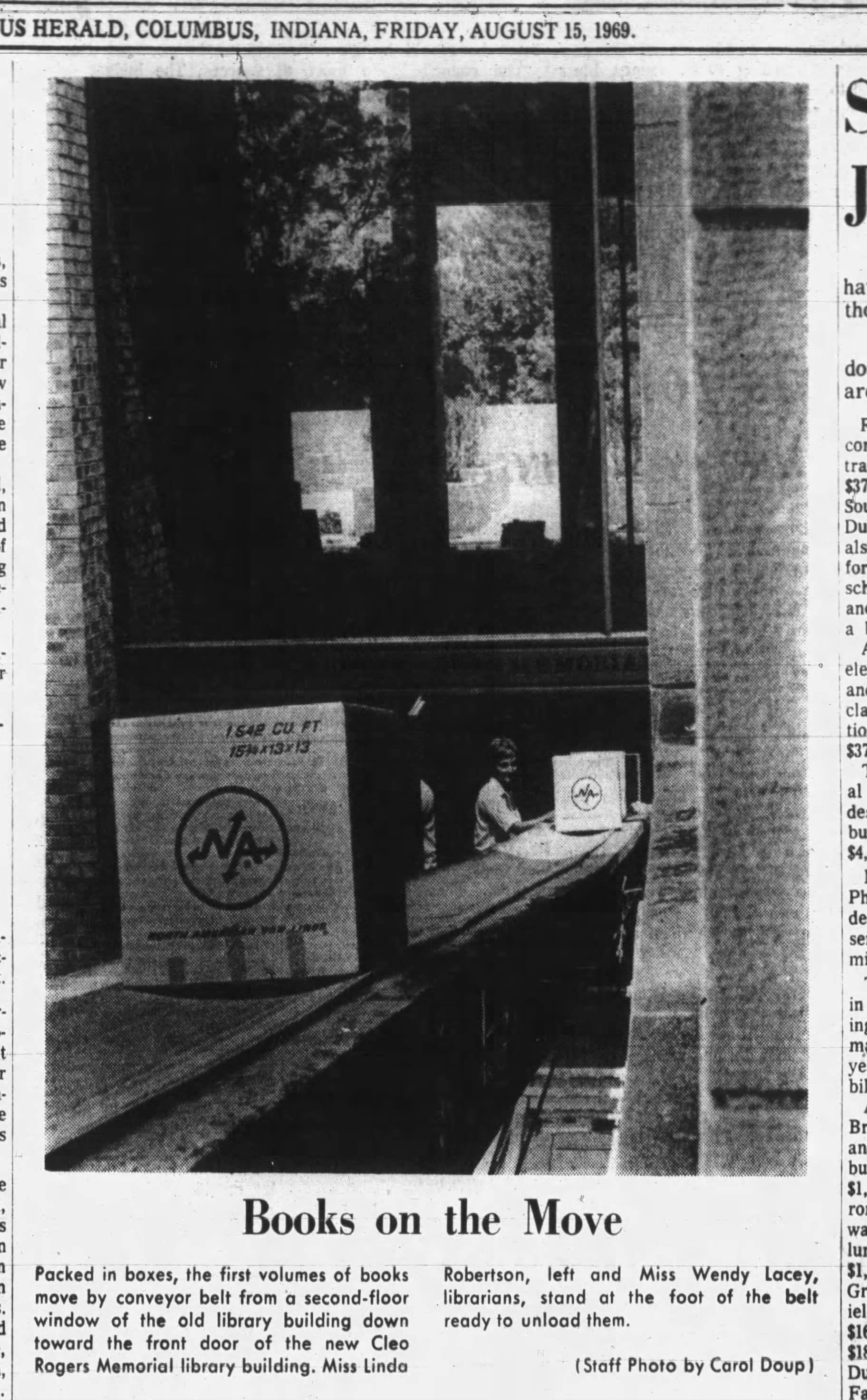
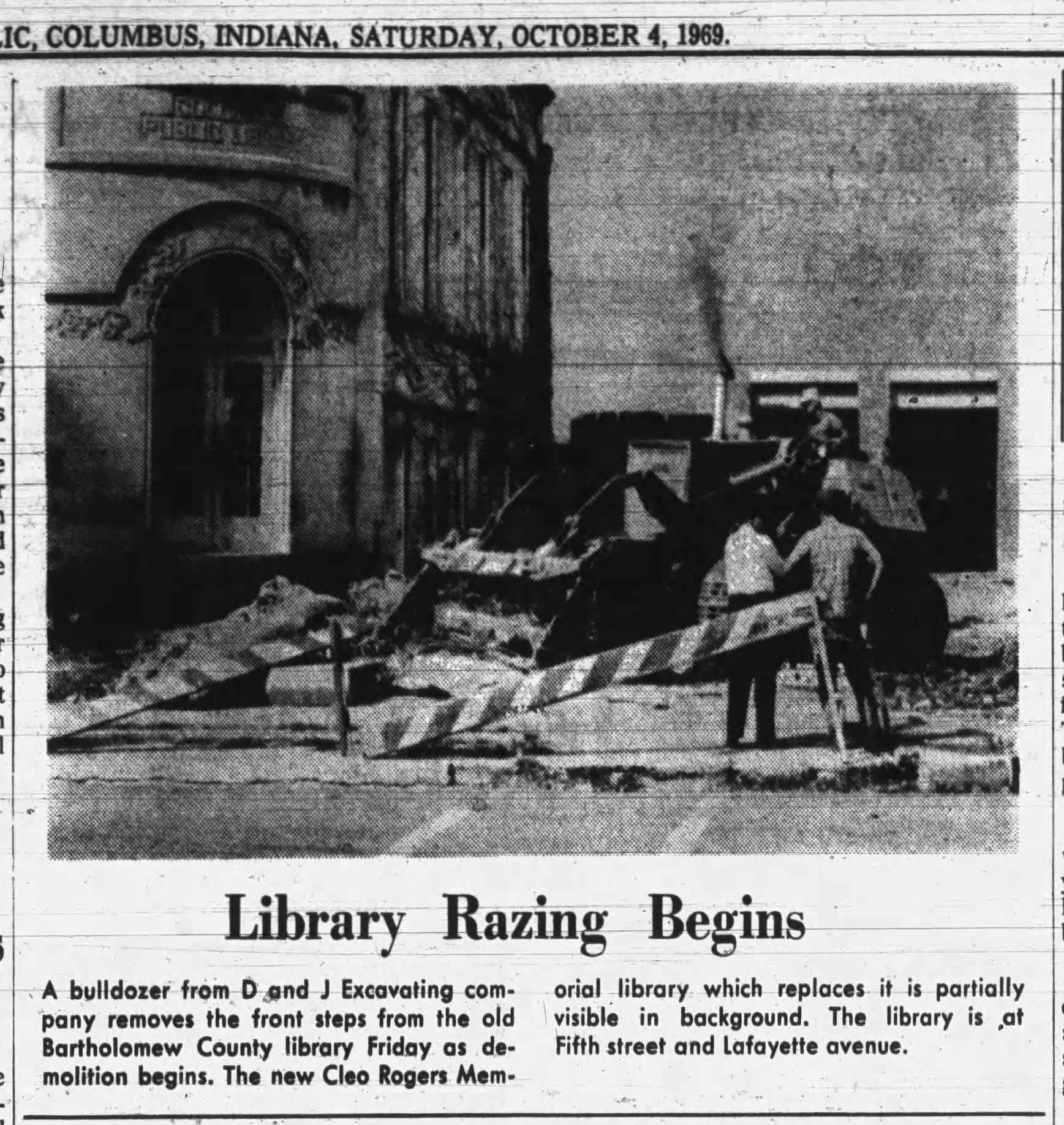
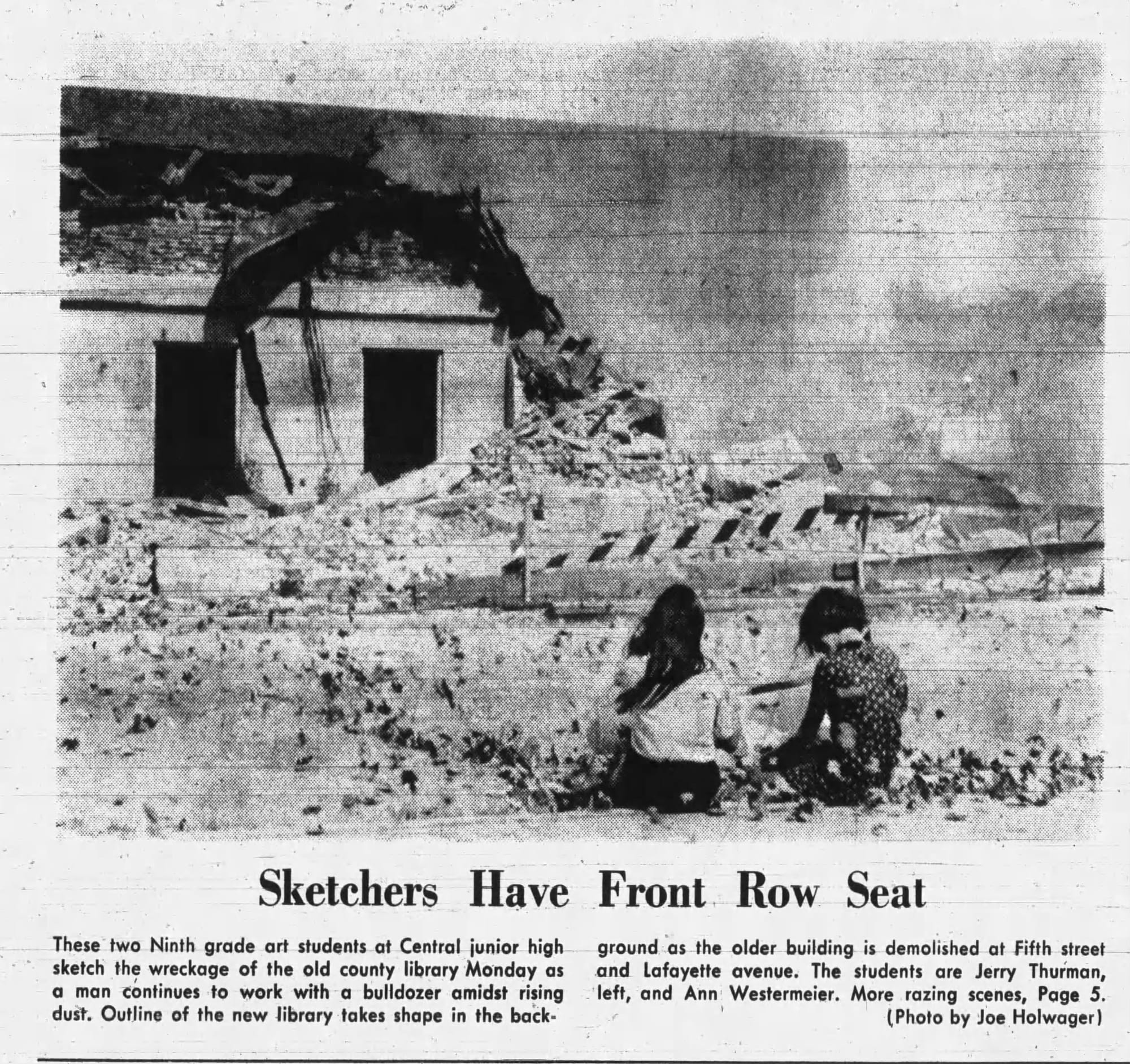
1968 articles on the continued construction | 1969 articles about the switch to the new library, moving the books, and demolishing the old
A mass of warm local brick in Flemish Bond, Pei & Associates’ design for Cleo Rogers Memorial Library accomplished both its main goals—it created a place where there wasn’t one and it serves as a fantastic library. Concrete waffle slab, stunning staircases, and an affectingly lush interior courtyard centered around a tree, inside it’s an inspiring civic space, and its simple-but-monumental exterior—together with the First Christian Church and the Irwin mansion—-delineated a new central civic “room” for the town of Columbus.
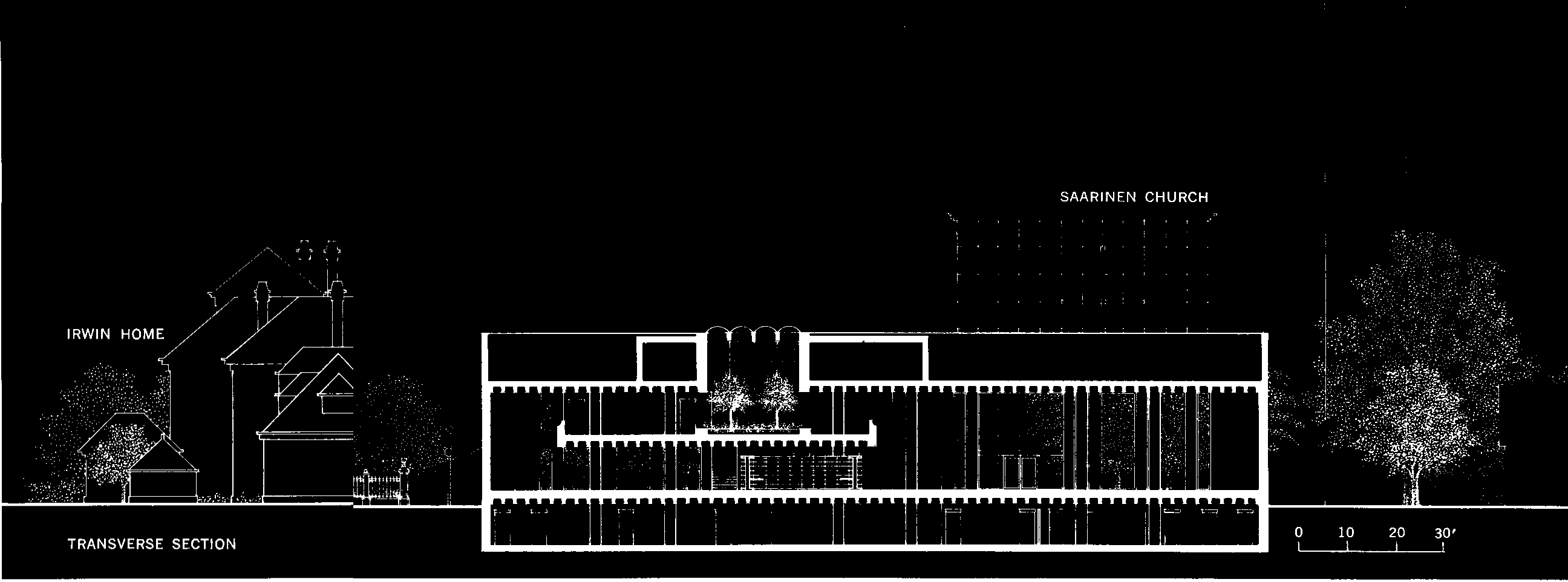
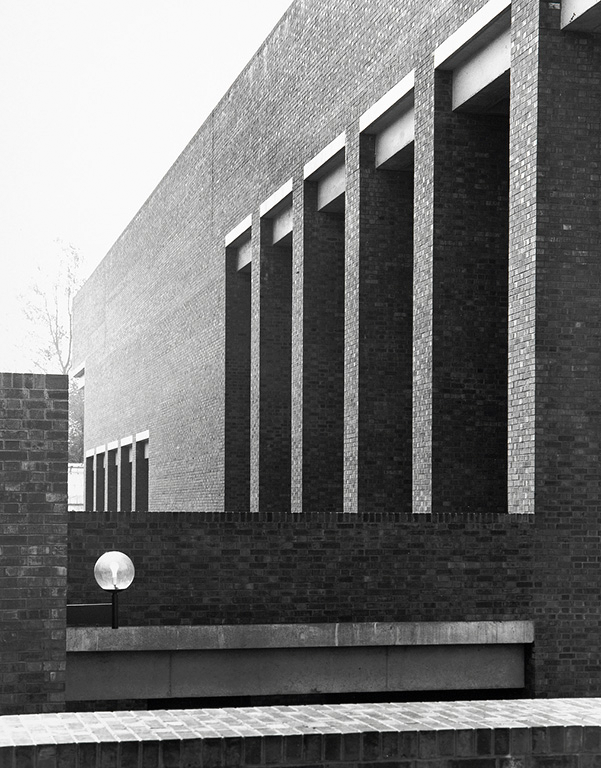
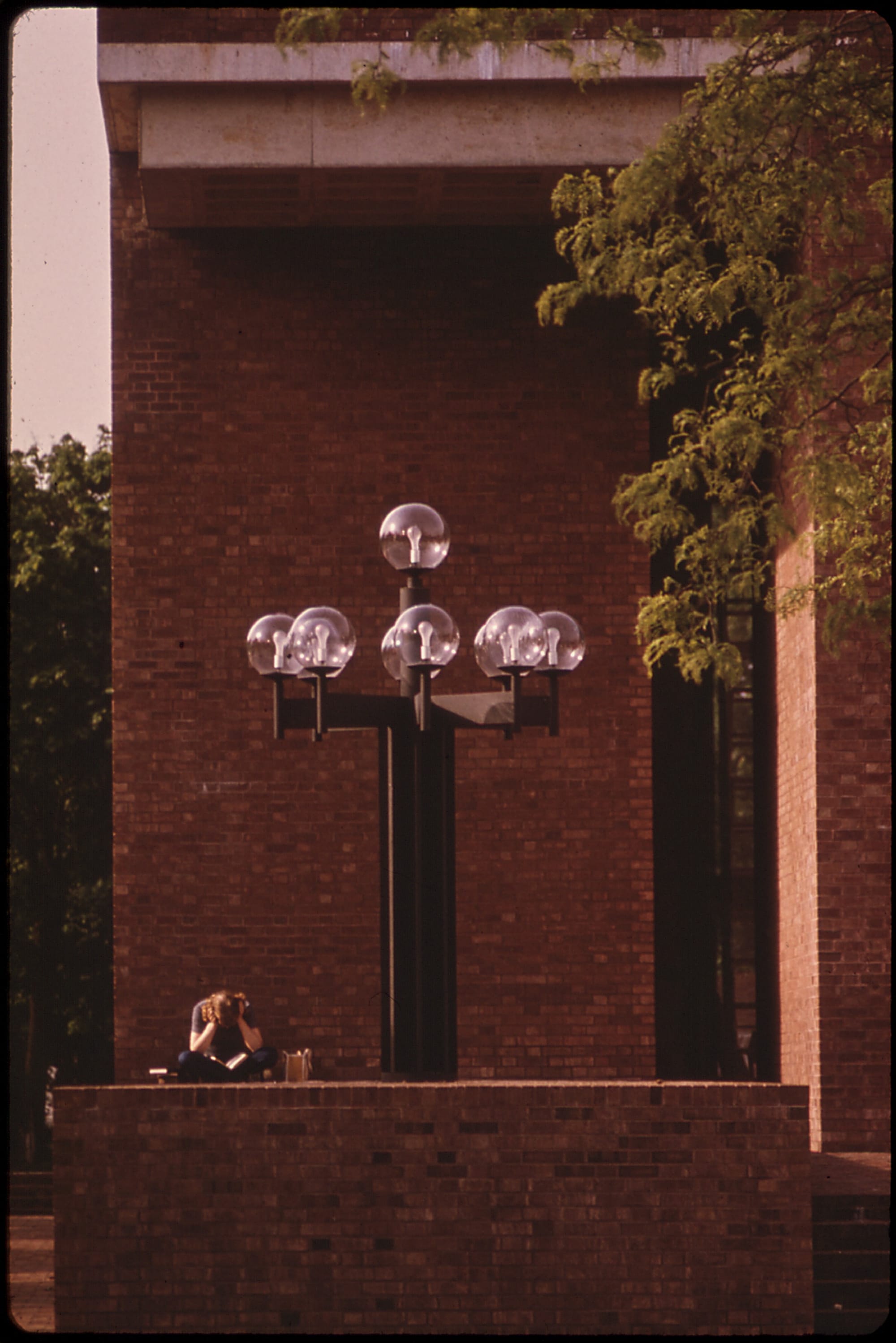
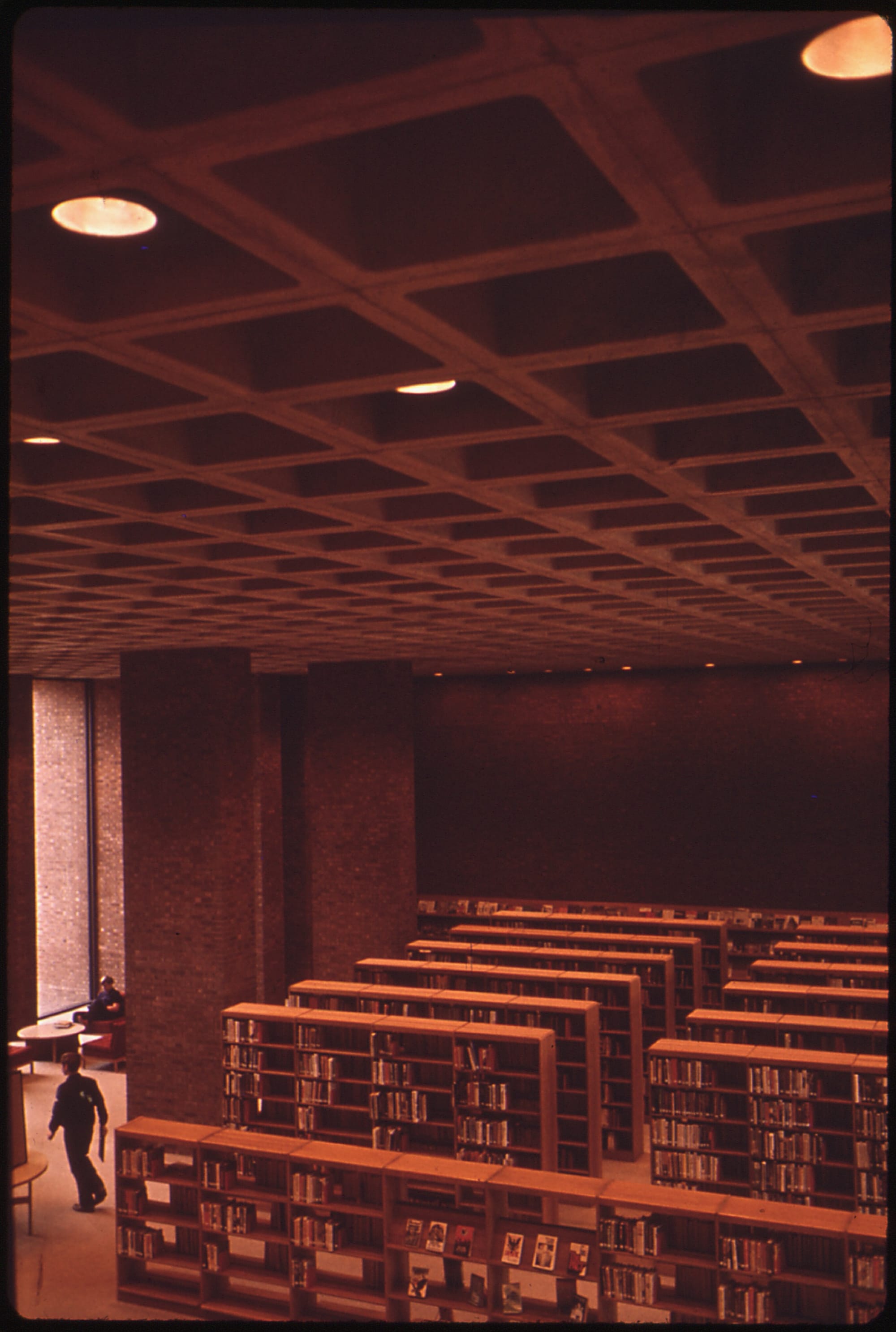
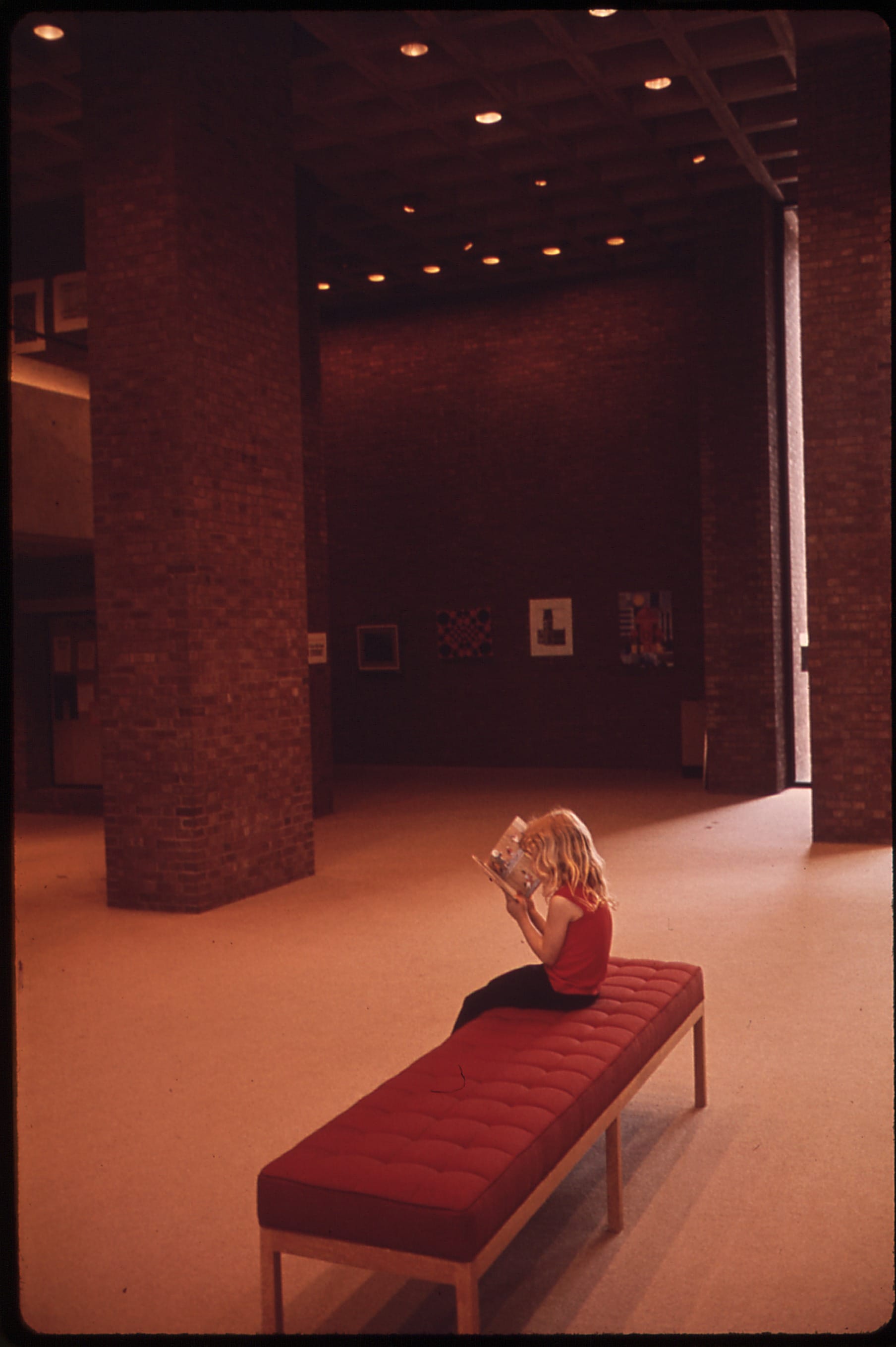
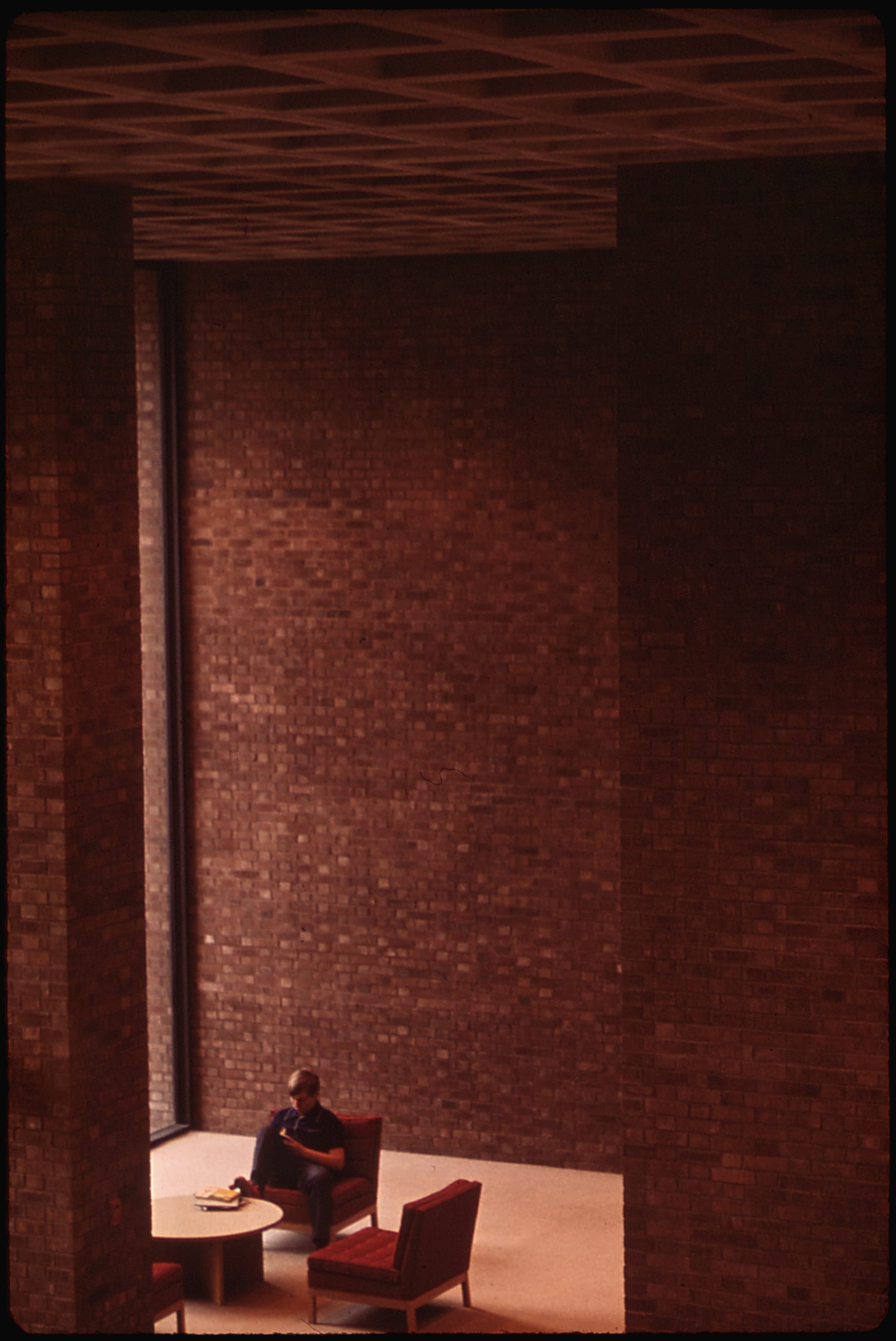
Transverse section diagram, 1971, Architectural Forum, the Internet Archive | Balthazar Korab, Library of Congress | Declan Haun, 1973, Wikimedia Commons | Declan Haun, 1973, Wikimedia Commons | Declan Haun, 1973, Wikimedia Commons | Declan Haun, 1973, Wikimedia Commons


That room still needed a focal point between the main architectural masses. Even the earliest sketches in 1964 carved out space in the plaza for a centerpiece fountain or sculpture, but they needed something special to hold its own between Pei’s library and Saarinen’s church.
I.M. Pei had a buddy who could do the job—British sculptor Henry Moore, a titan of modernist sculpture. Moore already had something in his back catalog he thought would be appropriate, an enlarged version of his sculpture “Large Torso: Arch”, which tango’d with concepts like the architecture of the body, the history of triumphal arches, and the geology of stone arches. This was a lifelong fascination of Moore’s, who once said “as a young sculptor, I saw Stonehenge and ever since I’ve wanted to do work that could be walked through and around”.
As you can imagine, a twenty-foot-tall bronze by Britain’s most famous sculptor was well beyond the library board’s budget. Thankfully, Columbus had an obvious benefactor they could hit up—Xenia and J. Irwin Miller agreed to commission Moore and donate “Large Arch” to the library.
Cast in bronze in Berlin, shipped across the Atlantic and up the Mississippi and Ohio Rivers, and installed in 1971, Large Arch commands space, focuses attention, and…can be a pleasantly silly thing for a kid to run through. There are other castings of “Large Arch” at the Henry Moore Foundation in the UK, the City Museum of Contemporary Art in Hiroshima, and Henie-Onstad Kunstsenter in Oslo.
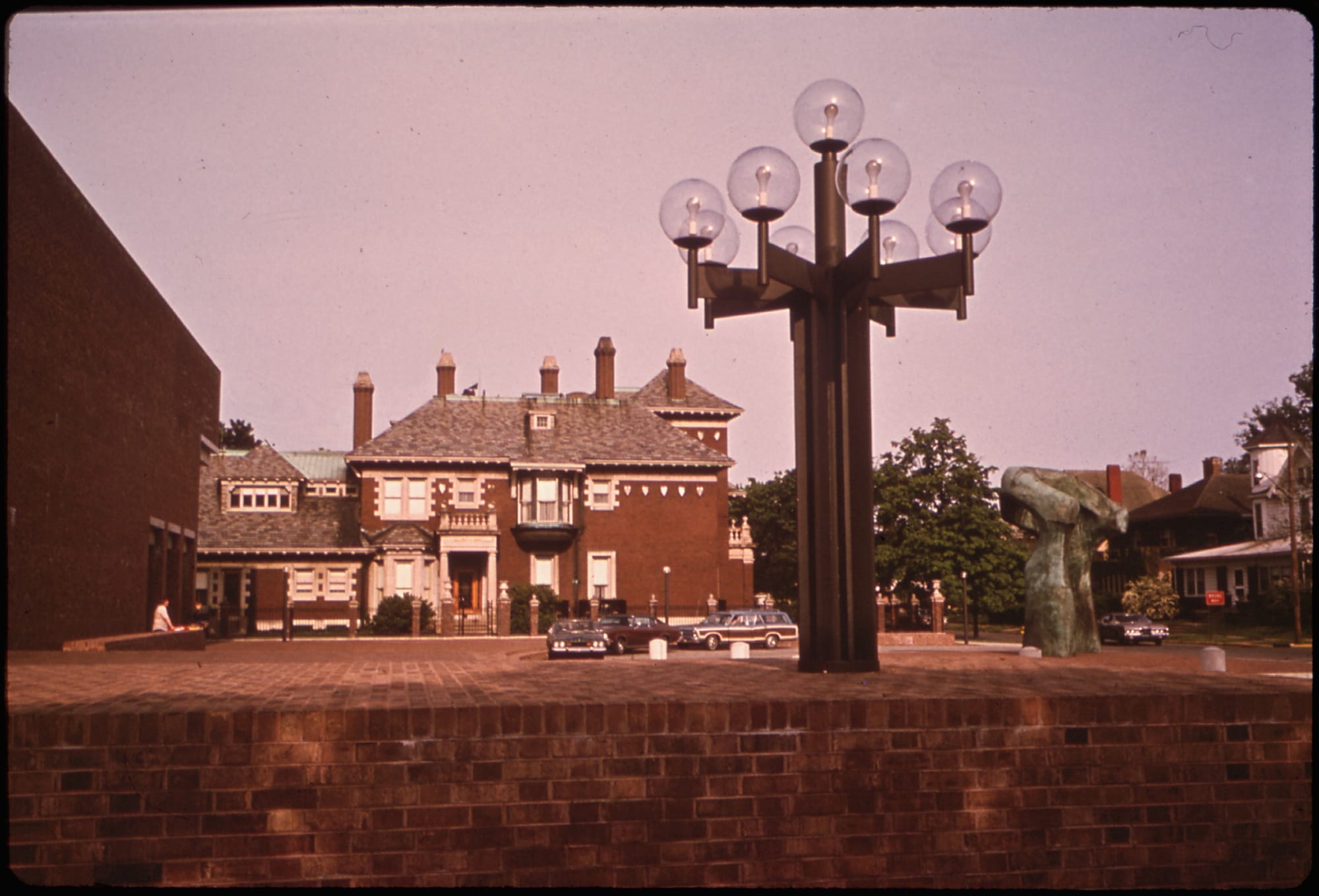
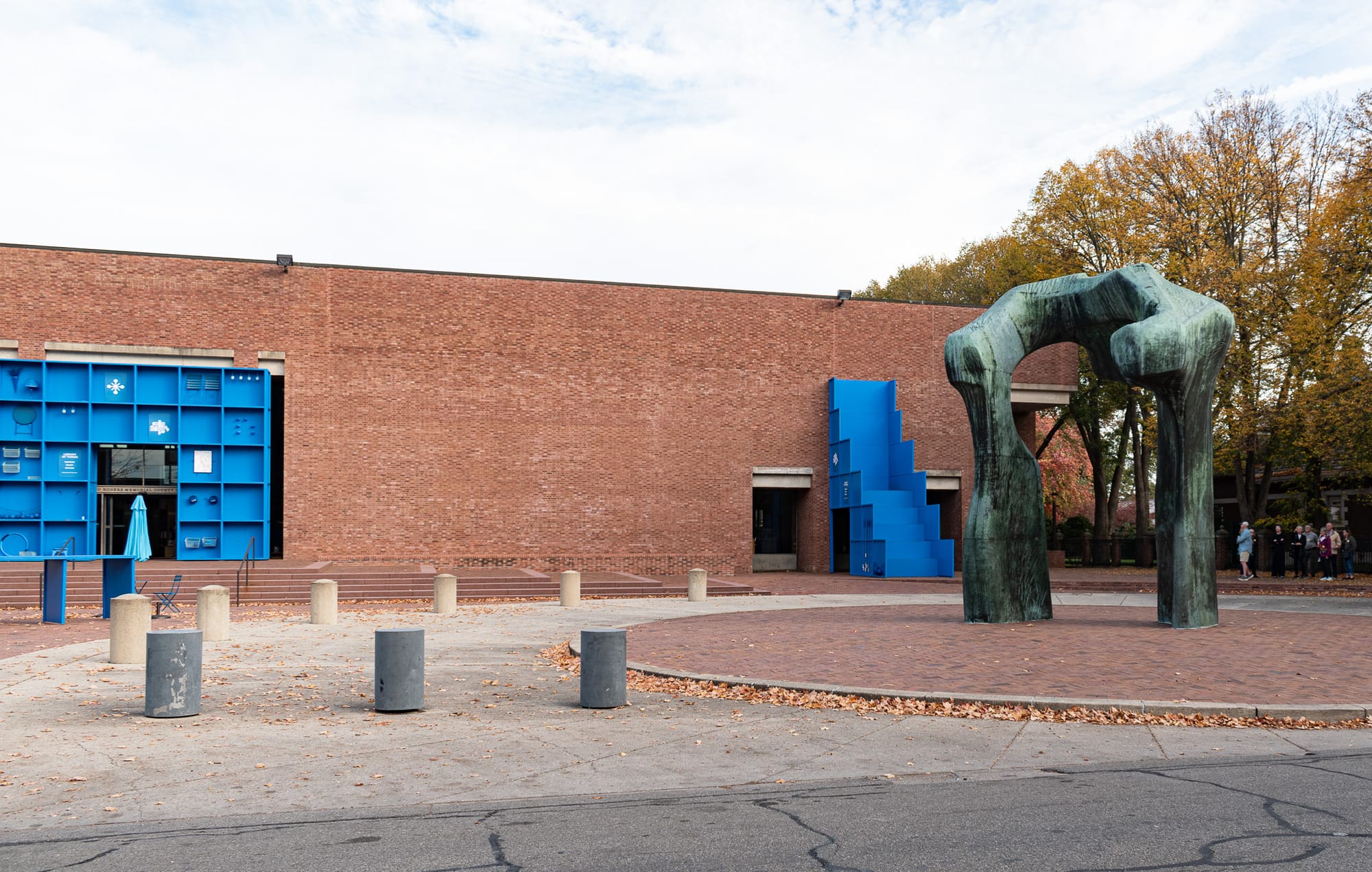
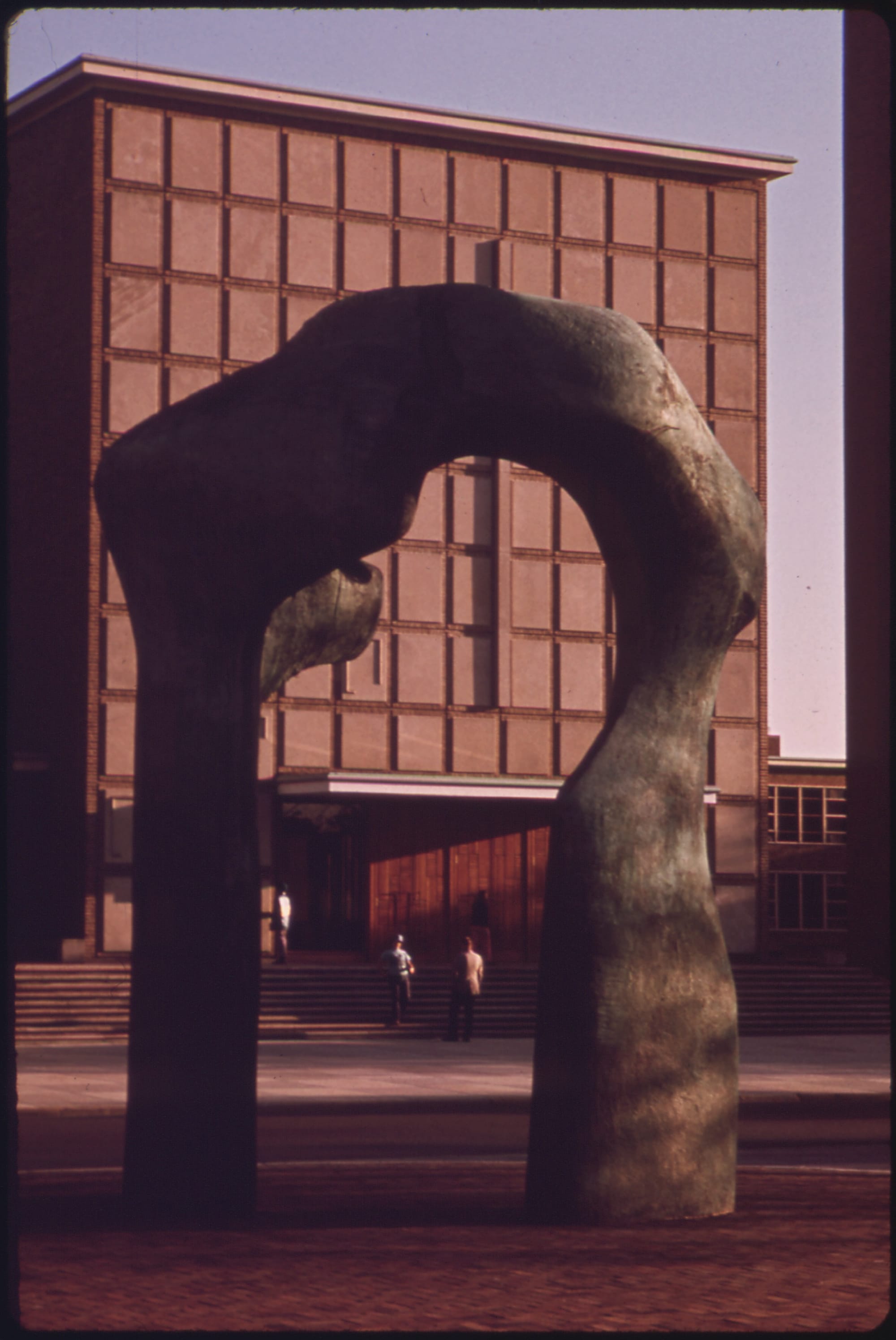
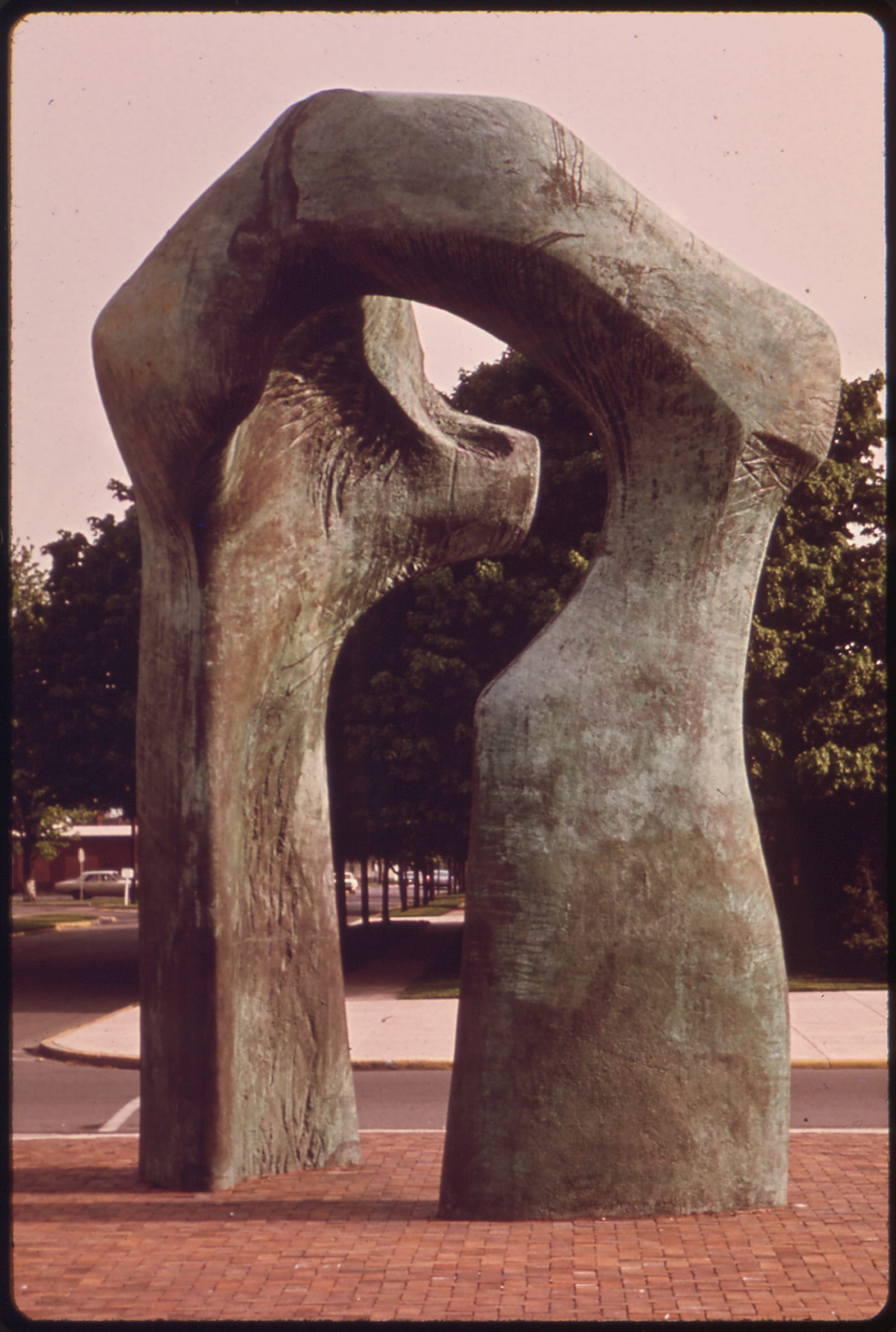
Declan Haun, 1973, Wikimedia Commons | 2023 | Declan Haun, 1973, Wikimedia Commons | Declan Haun, 1973, Wikimedia Commons


The temporary blue installation outside the library, Tatiana Bilbao ESTUDIO’s “Designed by the public” for Exhibit Columbus 2023, both benefits from and builds on the place created by Pei’s library. Columbus’ biennial architecture and design exhibition awarded Mexican architect Tatiana Bilbao the Miller Prize and commissioned this installation, which affixed a striking blue “library of objects” to the existing library, providing a free arsenal of things that visitors could use to play, to build, to meet, or anything else, activating the plaza that the library and “Large Arch” helped define.
Exhibit Columbus is a delightful exhibition—put it on your calendar for next year.
Production Files
Further reading:
- This fantastic online exhibit from the Bartholomew County Public Library Archives: Anchor, Move, Connect: Henry Moore's "Large Arch"
- "The Making of a Civic Space", Architectural Forum, 1971
- BCPL Informational Handout
- The Henry Moore Museum on "The Arch"
- Columbia University Libraries have all the correspondence on the Carnegie Library
 ↓
↓
A few more articles about the construction of the new library and the destruction of the old.
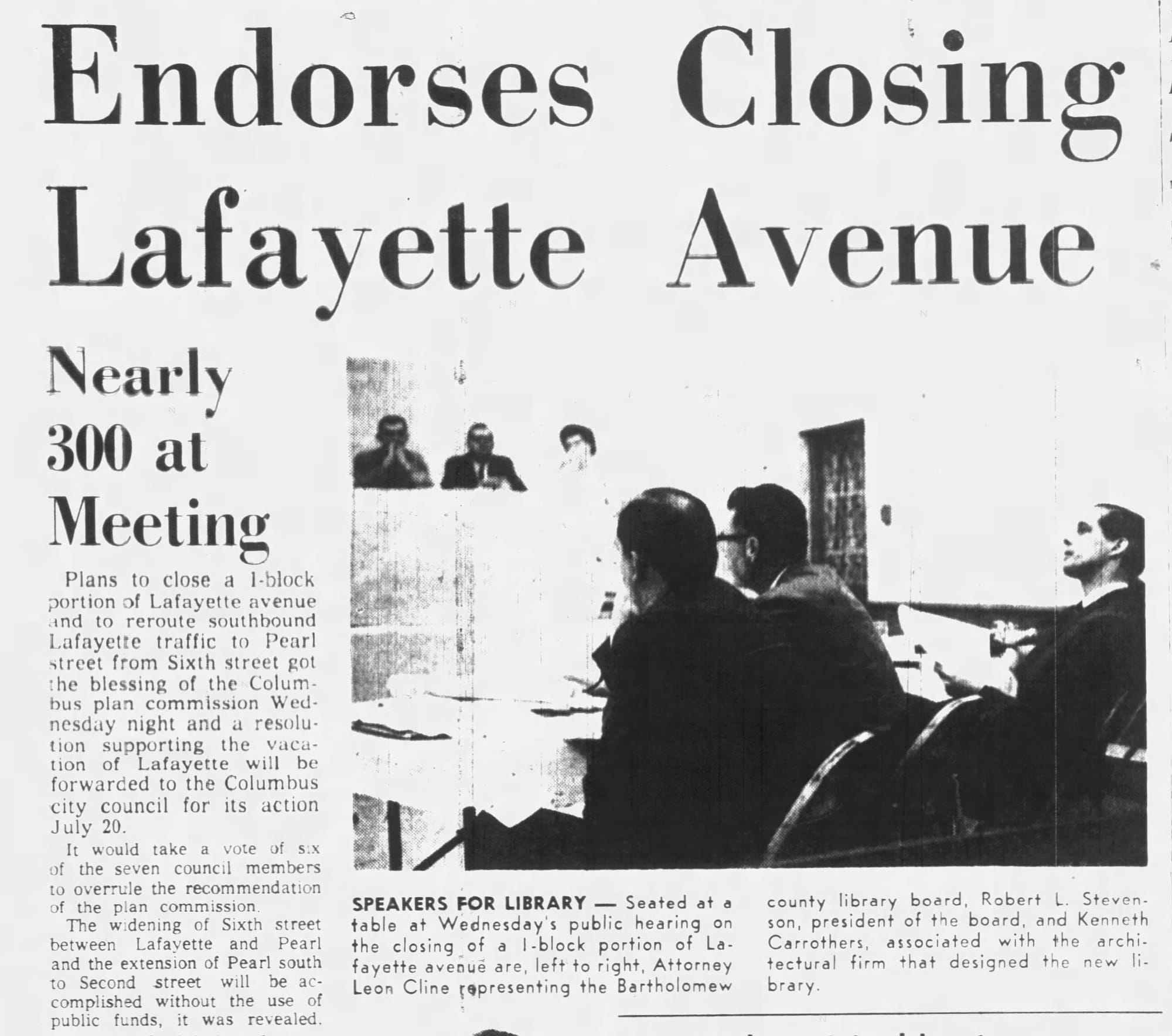
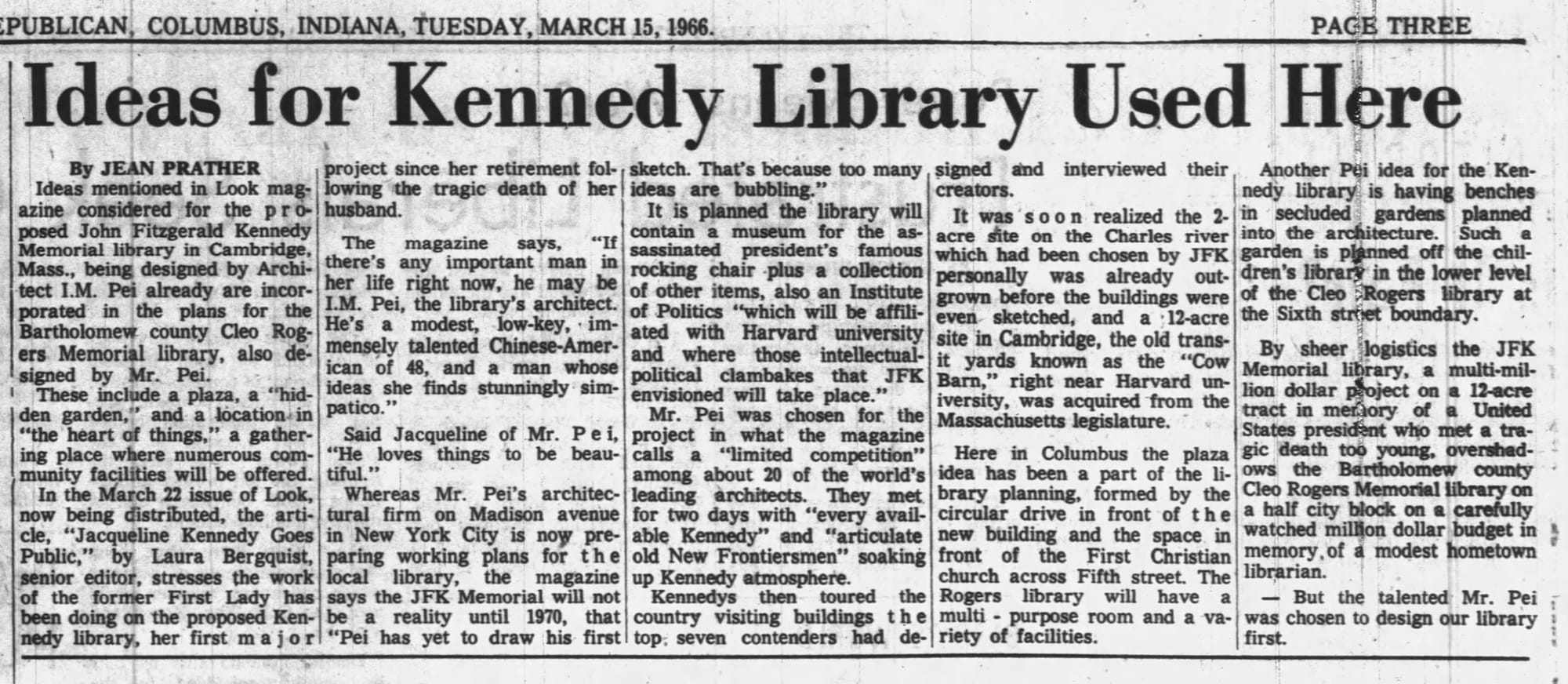
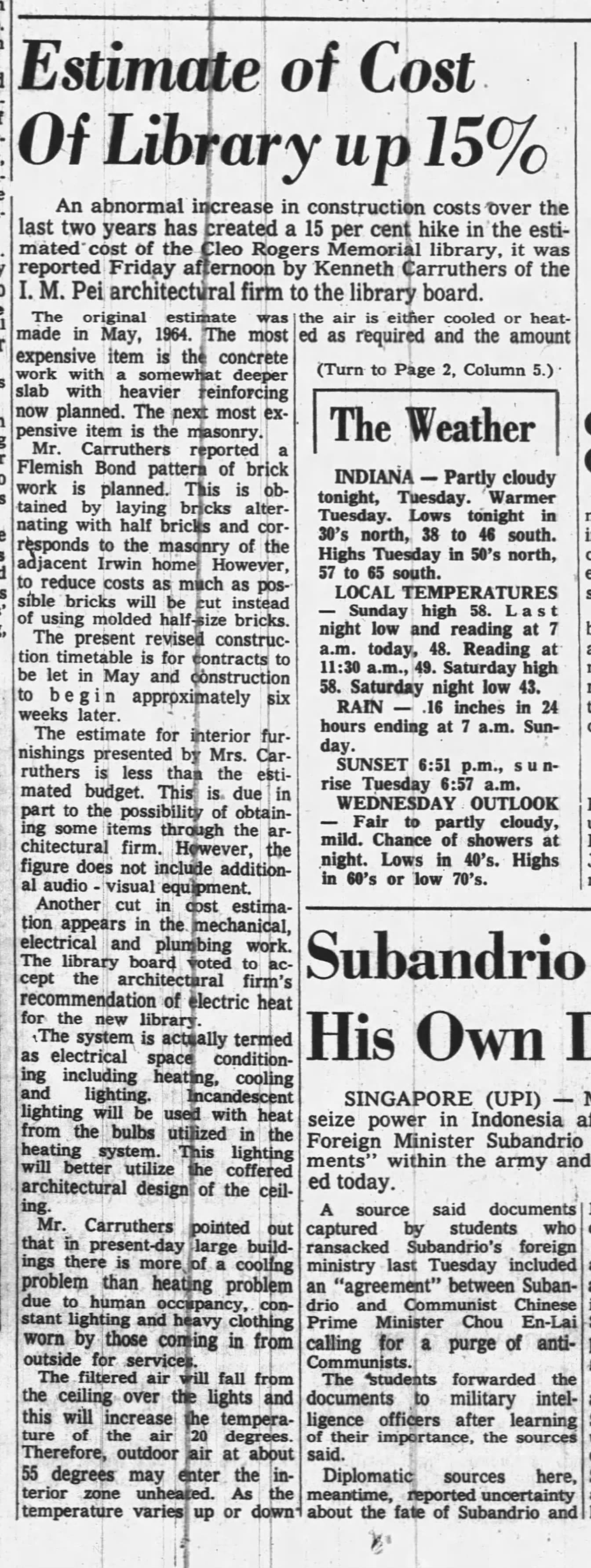
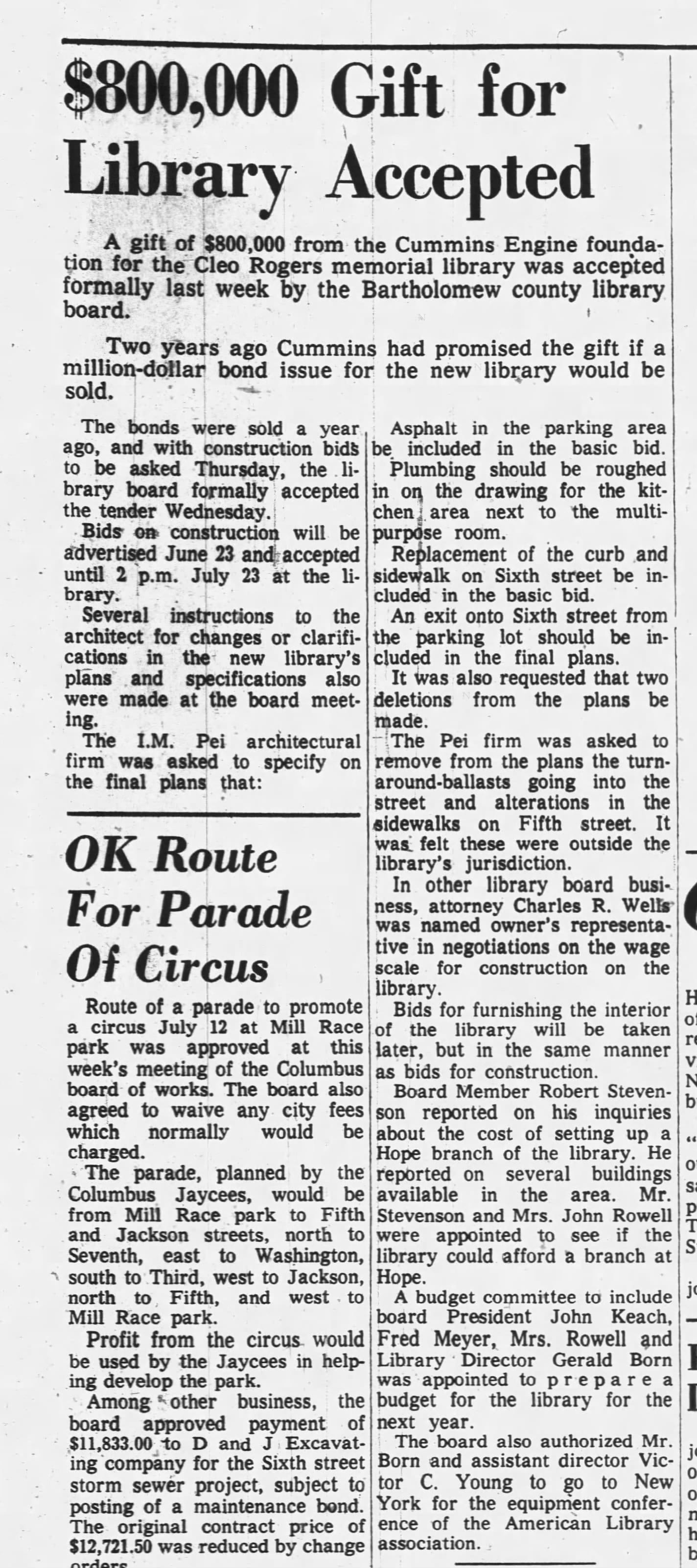
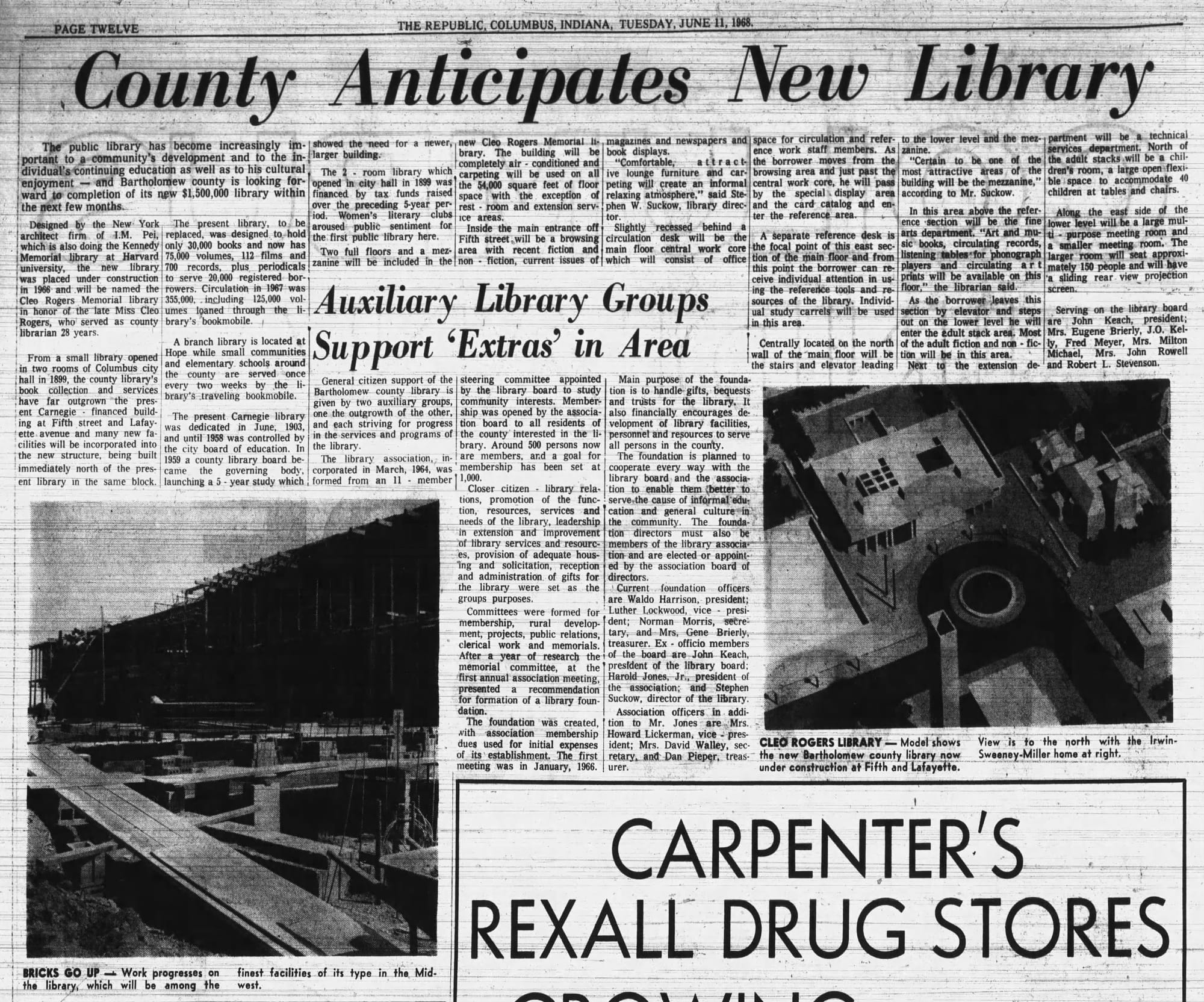
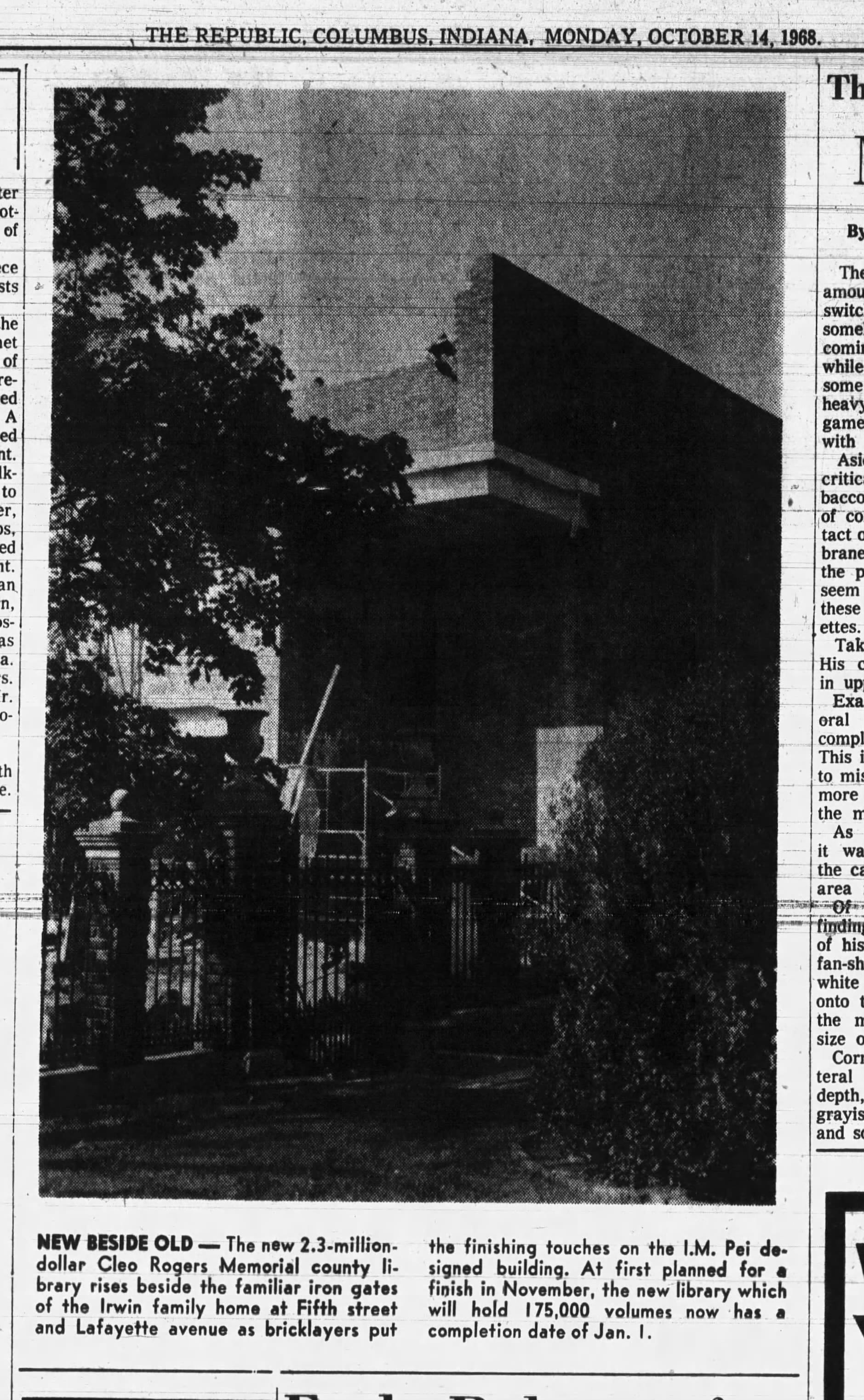
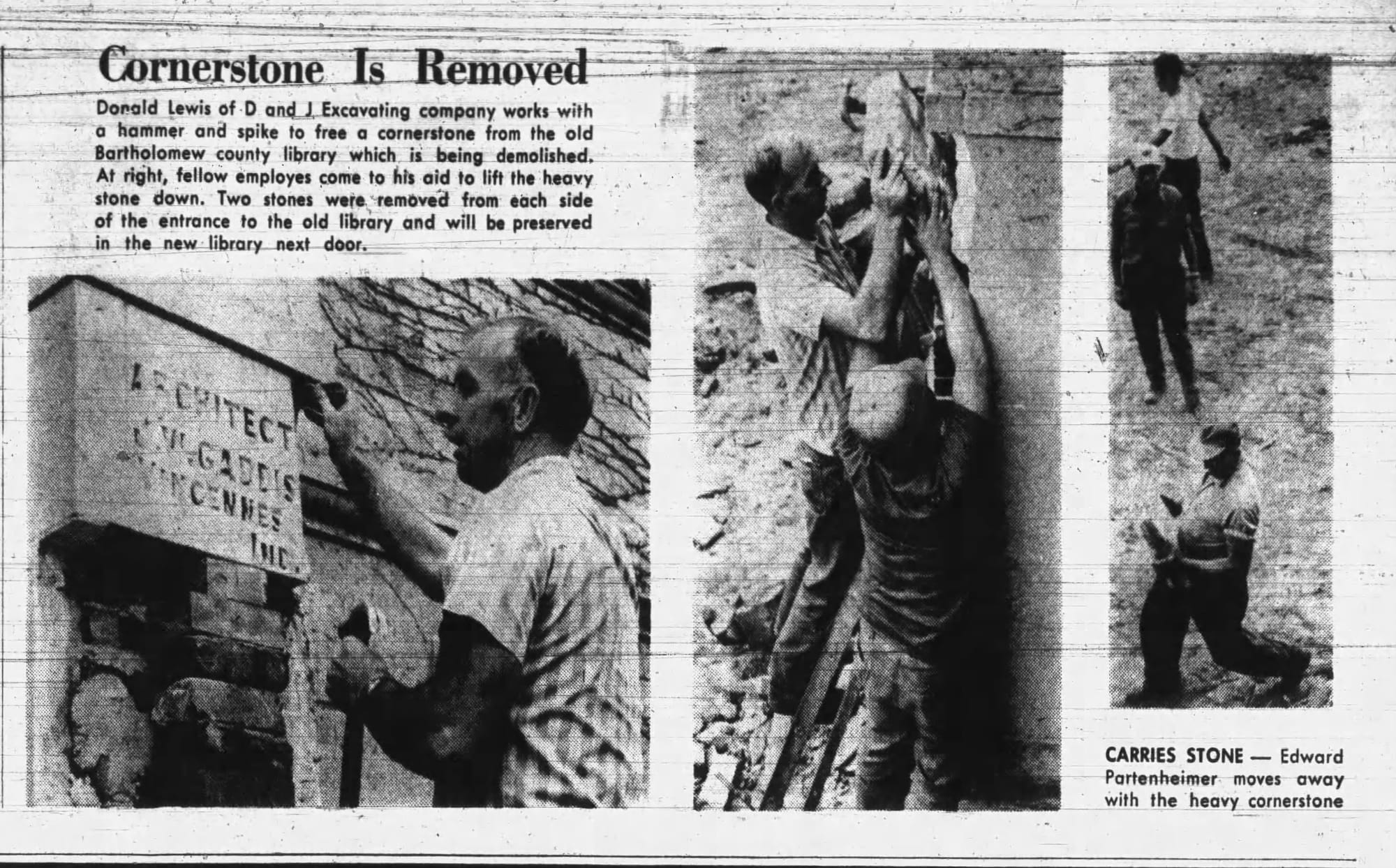
1964 | 1966 | 1966 | 1966 | 1968 | 1968 | 1969 | 1969
It's really an incredible library.


The architect of the Carnegie Library, John W. Gaddis, has a similar, contemporaneous Carnegie that still stands in Olney, Illinois. It was added to the National Register of Historic Places in 2002.

Member discussion: