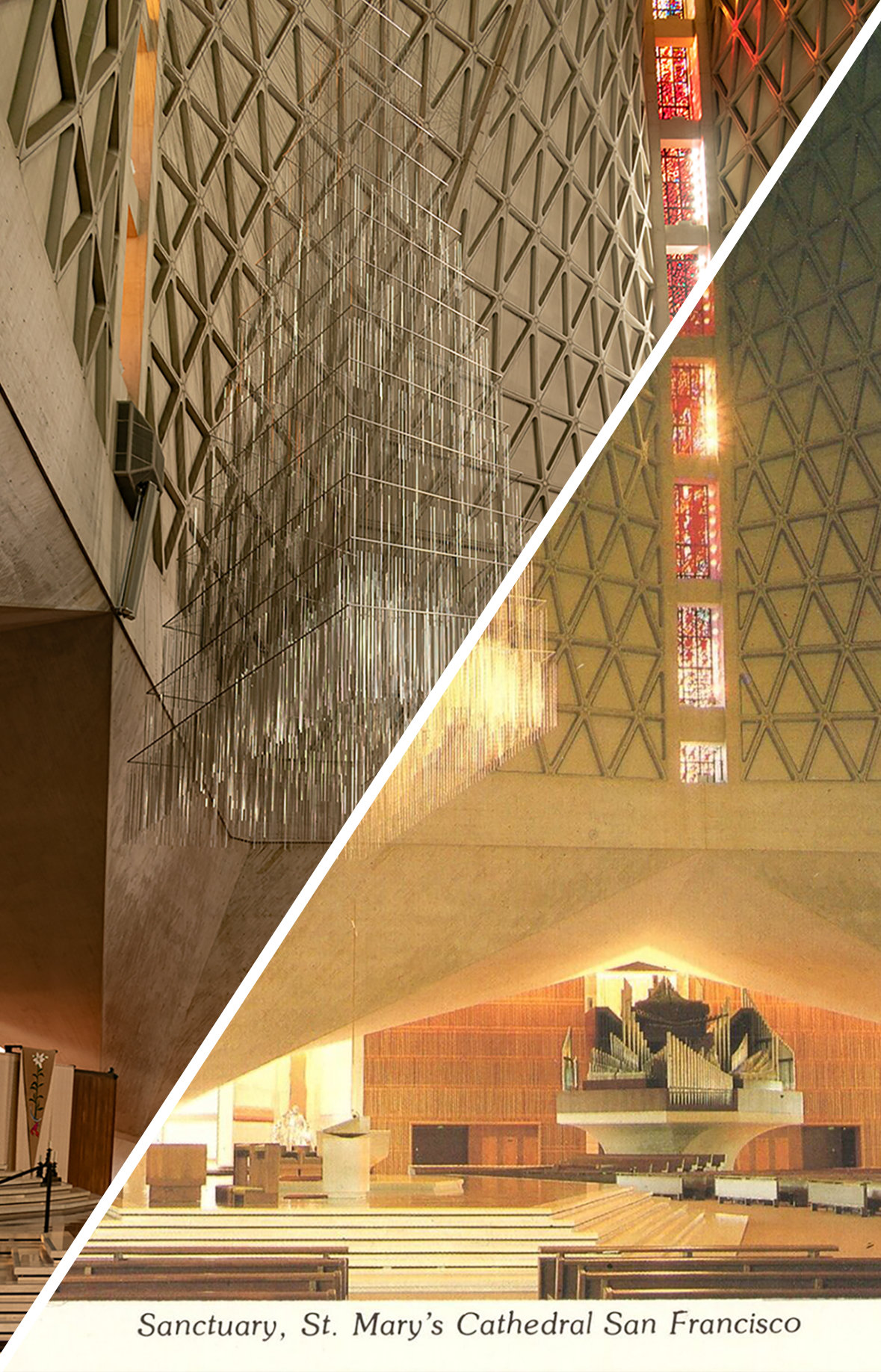
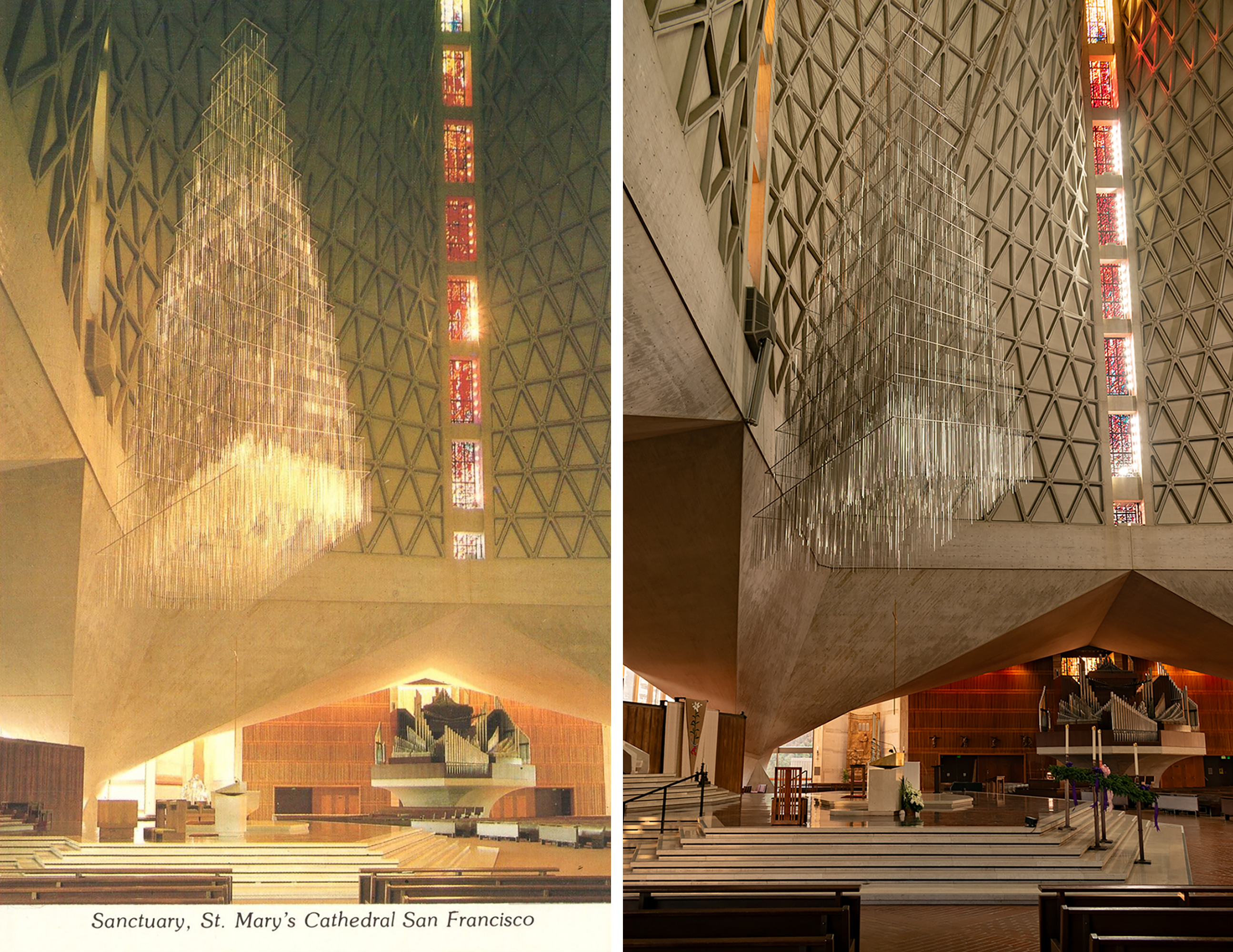
St. Mary’s Cathedral of the Assumption in San Francisco was the first American cathedral designed in the wake of Catholic reform—Mass in the vernacular language rather than Latin, a freestanding altar that allowed the priest to face the congregation—unleashed by Vatican II in 1965. Perhaps no aspect of the church’s design better embodied nor successfully navigated that tension more than Richard Lippold’s sparkling “Baldacchino”.
Repurposing an element out of ancient Catholic architecture—baldachins are altar canopies that mostly fell out of favor in the Middle Ages—and recontextualizing it for modernity, Lippold suspended thousands of aluminum prisms with gold-plated cables, creating the shimmering suggestion of a canopy over St. Mary’s main altar. Illuminated through stained glass windows designed by György Kepes, the twelve-story-tall piece took eight months to install. The iconic modernist church, designed by Pier Luigi Nervi and Pietro Belluschi together with John Michael Lee, Paul A. Ryan and Angus McSweeney, opened in 1971.
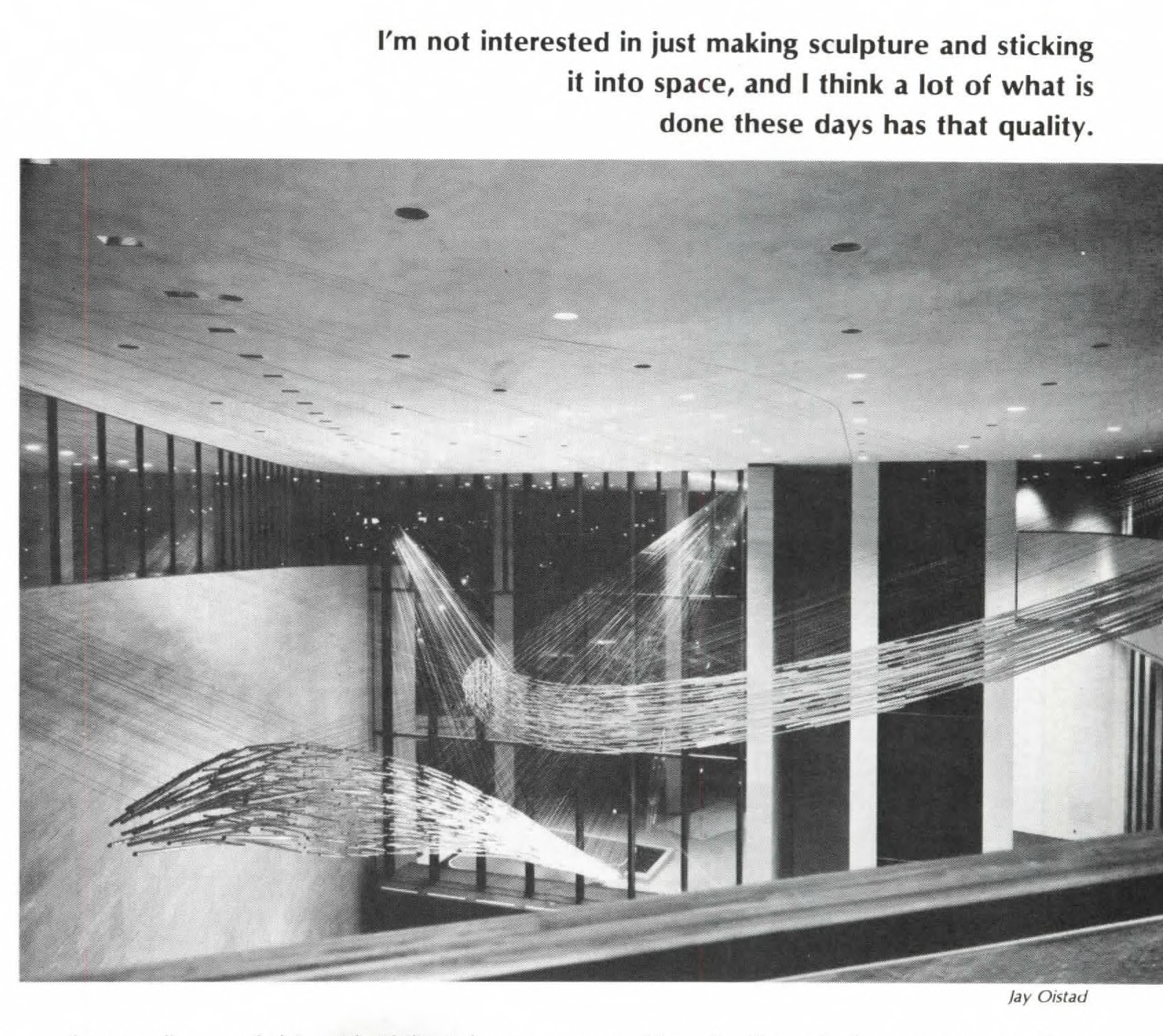
Trained as an industrial designer at the University of Chicago and the School of the Art Institute, by the late 1960s, Richard Lippold had become one of the United States’ preeminent practitioners of architectural sculpture. The go-to guy to create a massive piece for corporate lobbies or civic spaces, Lippold sculptures decorate the Inland Steel Building (“Radiant I”), the Lincoln Center Philharmonic Hall (“Orpheus and Apollo”), and the Pan Am Building (“Flight”).
1968, Lippold working on "Orpheus and Apollo" at Lincoln Center, the Internet Archive
The baldacchin in St. Mary’s ties back to an earlier work, though—in the late 1950s, Belluschi, Lippold, and Kepes had all worked together on the Portsmouth Abbey Church in Rhode Island. Designed by Belluschi with stained glass by Kepes, Lippold created a wire sculpture, “Trinity”, that looms over the altar.

When Belluschi and Nervi were added to the design team for St. Mary’s after the initial cathedral plans disappointed the Archdiocese, Belluschi put the band back together for a much larger encore. Part of the wave of reforms that came alongside Vatican II, in 1964 the papal decree Inter Oecumenici encouraged the construction of free-standing altars, which allowed priests to celebrate Mass facing the congregation. Previously, the tabernacle needed to be fixed to the altar, which generally forced it against a wall. The high altar freed from the building’s walls, the designers of St. Mary’s Cathedral still needed something that would make the altar the visual centerpiece of the sanctuary.

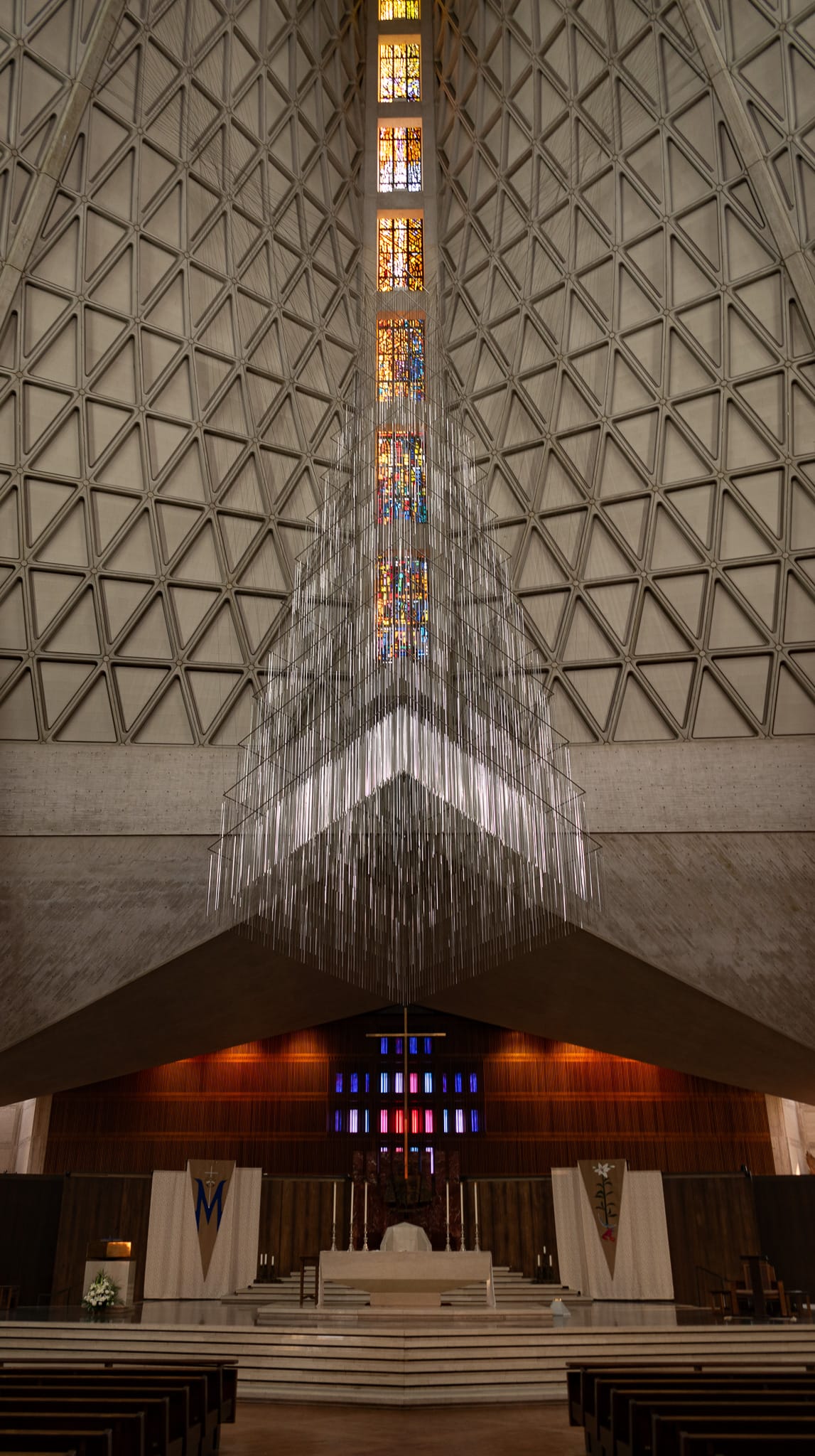
Baldachin in the Bari Cathedral from 1233, Wikimedia Commons | Lippold's Baldacchino, 2024, Wikimedia Commons
,_1233,_01.jpg?ref=postcard-past.com)

The baldacchino, a bit of very old Catholicism in a very modern church, was their solution. Baldachins were cloth canopies suspended over high altars in Catholic churches in the Middle Ages, as well as more permanent architectural versions, ciboria. By the late middle ages they’d fallen out of style. This was Lippold and Belluschi reaching back 800 years for inspiration or pointing directly to St. Peter’s Basilica (home to the baldachin), then refracted through contemporary materials and installed by hand—kind of the ideal Vatican II artwork for the first Vatican II cathedral.

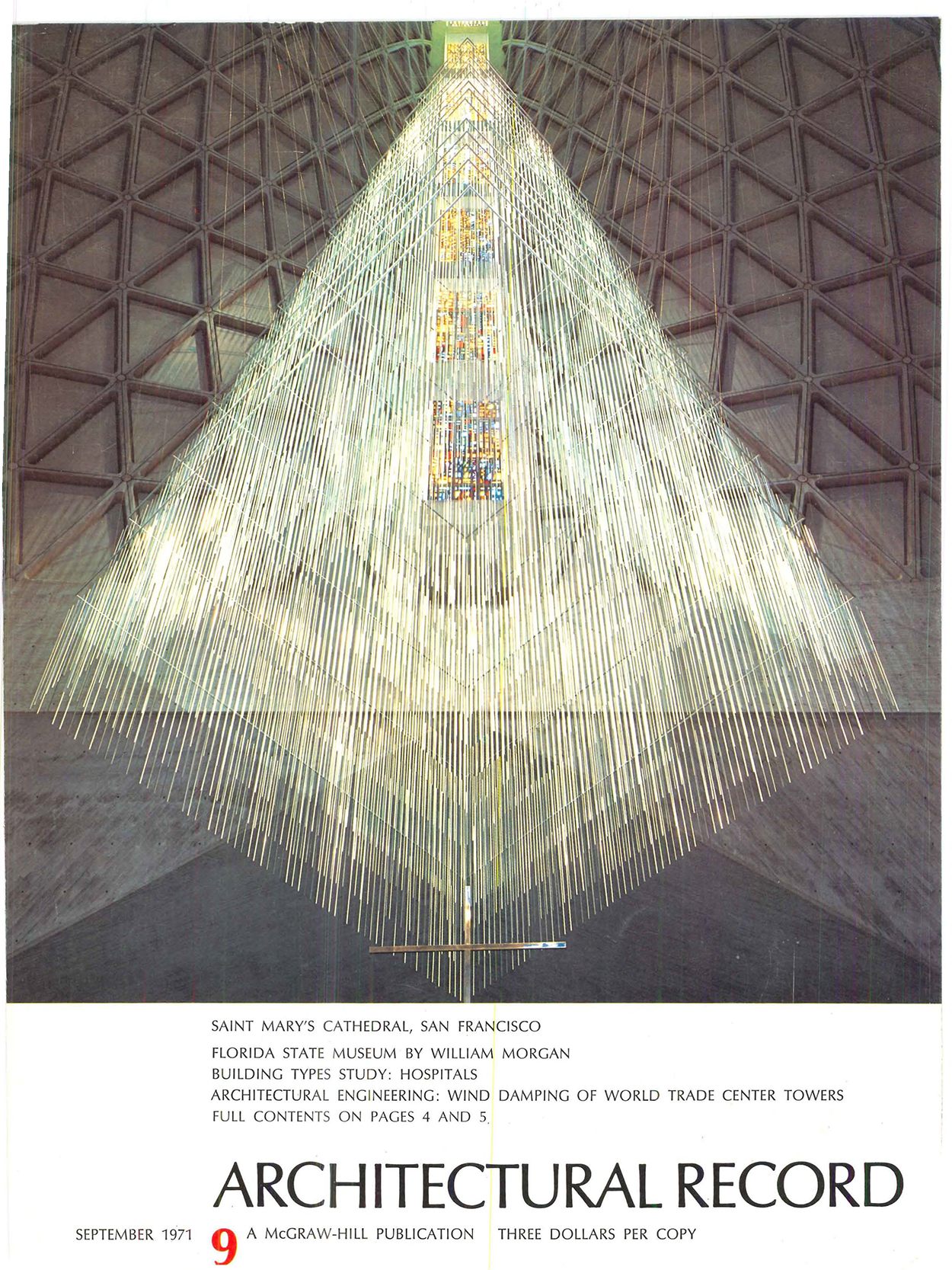
Lippold working on a piece, 1958, School Arts, the Internet Archive | Cover of Architectural Record, 1971, the Internet Archive | 1978, Lippold interview in Architectural Record, the Internet Archive
Production Files
Further reading:


 admin_bm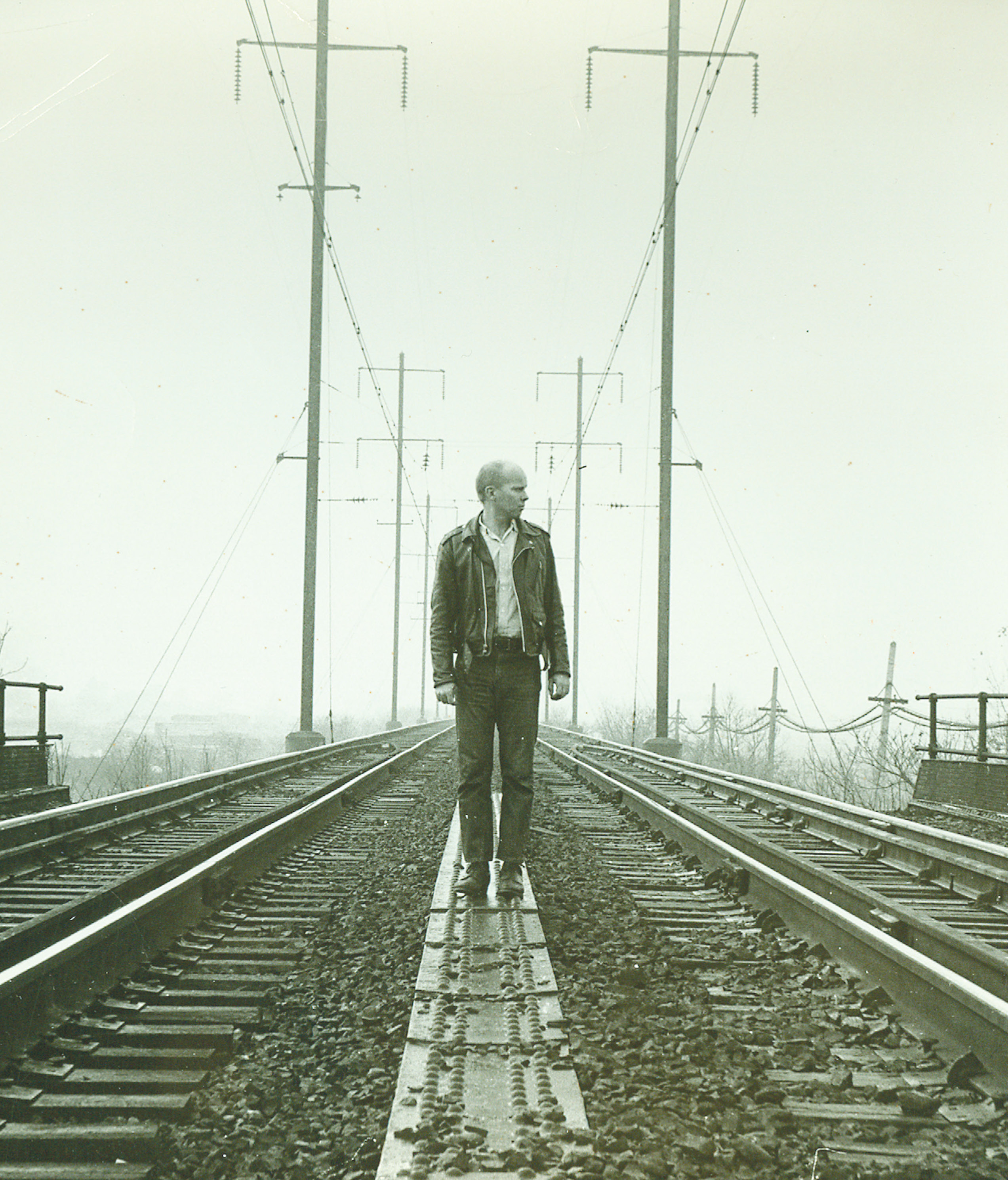
 Richard Lippold Foundation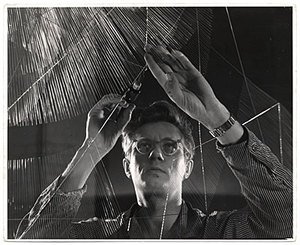
Richard Lippold had an interesting career. Wildly popular for huge commissions in the 1960s and 1970s, some contemporaries also dismissed his work—suggesting he worked too closely with large corporation and his clients, his work too polished, too slick, and too empty. Associated with Black Mountain College, he was romantically linked with enigmatic artist Ray Johnson (one of my favorites) and made an appearance in the 2002 documentary about Johnson's work, How to Draw a Bunny.
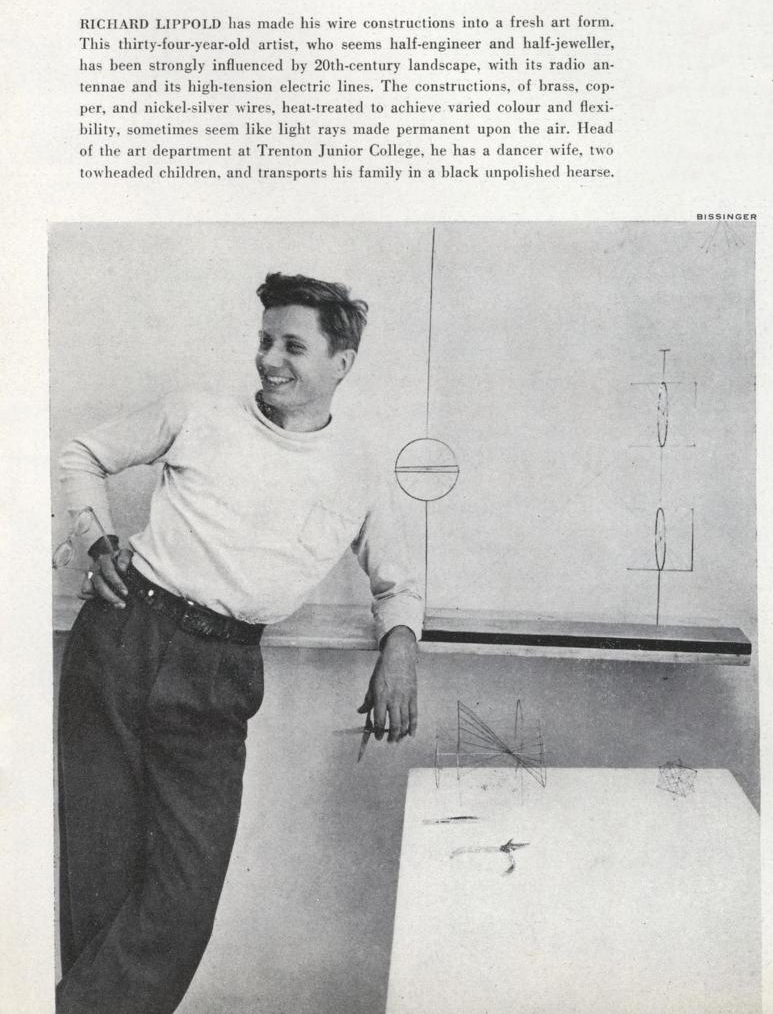
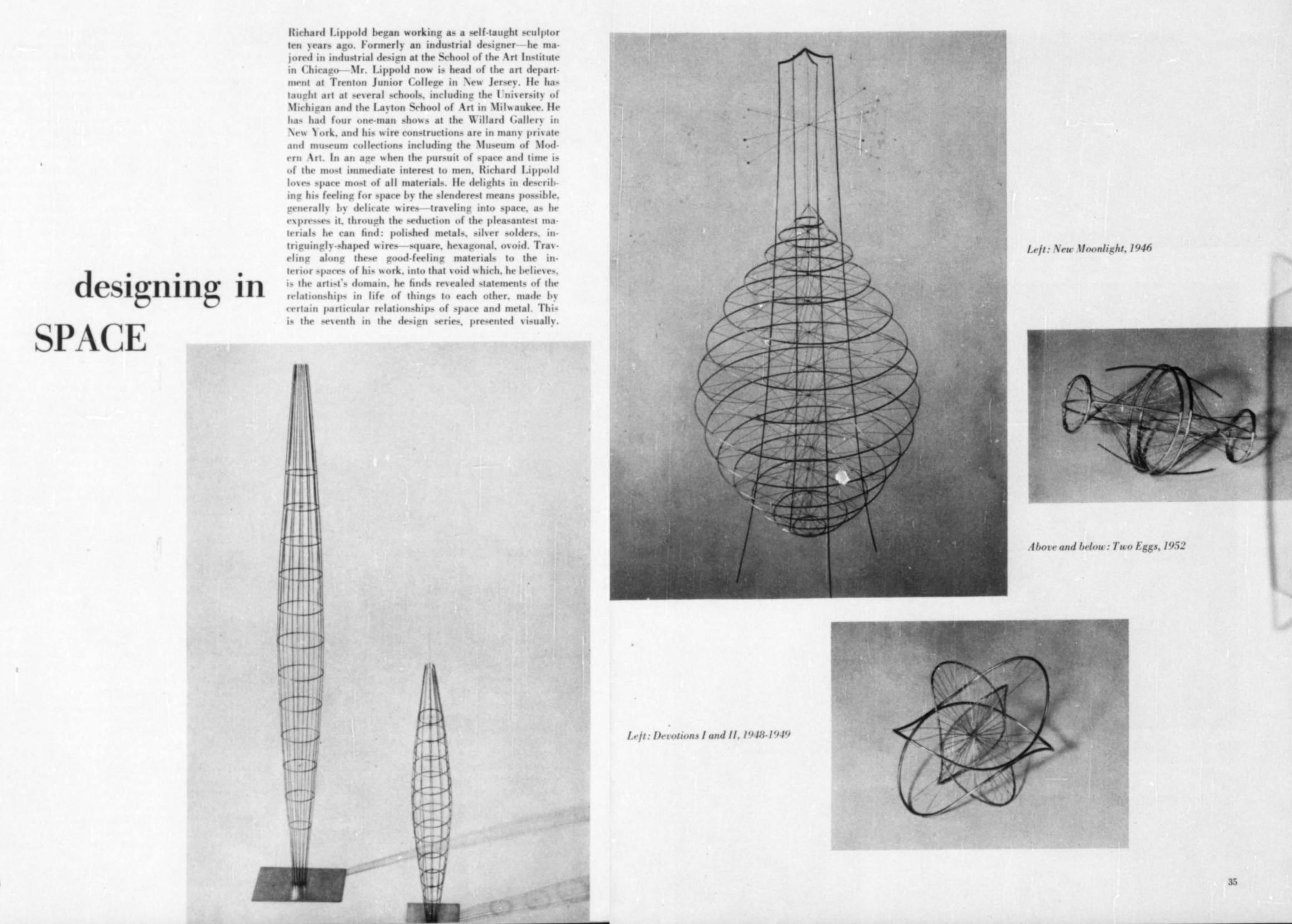
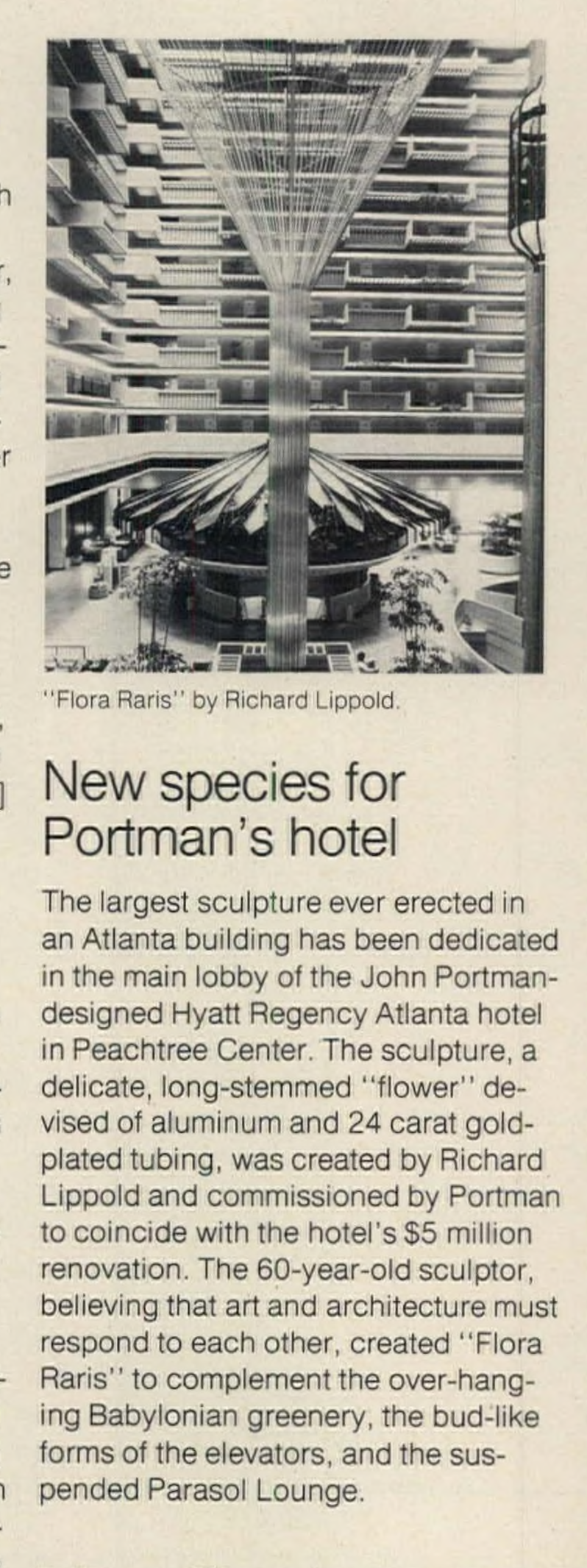
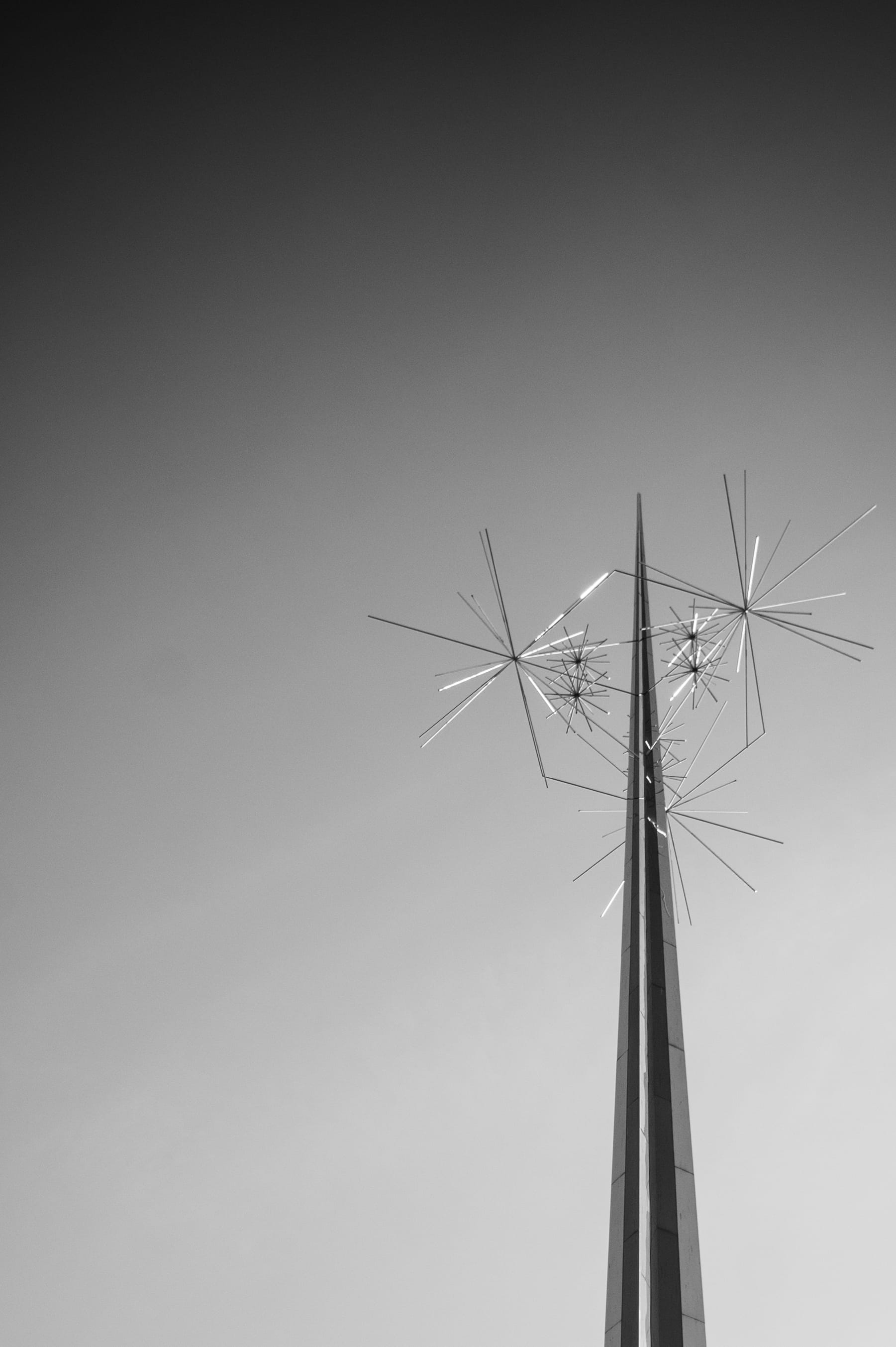
Lippold in Vogue, 1949, the Internet Archive | 1952, Lippold work in Craft Horizons, the Internet Archive | Lippold commission for a John Portman Hotel, 1975, Progressive Architecture, the Internet Archive | "Ad Astra", 2014, Wikimedia Commons
.jpg?ref=postcard-past.com)

Lippold's work was both mechanical and handcrafted, playful and cold. His Lincoln Center installation, "Orpheus and Apollo", was recently moved to La Guardia Airport after a renovation.
And his "Trinity" at Portsmouth Abbey was recently restored.
Member discussion: